
Antibiotic Birth Control Checker
Most antibiotics don't affect birth control effectiveness, but rifampin (rifampicin) and rifabutin are exceptions. Enter an antibiotic name to see if it affects your birth control.
Enter an antibiotic name to check if it interacts with birth control pills.
For decades, women have been told to use backup contraception when taking antibiotics. You get a prescription for amoxicillin for a sinus infection, and your pharmacist hands you a packet of condoms with a warning: "These might make your pill not work." But here’s the truth: antibiotics almost never interfere with birth control pills - except for one very specific case.
The One Antibiotic That Actually Matters
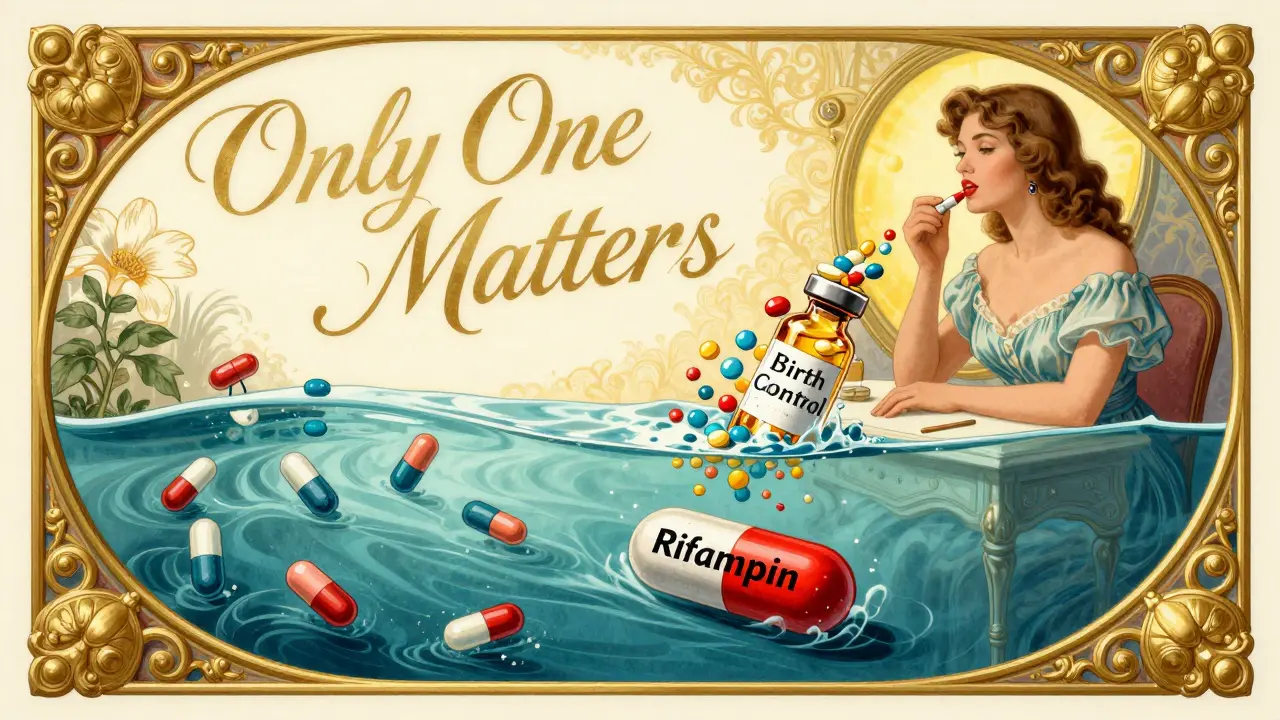
There’s only one antibiotic with solid, repeated proof of reducing the effectiveness of birth control pills: rifampin (also called rifampicin). It’s not a common drug. You won’t get it for a simple infection. It’s used to treat tuberculosis, some types of meningitis, and certain rare bacterial infections. And it works differently than other antibiotics. Rifampin speeds up how your liver breaks down hormones. Specifically, it turns on enzymes (CYP3A4) that metabolize ethinylestradiol, the estrogen in most birth control pills. Studies show it can drop estrogen levels by 40% to 60%. That’s enough to make the pill less effective. If you’re on rifampin, you need another form of birth control - like condoms or an IUD - while taking it and for at least four weeks after stopping. Rifabutin, a close cousin of rifampin, has a similar but weaker effect. It reduces estrogen levels by about 25%. It’s not as strong, but doctors still recommend using backup contraception with it, just to be safe.What About Amoxicillin, Doxycycline, or Azithromycin?
This is where the confusion starts. Most people think all antibiotics can mess with birth control. But science says otherwise. A 2018 review of 17 studies involving over 1,800 women found no increase in pregnancy rates among those taking common antibiotics like amoxicillin, doxycycline, or azithromycin with birth control pills. The pregnancy rate was almost identical: 0.69 per 100 woman-years for antibiotic users versus 0.54 for those not taking antibiotics. That difference? Not statistically meaningful. Multiple pharmacokinetic studies confirm this. One study gave women 500 mg of amoxicillin three times a day for 10 days - way more than most people take - and found zero change in hormone levels. Another tested doxycycline at full treatment doses and saw no drop in contraceptive hormone concentrations. Even azithromycin, which has been blamed in anecdotal reports, shows no effect in controlled trials. So why do people still believe this? Because the myth started decades ago, when birth control pills had much higher hormone doses - up to 100 micrograms of estrogen. Today’s pills contain 20 to 35 micrograms. Back then, maybe some interactions were possible. Now? Not likely.Why Do Pharmacists Still Warn About It?
Here’s the uncomfortable part: many pharmacists still tell patients to use backup contraception with any antibiotic. A 2017 survey found that 68% of community pharmacists recommended backup methods for amoxicillin - even though there’s no evidence to support it. Meanwhile, 98% correctly warned about rifampin. Why? Because the warning is still printed on birth control pill packaging. The FDA labels say “antibiotics” as a potential interaction - without naming which ones. That’s outdated. In 2022, the FDA admitted these warnings are misleading and based on old case reports, not science. But changing labels takes years. Pharmacists are caught between outdated packaging and patient anxiety. They’d rather say “use a condom” than risk someone getting pregnant. But that’s not evidence-based care. It’s fear-based counseling.
What About Gut Bacteria? Isn’t That a Thing?
Another theory floating around is that antibiotics kill gut bacteria, which are supposed to help recycle estrogen back into the bloodstream. The idea is: fewer bacteria = less estrogen = less protection. It sounds logical. But it doesn’t hold up in real studies. Even when antibiotics like amoxicillin or ciprofloxacin wipe out gut flora, there’s no measurable drop in hormone levels. The body doesn’t rely on gut bacteria to maintain contraceptive hormone levels. Estrogen is absorbed directly in the intestines and processed by the liver - not recycled by microbes. The enterohepatic recirculation theory was popular in the 1980s. But modern research has debunked it. If gut bacteria were the key, then probiotics or yogurt would restore effectiveness - but they don’t. And we’ve seen no rise in birth control failures after antibiotic use in large population studies.What Do the Experts Say Now?
Major medical groups have updated their guidelines based on the evidence:- ACOG (American College of Obstetricians and Gynecologists): “Only rifampin has been shown to decrease the effectiveness of combined hormonal contraception.”
- UK Faculty of Sexual and Reproductive Healthcare: “There is no evidence for an interaction between combined hormonal contraception and broad-spectrum antibiotics (excluding rifampicin and rifabutin).”
- Centers for Disease Control and Prevention (CDC): Rifampin is Category 4 (unacceptable risk). All other antibiotics are Category 1 (no restrictions).
- European Medicines Agency (EMA): As of January 2023, all OCPs sold in the EU no longer list non-rifamycin antibiotics as interacting drugs.
What Should You Do?
If you’re on birth control pills and your doctor prescribes an antibiotic:- Ask: Is this rifampin or rifabutin? If yes, use backup contraception.
- If it’s anything else - amoxicillin, doxycycline, ciprofloxacin, azithromycin, clindamycin, etc. - you don’t need backup contraception.
- Don’t panic if your pharmacist says otherwise. Politely ask if they’ve reviewed the latest guidelines. Many haven’t.
- Keep taking your pill on time. Missing pills is far more dangerous than taking an antibiotic.
Why Does This Myth Still Exist?
Because fear sticks. One case report from the 1970s - a woman who got pregnant while on amoxicillin - started the rumor. Since then, every pharmacist, every doctor, every friend has repeated it. It became common knowledge. Even now, 62% of women on birth control still use backup contraception during antibiotic courses, according to a Planned Parenthood survey. That’s over 6 million women in the U.S. alone, spending an estimated $147 million a year on emergency contraception and condoms they don’t need. The pharmaceutical industry is finally starting to act. In 2020, the American Society for Reproductive Medicine petitioned the FDA to remove vague antibiotic warnings from pill packaging. The FDA agrees - but change moves slowly.What’s Next?
Research is moving forward. The NIH is funding a $2.4 million study called ACILE, tracking 5,000 women over three years to collect real-world data. Scientists at UCSF are also studying genetic differences in liver enzymes. Maybe a tiny fraction of women - those with specific CYP3A4 gene variants - could be more sensitive. But so far, no one’s found them. The bottom line? For 99.9% of people, antibiotics and birth control pills are safe to take together. The only exception is rifampin and rifabutin. Everything else? You’re fine. Stop worrying. Stop buying extra condoms. Just take your pill.Do antibiotics like amoxicillin or doxycycline make birth control pills less effective?
No. There is no proven interaction between common antibiotics like amoxicillin, doxycycline, azithromycin, or ciprofloxacin and birth control pills. Multiple studies have shown no drop in hormone levels or increase in pregnancy rates when these antibiotics are taken with hormonal contraception. The only exception is rifampin.
What about rifampin? Does it really affect birth control?
Yes. Rifampin (rifampicin) is the only antibiotic with strong, consistent evidence of reducing birth control effectiveness. It speeds up how your liver breaks down estrogen, cutting hormone levels by 40-60%. If you’re prescribed rifampin, use a backup method like condoms or an IUD during treatment and for four weeks after stopping.
Why do pharmacists still tell me to use backup contraception with antibiotics?
Because many birth control pill labels still say “antibiotics” as a potential interaction - without specifying which ones. Pharmacists are following outdated packaging warnings, not current science. A 2017 survey found 68% of pharmacists recommended backup contraception for amoxicillin, even though evidence doesn’t support it. The medical community is working to update labeling, but it takes time.
Can gut bacteria from antibiotics lower estrogen levels and cause birth control failure?
No. While antibiotics can disrupt gut bacteria, studies show this does not affect estrogen levels enough to reduce birth control effectiveness. The body absorbs and processes hormones directly through the liver, not through gut bacteria recycling. Even when gut flora is wiped out, hormone levels remain stable.
Should I take emergency contraception after having unprotected sex while on antibiotics?
Only if you were taking rifampin or rifabutin. For all other antibiotics, emergency contraception is unnecessary. Taking it when not needed can cause side effects like nausea or irregular bleeding. If you’re unsure, talk to your doctor - but don’t assume the antibiotic caused the failure. Missing pills, vomiting, or diarrhea are far more likely causes.
Are there any new guidelines I should know about?
Yes. As of January 2023, the European Medicines Agency removed all non-rifamycin antibiotic warnings from birth control labels in the EU. The FDA is reviewing its guidance and is expected to follow. Major U.S. organizations like ACOG and the CDC already state that only rifampin and rifabutin require backup contraception. If your provider still says otherwise, ask them to check the latest guidelines.
11 Comments
so like... what if the pharma companies are LYING to us? i mean, why would they put that warning on the box if it wasn't true? they're just trying to sell more condoms, right? or is this all a big plot to make women pay for emergency birth control? i'm not buying it. 🤔
this is such a relief to read. i've been using condoms with every antibiotic since college and it's been a total pain. thank you for laying this out clearly. i feel like a weight's been lifted. 🙌
the real tragedy here isn't just the wasted condoms-it's the erosion of trust in medical advice. when every warning is either outdated or exaggerated, people stop believing anything. if we keep conflating myth with science, we're training a generation to ignore all warnings-even the ones that matter. rifampin is real. everything else? not so much. we need better communication, not more fear.
so you're telling me my pharmacist has been scamming me for years? cool. i'll just start ignoring all medical advice from now on. if they can't get this basic thing right, why should i trust them with anything else? #trustnoone
this is so important for women in developing countries too. we don't always have access to extra condoms or emergency pills. knowing that amoxicillin won't mess with my birth control means i can actually plan my life without panic. thank you for this. 🙏
OMG I DIDN'T KNOW THIS. i've been buying condoms like they're going out of style every time i get a sinus infection 😭 this is literally saving me $$$ and my dignity. why is this not on every pharmacy poster??
just take your pill
so the entire medical establishment has been running a 50-year-long scam to sell more condoms... and now we're supposed to believe the FDA finally woke up? 🤨 i've got a bridge in Brooklyn to sell you.
the enterohepatic recirculation hypothesis, while empirically discredited in controlled pharmacokinetic models, remains a persistent heuristic in layperson pharmacological cognition due to cognitive anchoring and the availability heuristic. the persistence of this myth reflects a broader epistemic vulnerability in public health communication.
my pharmacist said i needed backup. i believed her. now i feel stupid. but at least i'm not pregnant.
what if the real problem is that birth control pills are unreliable anyway? maybe antibiotics aren't the issue-maybe the pill is just bad science wrapped in pink packaging. who's to say this isn't all just corporate propaganda to keep women dependent on hormones?