

MG Antibiotic Safety Checker
Safety Assessment
When you have myasthenia gravis (MG), even a simple infection can turn dangerous. But here’s the catch: the very antibiotics meant to treat that infection might make your muscle weakness worse. It’s a tightrope walk - treat the infection, or risk triggering a myasthenic crisis. And the stakes? Breathing, swallowing, even standing up. This isn’t theoretical. It’s happening to real people right now.
What Happens When Antibiotics Meet Myasthenia Gravis?
Myasthenia gravis is an autoimmune disease where your body attacks the receptors at the point where nerves meet muscles. These receptors, called acetylcholine receptors, are like locks. Acetylcholine is the key. When the key fits, the muscle contracts. In MG, there are fewer locks. So even normal signals don’t get through well enough. That’s why you get drooping eyelids, weak arms, trouble swallowing.
Now, add antibiotics into the mix. Some of them don’t just kill bacteria - they mess with that same nerve-muscle connection. They can block the release of acetylcholine, stop it from binding to receptors, or even reduce the muscle’s ability to respond. For someone with MG, this is like removing the last few working locks on a door that was already half-broken. The result? Sudden, severe weakness. Sometimes, it leads to myasthenic crisis - where breathing muscles fail and you need a ventilator.
Which Antibiotics Are Most Dangerous?
Not all antibiotics are created equal when it comes to MG. Some carry clear red flags. Others? Much safer.
- High-risk antibiotics: Fluoroquinolones (ciprofloxacin, levofloxacin, moxifloxacin), macrolides (azithromycin, clarithromycin, erythromycin), and aminoglycosides (gentamicin, tobramycin, neomycin). These are the ones with FDA black box warnings for MG patients. Aminoglycosides are especially bad - they directly block muscle receptors. Even a single dose can cause trouble.
- Intermediate-risk: Tetracyclines, trimethoprim-sulfamethoxazole, and linezolid. These aren’t automatic no-gos, but they need caution. Use them only if safer options won’t work.
- Low-risk antibiotics: Penicillins like amoxicillin, ampicillin, and penicillin V. In a 2024 study of 365 MG patients, only 1.3% had worsening symptoms after taking penicillins. That’s the lowest rate of any class. For many infections, these are the best first choice.
Here’s the twist: a 2024 Cleveland Clinic study of over 900 antibiotic courses found that fluoroquinolones and macrolides caused worsening in only about 2% of cases. That’s only slightly higher than penicillins. So why the scary reputation? Because when it goes wrong, it goes very wrong. And the risk isn’t the same for everyone.
Who’s Most at Risk?
Not every MG patient reacts the same way. Some can take a fluoroquinolone and be fine. Others crash after one dose. The Cleveland Clinic study found three key factors that raise your risk:
- Recent hospitalization or ER visit for MG: If you’ve been hospitalized or rushed to the ER for MG symptoms in the last six months, your body is already on edge. Your neuromuscular system is fragile. Avoid high-risk antibiotics if possible.
- Female sex: Women with MG are more likely to have an antibiotic-triggered flare. The reason isn’t fully understood, but it’s consistent across studies.
- Diabetes: This one’s surprising. But people with diabetes and MG had a higher chance of worsening after antibiotics. Could be related to nerve damage or immune changes.
If you have any of these, your doctor should think twice before prescribing ciprofloxacin or azithromycin. Penicillin is still the safest bet.
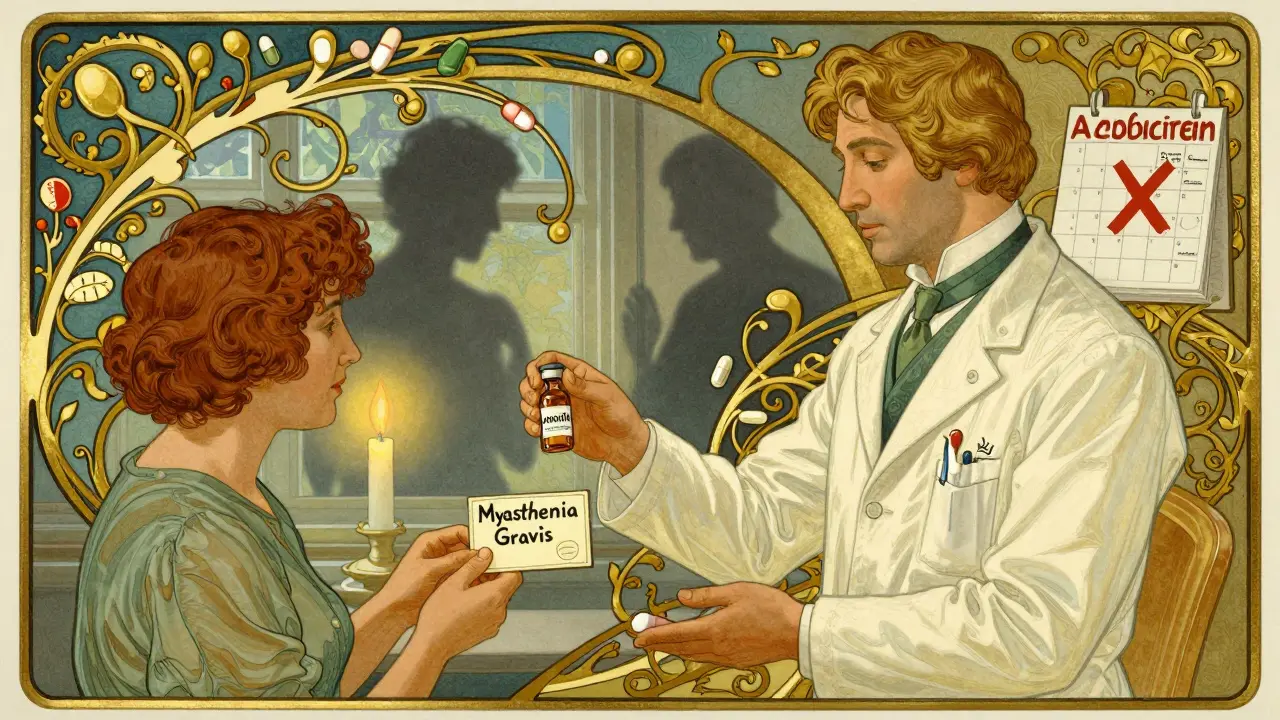
It’s Not Always the Antibiotic - Often, It’s the Infection
Here’s something critical: in 88% of cases where MG worsened after an antibiotic, the real culprit wasn’t the drug - it was the infection itself.
Respiratory infections, urinary tract infections, even a simple sinus infection can trigger an MG flare. Your immune system is already firing on all cylinders. Adding a drug that interferes with nerve signals just pushes you over the edge.
This is why doctors sometimes have to choose between two bad options: treat the infection with a risky antibiotic, or let the infection run wild and risk a worse flare. The answer? Treat the infection - but choose the safest antibiotic possible, and monitor closely.
What Should You Do?
If you have MG, here’s your action plan:
- Always tell every doctor and pharmacist you have MG. Write it on your phone, carry a card, put it in your medical app. Don’t assume they’ll know.
- Ask: “Is there a safer antibiotic for someone with MG?” If they say “yes, but this one works better,” ask why. Push for alternatives.
- Never take a new antibiotic without talking to your neurologist or MG specialist. Even if it’s for a cold or a UTI. Your specialist knows your history and can guide the choice.
- Watch for warning signs in the first 72 hours: Increased drooping, trouble swallowing, shortness of breath, weakness in arms or legs that’s worse than usual. If you notice any of these, call your doctor immediately.
- Keep your MG under control. If your symptoms are stable, your risk is lower. If you’re having flares often, your body is more vulnerable.
There’s no magic bullet. But knowing the risks gives you power. You’re not just a patient - you’re your own best advocate.

The Bigger Picture: Guidelines Are Changing
For years, the advice was simple: avoid fluoroquinolones and macrolides at all costs. That’s still the official stance from the Myasthenia Gravis Foundation of America. But new data is changing things.
The Cleveland Clinic study is the largest ever done on this topic. It looked at real-world use - not just case reports. And it found that the risk is lower than we thought. That doesn’t mean these drugs are safe. It means we need to be smarter about who gets them.
Neurologists are starting to shift from blanket bans to risk-based decisions. If you’re young, stable, and healthy, you might be able to use a fluoroquinolone for a serious infection - with close monitoring. But if you’ve been hospitalized recently? Stick with amoxicillin.
Pharmacists are also stepping up. More are checking MG status before dispensing antibiotics. That’s a good thing. You shouldn’t have to be the one reminding them.
What’s Next?
Researchers are now looking at why some people react and others don’t. Is it genetics? Immune profile? Kidney function? The goal is to build a tool that can predict your personal risk - like a scorecard based on your age, MG severity, diabetes status, and kidney health. That way, your doctor won’t have to guess.
For now, the message is clear: don’t avoid antibiotics out of fear. But don’t take them lightly either. Choose wisely. Monitor closely. Communicate constantly. Your muscles are counting on it.
Can I take amoxicillin if I have myasthenia gravis?
Yes, amoxicillin is one of the safest antibiotics for people with myasthenia gravis. A 2024 study of over 900 antibiotic courses found only a 1.3% risk of worsening symptoms with penicillins like amoxicillin. It’s often the first choice for infections like sinusitis, strep throat, or urinary tract infections in MG patients.
Are fluoroquinolones completely off-limits for MG patients?
Not always. While fluoroquinolones like ciprofloxacin and levofloxacin carry FDA black box warnings for MG, recent research shows the actual risk of worsening symptoms is low - around 2%. For stable patients with no recent hospitalizations, they may be used when no safer alternative exists, but only with close monitoring for breathing or swallowing problems.
What should I do if I start feeling weaker after taking an antibiotic?
Call your neurologist or go to the emergency room immediately. Worsening weakness, trouble swallowing, or shortness of breath could signal a myasthenic crisis. Don’t wait. Early treatment - like IVIG or plasma exchange - can prevent respiratory failure.
Why are women with MG at higher risk for antibiotic-triggered flares?
The exact reason isn’t known, but studies consistently show women with MG are more likely to experience worsening symptoms after antibiotics. It may relate to hormonal differences, immune system variations, or how certain drugs are processed in the body. Regardless of the cause, it’s a real and documented risk.
Can infections trigger MG flares even without antibiotics?
Yes. In fact, infections are the most common trigger for MG flares - even more than antibiotics. Up to 88% of cases where MG worsens after antibiotic use are actually due to the infection itself. That’s why treating infections promptly is critical, even if the antibiotic carries some risk.
Should I avoid all antibiotics if I have MG?
No. Avoiding antibiotics can be more dangerous than using them. Untreated infections can cause severe MG flares, hospitalization, or even death. The goal isn’t to avoid antibiotics - it’s to choose the safest one for your situation and monitor for side effects.
12 Comments
Just had a UTI last month and asked my doc for amoxicillin instead of cipro because of my MG. She was surprised I even knew to ask. Glad I did. No issues. Seriously, know your meds. Your muscles will thank you.
I’ve been MG for 12 years and never realized infections themselves are the real trigger more than the antibiotics. That 88% stat blew my mind. I thought it was always the drugs. This changes how I think about every cold now.
Oh honey, let’s be real - this whole antibiotic fear is just Big Pharma’s way of selling you safer, pricier drugs while they quietly profit off the fear of fluoroquinolones. You think they don’t know the real risk is 2%? They do. They just need you terrified so you’ll pay $180 for a 10-day course of penicillin when cipro costs $4. Wake up. The system is rigged. Your body isn’t fragile - your trust is.
Actually, the FDA black box warning exists for a reason. It’s not about profit, it’s about liability. And if you’re going to dismiss medical warnings based on a single 2024 study, you’re not being an advocate - you’re being reckless. There’s a difference between informed choice and dangerous ignorance.
They’re lying. The CDC knows fluoroquinolones cause MG crises - they just don’t want you to know. I saw a woman on YouTube lose her ability to swallow after one dose. They covered it up. Hospitals are full of people who were told ‘it’s just the infection’ - but the drug was the match. They’re silencing us. You’re being watched.
My wife had MG and took azithromycin for a sinus infection. She ended up in ICU. Now I don’t trust any doctor who says ‘it’s fine.’ If you’re American, you should be ashamed of this broken healthcare system that lets Big Pharma kill people with cheap antibiotics. We need to ban these drugs for everyone. Not just MG patients. Everyone.
As a pharmacist with over two decades of clinical experience, I must emphasize that the paradigm shift in antibiotic stewardship for MG patients is both scientifically robust and ethically imperative. The data from the Cleveland Clinic cohort - while preliminary - suggests a nuanced, risk-stratified approach supersedes blanket contraindications. I now routinely consult MG registries prior to dispensing macrolides, and I encourage all patients to maintain a personal medication log with neurologist approval.
You think you’re smart because you read a study? I’ve been in India for 30 years. We give cipro to everyone. MG patients? We give it too. No one dies. You Americans overthink everything. Your bodies are weak because you eat too much sugar and sit on couches. Stop blaming the medicine. Fix your life.
Hey, I’ve got MG too - been stable for 8 years. I take amoxicillin for every little thing. I’ve never had a flare from meds. What helped me most? Eating clean, sleeping well, and not stressing out. Don’t panic. Your body’s stronger than you think. And if your doctor doesn’t listen? Find one who does. You’re not alone in this.
Here’s the thing nobody talks about - antibiotics aren’t the enemy. The real villain is the delay in diagnosis. I had a friend who ignored a UTI for weeks, then took cipro - and crashed. But if she’d treated it early with penicillin? No crisis. The infection wasn’t ‘the trigger’ - the neglect was. We need better education, not fear. And maybe a damn app that flags risky scripts before they’re filled.
If you have MG, you are not helpless. You are the CEO of your own body. Write down your meds. Carry a card. Ask questions. Say ‘no’ if something feels off. Your neurologist isn’t your savior - you are. Knowledge is power. Use it. Don’t wait for someone to save you. Save yourself.
In India, we don’t have the luxury of choosing antibiotics like you do in the US. We take what’s available, what’s cheap, what’s in stock. My cousin with MG took cipro because it was the only thing the clinic had - and she survived. Yes, she got weaker for three days. But she didn’t die. Maybe the risk isn’t in the drug - maybe it’s in the fear. We need to stop treating MG patients like glass figurines. They’re warriors. Let them fight - with the tools they have.