

Many people take thyroid medication like levothyroxine to manage hypothyroidism, but what they don’t realize is that common supplements like calcium and iron can seriously mess with how well the medicine works. If you’re on thyroid meds and also taking calcium for your bones or iron for anemia, you might be unknowingly making your treatment less effective. The result? Fatigue, weight gain, brain fog, and a TSH level that keeps climbing even though you’re doing everything right.
Why Calcium and Iron Ruin Thyroid Medication Absorption
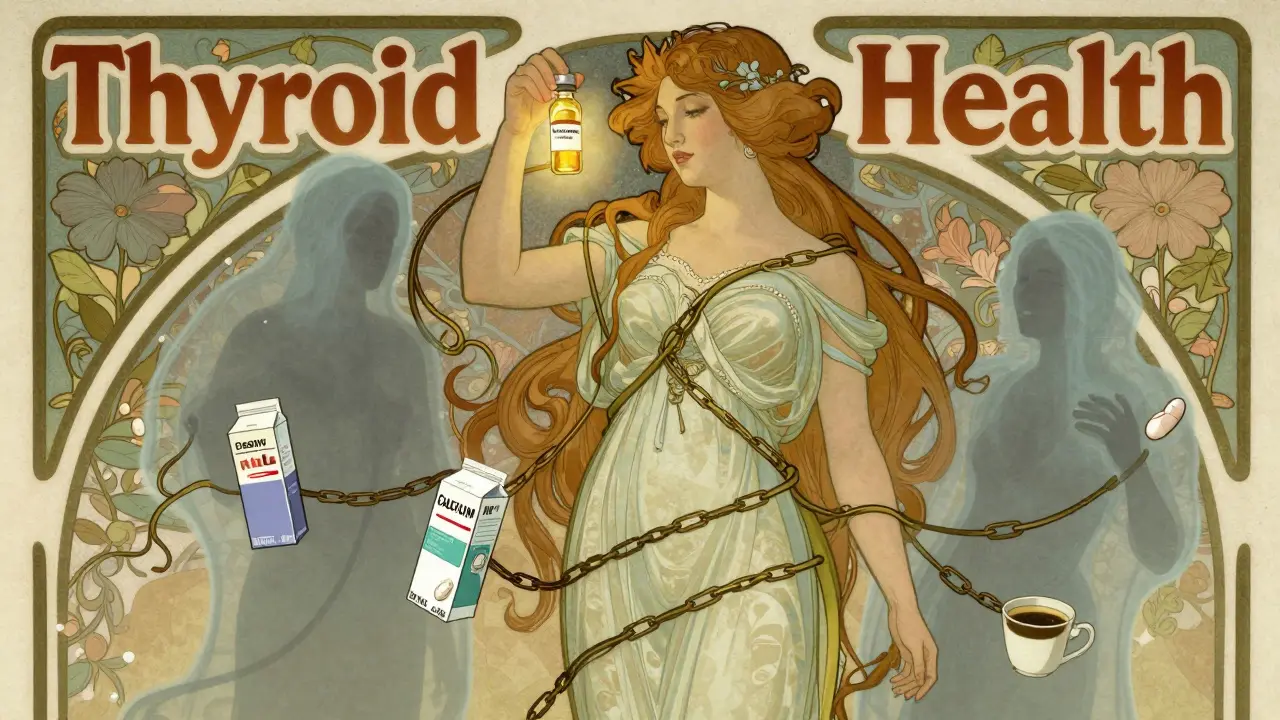
Thyroid hormone replacement, usually levothyroxine (brand names like Synthroid or generic versions), needs to be absorbed in the small intestine. But calcium and iron - especially in supplement form - don’t just sit there quietly. They bind to the hormone in your gut, forming a solid, insoluble complex that your body can’t absorb. Think of it like mixing glue with your medicine. The pill is still there, but your body can’t use it.
Studies show this isn’t a small issue. When calcium carbonate (1,200 mg) is taken at the same time as levothyroxine, absorption drops by 22% to 36%. Iron supplements, like ferrous sulfate (325 mg), reduce absorption by about 21%. That’s not a typo - you’re losing over a third of your dose. And if you’re already on the lower end of your dose range, this drop can push your thyroid levels out of balance.
The science is clear: di- and trivalent cations (that’s fancy talk for calcium and iron ions) latch onto levothyroxine molecules like magnets. Once bound, they pass right through your gut without being absorbed. Your thyroid hormone levels drop. Your pituitary gland notices and starts pumping out more TSH to signal your thyroid to work harder - but you don’t have a working thyroid anymore. So your TSH climbs, and you feel worse.
How Long Should You Wait?
The good news? You don’t have to stop taking calcium or iron. You just need to space them out. But how long? It depends on who you ask, but here’s what the evidence says:
- Calcium supplements: Wait at least four hours before or after your thyroid medication. The Mayo Clinic, the American Thyroid Association, and Synthroid’s official prescribing info all agree on this. Some international guidelines say three hours, but four is the safest bet.
- Iron supplements: Wait two to four hours. The American Association of Clinical Endocrinologists says two hours is enough, but studies show absorption can still be reduced by up to 39% if taken too close. To be safe, aim for four hours.
Here’s what a practical daily schedule might look like:
- Take your thyroid medication first thing in the morning, with a full glass of water, on an empty stomach.
- Wait 30 to 60 minutes before eating, drinking coffee, or taking any other pills.
- Take calcium supplements at dinnertime - or better yet, right before bed.
- Take iron supplements with dinner, or at night, at least four hours after your thyroid pill.
Some people find it easier to take their thyroid medication at bedtime, as long as they haven’t eaten for at least three to four hours. This works well for those who also take iron or calcium at night. Just make sure your stomach is empty.
Who’s Most at Risk?
You’re more likely to run into this problem if you fall into one of these groups:
- Postmenopausal women: Calcium for osteoporosis is common. Many don’t realize their bone pills are sabotaging their thyroid treatment.
- Menstruating or pregnant women: Iron supplements are often prescribed for anemia. A 2023 case study showed a pregnant woman still had elevated TSH (8.2 mU/L) even when she took iron four hours after her thyroid med.
- Elderly patients: Often juggle multiple prescriptions - calcium, iron, antacids, vitamins - all within hours of thyroid medication.
- People with Hashimoto’s: More likely to need both thyroid meds and supplements due to nutrient malabsorption.
A 2022 survey from Thyroid UK found that 68% of patients struggled to keep their supplements and meds separated. It’s not easy when you’re taking five different pills a day.

Other Things That Interfere (And You Might Not Know)
Calcium and iron aren’t the only troublemakers. Here’s what else can block levothyroxine absorption:
- Soy products: Soy milk, tofu, edamame - they can increase your needed dose by 18% to 30%.
- Walnuts: One study found they reduce absorption by 24% if eaten with your pill.
- Grapefruit juice: Interferes with liver enzymes that help process thyroid meds.
- High-fiber foods: Eating more than 30 grams of fiber within an hour of taking your pill can raise TSH by 15% to 25%.
- Coffee and tea: Tannins in both can reduce absorption. Wait at least an hour after taking your pill.
- Biotin: Found in hair and nail supplements. Doses above 5 mg daily can cause falsely high thyroid test results, making your doctor think you’re overmedicated when you’re not.
And here’s a sneaky one: calcium-fortified orange juice. One cup has about 350 mg of calcium - enough to interfere if you drink it with or right after your thyroid med. Same goes for almond milk, soy milk, or oat milk that’s fortified with calcium.
What to Do If You’re Already Taking Them Together
If you’ve been taking calcium or iron within a few hours of your thyroid pill, don’t panic. But do act.
First, get your TSH and free T4 levels checked. A rising TSH (above 4.0 mU/L) could mean your dose needs adjustment. If your levels were stable before and suddenly jumped, supplements are likely the cause.
Second, change your timing. Move calcium and iron to bedtime, or at least four hours after your thyroid med. Keep a log: write down what you took and when. Many patients notice a difference within six to eight weeks.
Third, talk to your doctor. Don’t just stop your supplements. If you’re taking iron for low ferritin, you still need it - you just need to time it right.
What About Newer Thyroid Meds?
There’s some hope on the horizon. A new liquid formulation of levothyroxine, currently in Phase III trials, shows only an 8% reduction in absorption when taken with calcium - compared to 32% for standard tablets. If approved, this could change everything. But right now, it costs about $350 a month. Generic levothyroxine? Around $15.
For now, the cheapest, most effective solution is still timing. No fancy pills needed.
Real-Life Stories
On Reddit’s r/Hashimotos community, users share stories like:
- u/ThyroidWarrior99: “My TSH went from 1.8 to 6.4 after I started taking a calcium pill with my morning vitamins. I moved calcium to bedtime. Three months later, TSH dropped back to 2.1.”
- u/HypoMama: “I was exhausted after having my baby. Iron helped, but my TSH kept climbing. I switched my thyroid med to bedtime. No more spikes.”
These aren’t rare. They’re common. And they’re fixable.
Bottom Line
You can still take calcium and iron. You just can’t take them at the same time as your thyroid medication. The fix is simple: space them out by at least four hours. Take your thyroid pill first thing in the morning with water. Wait an hour before eating or drinking anything else. Then take your other meds and supplements later - preferably at night.
Don’t assume your doctor told you this. A 2023 study found only 42% of patients got proper counseling when starting thyroid meds. Don’t be one of them. Check your labels. Read the fine print. Ask your pharmacist. Your energy, your mood, and your long-term health depend on it.
Can I take calcium and iron together?
Yes, you can take calcium and iron together - but not with your thyroid medication. They don’t interfere with each other. The problem is when they’re taken near levothyroxine. Space them out from your thyroid pill by at least four hours.
What if I forget and take them at the same time?
Don’t panic. One mistake won’t ruin your treatment. But if it happens often, your thyroid levels could drop over time. Skip the next dose of calcium or iron that day, and get back on schedule. If this happens repeatedly, talk to your doctor about checking your TSH.
Can I take thyroid medication at night?
Yes, many people do. Taking levothyroxine at bedtime, at least three to four hours after your last meal, can improve absorption and make it easier to avoid interactions with calcium, iron, or soy. Studies show nighttime dosing works just as well as morning dosing - as long as you’re consistent.
Do all forms of calcium and iron interfere?
Yes. Calcium carbonate, calcium citrate, ferrous sulfate, ferrous fumarate, and ferrous gluconate all interfere. Even calcium-fortified foods like orange juice or plant-based milk can cause problems if consumed within four hours of your thyroid med. Stick to plain water with your pill.
How long does it take to see improvement after fixing the timing?
It usually takes six to eight weeks for your thyroid hormone levels to stabilize after you fix the timing. Your doctor will likely recheck your TSH and free T4 around that time. Don’t expect overnight results - your body needs time to rebalance.
13 Comments
Oh wow, so the government and Big Pharma don't want us to know that calcium and iron are just *convenient scapegoats* for why thyroid meds 'fail'? 🤔 Or maybe... they're *actually* interfering? How dare science ruin a good conspiracy. I've been taking my levothyroxine with my calcium gummy bears since 2017. My TSH is 12.4. Coincidence? Or is this just how they keep us docile? #WakeUpSheeples
This is one of those posts that actually saves lives. Seriously. I used to take my iron with breakfast and wonder why I felt like a zombie. Then I read this, switched to nighttime iron, and BAM - my energy came back like I’d been rebooted. If you’re on thyroid meds, this isn’t just advice - it’s a survival guide. Share this with someone who’s still taking their supplements with their pill. You might save their quality of life.
Thank you for writing this. 💙 I’ve been struggling for years with fatigue and brain fog, and no one ever told me about the calcium-iron-thyroid connection. I just moved my supplements to bedtime - and already, after two weeks, I feel *lighter*. Like I’m not dragging a sack of wet sand around anymore. Please keep sharing this kind of info. It’s rare to find something so practical and life-changing. You’re helping people more than you know.
The empirical data presented here is statistically negligible when contextualized within the broader pharmaco-kinetic ecosystem. The 36% absorption reduction is a construct of controlled in vitro environments that fail to account for inter-individual variability in gastric pH, microbiome modulation, and enterohepatic recirculation. Furthermore, the assumption that 'spacing' resolves the issue ignores epigenetic expression of P-glycoprotein transporters. This is pseudoscience dressed as clinical guidance. Your 'four-hour rule' is an artifact of outdated pharmacopeia.
Wait... wait... so... are you saying that the *pharmaceutical industry* is *not* secretly adding fluoride to our calcium supplements to make us more docile? And that the FDA *doesn’t* know about this? And that my doctor... is just... *ignorant*? I’ve been taking my thyroid med with my calcium + iron + biotin + magnesium + zinc + omega-3 + vitamin D + turmeric + ashwagandha... and now I’m terrified. Is my thyroid even real? Did I ever have one? I think I’m having a nervous breakdown. Someone send help. Or maybe just a therapist. Or a priest. Or a scientist. Or all three. 🥺😭
Man, I used to take my thyroid pill with my morning coffee and a handful of walnuts and a soy latte and a calcium chew. I thought I was being healthy. Turns out I was just performing a ritual of self-sabotage. I’ve been tired, bloated, and emotionally numb for two years. I just changed my routine - pill on empty stomach, water only, then wait an hour. Then coffee. Then food. Iron and calcium at bedtime. And guess what? I cried the first morning I didn’t feel like a corpse. It’s not magic. It’s just fucking biology. And we’re all too dumb to listen to it.
I’ve been on levothyroxine for 12 years. I never knew any of this. I just thought I was 'one of those people' who never responded to meds. I’m going to adjust my schedule tomorrow. Thank you.
This is the kind of information that should be printed on every thyroid med bottle. Seriously. I wish my doctor had told me this when I started. I’ve been taking calcium at breakfast with my pill for 8 years. My TSH was 7.2 last month. I just moved calcium to bedtime. I feel hopeful. To anyone reading this: you’re not broken. You’re just taking your meds wrong. It’s fixable. And you’re not alone.
I am from India and here everyone takes calcium and iron with food because we believe food helps absorption! But I read your post and I am shocked! My mom has hypothyroid and she takes her medicine with milk and then eats paratha with iron-rich spinach - she is always tired! I told her to take medicine before breakfast with water only and then eat after 1 hour. She said I am mad! But I am not mad - I am educated! Now she is taking medicine at night too - after dinner. She says she feels better! India needs more awareness like this! Thank you for sharing! 🙏❤️
I’ve been doing this wrong for 15 years. I thought I was being 'organized' by taking all my pills together. Now I’m realizing I’ve been slowly poisoning my own health. My TSH was 8.9 last month. I didn’t even know that was bad. I thought I was just 'getting older'. I’m going to fix it. I’m going to change. I’m going to start over. I don’t know if I can do it. But I have to. For me.
I took my thyroid med with my calcium at breakfast for 7 years. I was always tired. I thought I was just lazy. Turns out I was just dumb. I switched to nighttime calcium. My energy came back. That’s it. No magic. Just timing.
OMG I JUST REALIZED I’VE BEEN TAKING MY IRON AND THYROID TOGETHER SINCE 2020!! I THOUGHT I WAS BEING SMART BY DOING IT ALL AT ONCE!! I’M GOING TO CHANGE MY ROUTINE TONIGHT!! I’M SO ANXIOUS NOW BUT ALSO HOPEFUL!! THANK YOU FOR THIS!!
I am from India and I take thyroid medicine in night. I also take iron and calcium at night. But I take them after 4 hour of thyroid. I feel very good. My TSH is normal now. My friends in India take all together. They feel tired. I tell them this. They say it is too complicated. But it is not complicated. Just wait. Just simple. Life is simple if we follow science.