
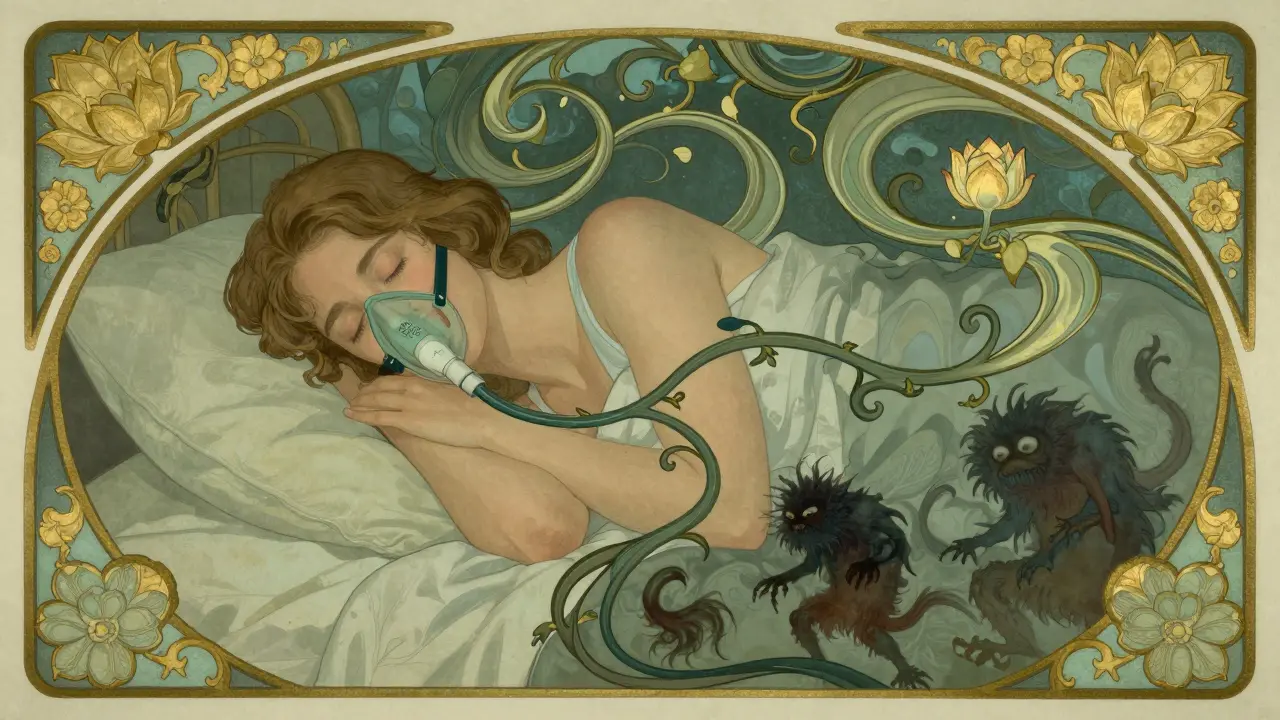
When you’re struggling to breathe at night, sleep doesn’t just get interrupted-it gets stolen. For millions of people with obstructive sleep apnea (OSA), the simple act of resting becomes a battle against collapsing airways. That’s where CPAP machines come in. They’re not glamorous, but they’re life-changing. Used properly, they can slash your apnea events, cut your risk of heart disease, and help you wake up feeling like a human again instead of a zombie. But here’s the truth: most people quit. Not because the machine doesn’t work. Because it doesn’t fit.
What CPAP Machines Actually Do
A CPAP machine doesn’t cure sleep apnea. It keeps it at bay. Every night, it pushes a steady stream of air through a mask, acting like a splint for your throat. This stops your airway from collapsing when you breathe in. The result? No more gasping, no more choking, no more waking up 20 times an hour. Studies show that consistent users drop their apnea-hypopnea index (AHI) from dangerous levels-sometimes over 30 events per hour-to under 5. That’s normal breathing. And it’s not just about sleep. People who stick with CPAP see a 20-30% drop in heart attacks and strokes over time. The American Academy of Sleep Medicine calls it the gold standard for moderate to severe OSA. But here’s the catch: 54% of people stop using it within the first year. Why? It’s rarely the pressure. It’s the mask.
The Four Main Types of CPAP Machines
Not all machines are the same. Choosing the wrong one is like buying hiking boots that don’t fit your feet-you’ll end up limping.
- Standard CPAP delivers one fixed pressure all night. Simple. Reliable. Cheap. Most cost between $500 and $1,000. If your breathing pattern is stable, this works fine. Popular models like the ResMed AirSense 10 and Philips DreamStation are common picks. But if you toss and turn, or your pressure needs change from night to night, this can feel like a constant tug on your face.
- APAP (Auto-Adjusting) watches your breathing and tweaks pressure automatically. It might push 8 cm H₂O one night, then 11 the next. No guesswork. This is why more doctors are starting patients here. A 2021 meta-analysis found 15% higher adherence with APAP than fixed CPAP. Models like the ResMed AirSense 11 AutoSet cost $1,700-$3,000. Worth it if you’re restless, gain weight, or have alcohol on weekends.
- BiPAP gives you two pressures: higher when you inhale, lower when you exhale. This makes breathing feel less like fighting a wind tunnel. Ideal for people needing high pressure (over 15 cm H₂O) or those with COPD or heart failure. Prices range from $600 to $1,600. But it requires a second sleep study to set correctly, adding $300-$500 to the cost.
- EPAP (Expiratory Positive Airway Pressure) devices are tiny, nasal valves that cost $50-$150 per month. They don’t use electricity. Just resistance on exhale. Only effective for mild OSA. If your AHI is above 15, skip this. One study showed only 45% efficacy versus 85% for full CPAP.
Market-wise, ResMed owns 45% of the space, Philips Respironics holds 30%, and Fisher & Paykel takes 15%. The ResMed AirSense 11 AutoSet has a 4.7/5 rating from over 1,200 reviews. The Philips DreamStation sits at 4.5/5. Both are solid. But if you travel often, look at the ResMed AirMini.
Mask Fitting: The Real Game-Changer
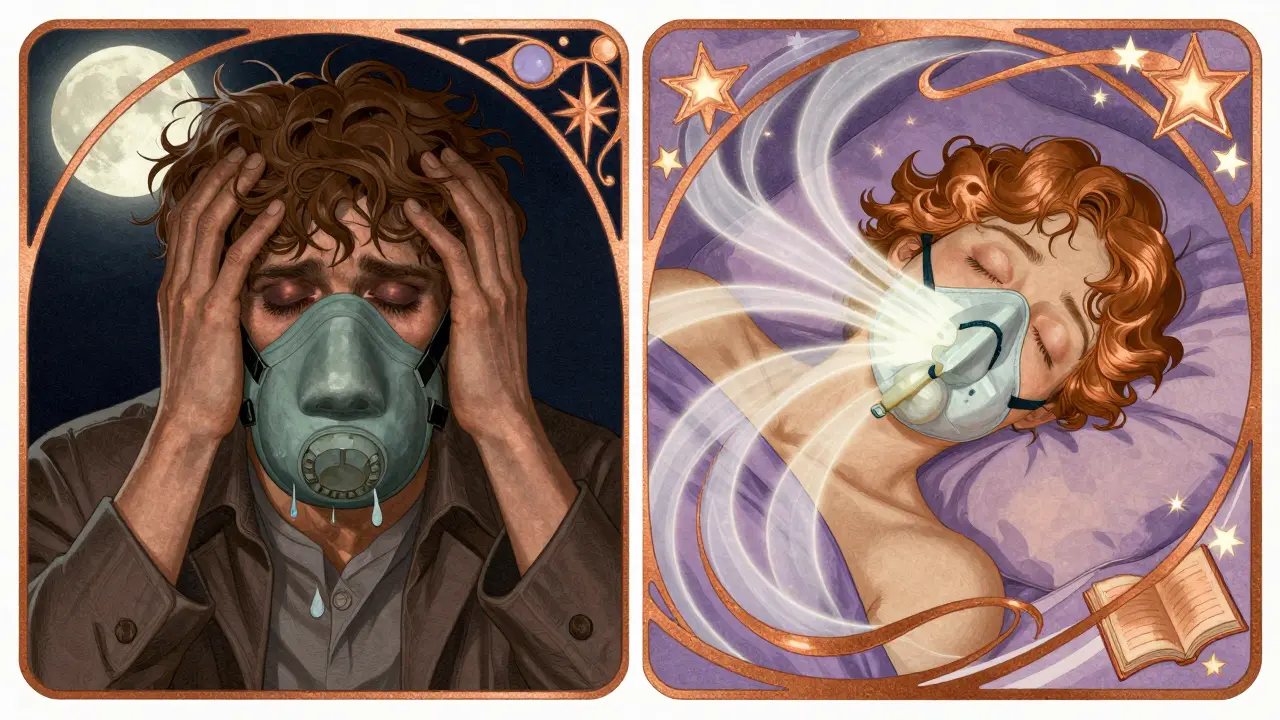
Here’s the secret no one tells you: 70% of CPAP failures come from mask issues-not pressure. You can have the fanciest machine on the planet, but if your mask leaks, you’re just paying for noise.
There are four main mask types:
- Nasal pillows sit at the nostrils. Lightweight. Minimal contact. Best for side sleepers. Only 32% of users choose these, but they’re the #1 pick for people who hate feeling claustrophobic. One Reddit user switched from a full nasal mask to the AirFit P10 and dropped leaks from 15 L/min to 3 L/min.
- Nasal masks cover the nose. Most common-45% of users. Good balance of seal and comfort. Ideal if you breathe through your nose.
- Full-face masks cover nose and mouth. Used by 18% of people. Usually for mouth breathers or those with nasal congestion. But they’re bulkier, harder to seal, and cause 35% more skin irritation than nasal pillows.
- Hybrid/oral masks are rare (5%). Designed for people with blocked noses who still breathe through their mouth.
Proper fitting isn’t about size-it’s about shape. Measure your nasal bridge width, cheekbone curve, and how your face moves when you sleep. A bad seal causes 60% of leaks. Acceptable leak rate? Below 24 L/min. Anything higher and you’re losing air-and sleep.
Try this: wear the mask for 10 minutes while watching TV. Don’t sleep yet. Just sit. If you’re itching, adjusting, or pulling it off, it’s not right. Don’t settle. Most suppliers offer 30- to 60-night trials. Use them.
Adherence Strategies That Actually Work
Getting used to CPAP isn’t about willpower. It’s about conditioning. Most people give up because they try to sleep with it on night one. That’s like running a marathon without training.
Here’s a real 4-step acclimation plan:
- Daytime mask desensitization: Wear the mask (with no air) for 5-10 minutes, 3 times a day. Just sit. Read. Watch Netflix. Get used to the feel.
- Use the ramp feature: This slowly increases pressure over 5-45 minutes. Most users start at 15 minutes. It feels less like a blast of air.
- Turn on heated humidification: Dry nose? Sore throat? 50% of those complaints vanish with humidification. Set it between 86°F and 95°F. If your machine doesn’t have one, get one.
- Track your data: Every machine now logs usage, leak rate, and AHI. Check it. If your AHI is still over 5, call your sleep specialist. If leaks are above 24 L/min, change your mask. Data turns guesswork into fixes.
Other proven tips:
- Use a CPAP pillow with cutouts. It reduces leaks by 40%.
- Start with 2 hours of daytime use. Then add 30 minutes each night. Build up slowly.
- Heated tubing helps. Users with it have 78% adherence vs. 52% without.
- Use apps like ResMed’s myAir. It gives daily feedback and coaching. Users with it are 27% more likely to stick with therapy.

What’s New in 2026
The tech keeps improving. ResMed’s AirSense 11 uses AI to predict apnea events before they happen-cutting AHI by 22% compared to older models. Philips’ DreamStation 3 runs at 25 dBA-quieter than a whisper. Travel devices like the AirMini are getting smarter. The new AirMini with optional humidifier attachment is now 20% quieter than last year’s model.
Insurance rules are tightening too. Starting in 2024, Medicare and most insurers require proof of 4+ hours of use per night, 70% of nights, to keep covering your device. That means machines now auto-send usage data to your provider. No more guessing.
And the market is expanding. More young adults (18-45) are being diagnosed. Trucking companies now require CPAP for drivers with AHI over 20-resulting in 32% fewer accidents. Sleep apnea isn’t just a health issue anymore. It’s a safety issue.
Why You Shouldn’t Quit
It’s hard. Yes. The mask feels weird. The noise annoys you. Your skin gets red. But think about this: if you stop, your OSA doesn’t go away. It gets worse. Your blood pressure climbs. Your risk of stroke, diabetes, and depression goes up. You’re not just losing sleep-you’re losing years.
One user on Reddit said: "I used to wake up exhausted. Now I remember my dreams. I haven’t felt this awake since college." That’s not hype. That’s science.
Don’t give up after a week. Give up after a month. And if it still doesn’t work? Talk to your sleep clinic. Try a different mask. Switch to APAP. Add humidification. There’s always a solution. But only if you keep looking.
Can I use a CPAP machine without a prescription?
In the United States, all CPAP machines require a prescription. This is because they’re classified as Class II medical devices by the FDA. Even if you buy one online, you’ll need a sleep study report and a doctor’s order to get insurance coverage. Some countries allow over-the-counter sales, but without proper pressure settings, you risk under- or over-treating your condition.
How do I know if my CPAP mask fits properly?
A properly fitted mask should seal without excessive tightening. You shouldn’t feel pain, red marks, or pressure sores after 30 minutes of use. Check your machine’s leak rate-if it’s under 24 L/min, the seal is good. If you’re waking up with dry mouth, nasal congestion, or air in your stomach, your mask is leaking. Try adjusting the headgear straps, switching mask types, or getting a custom-fit cushion. Most suppliers offer free fitting consultations.
Is APAP better than CPAP for beginners?
For many new users, yes. APAP adjusts pressure automatically, so you don’t need to guess what setting works. Studies show 15% higher adherence with APAP compared to fixed CPAP. If you’re unsure about your ideal pressure, or if you sleep in different positions, have variable breathing, or gain/lose weight, APAP reduces the guesswork. It’s more expensive upfront, but often leads to better long-term use.
Why do some people still quit CPAP even after trying different masks?
It’s rarely just the mask. Often, it’s a combo: dry air, noisy machine, uncomfortable tubing, or not using the ramp feature. Some people skip the acclimation phase and try to sleep with it on night one. Others don’t track their data and assume it’s not working. The key is patience and support. Use heated humidification, adjust the ramp time, try a different mask type, and connect with a sleep coach or online community. 85% of people who stick with it for 3 months see major improvements.
Can I travel with my CPAP machine?
Yes, and you should. Travel CPAPs like the ResMed AirMini weigh less than a pound and fit in your palm. They’re FAA-approved for flights. Just pack the power adapter and a travel humidifier if needed. Some airlines let you bring CPAPs on board without counting them as carry-on. Always bring a copy of your prescription. If you’re flying internationally, check voltage requirements-most modern machines auto-adjust between 100-240V.
Does insurance cover CPAP machines?
Most insurance plans cover 80% of the cost after you meet your deductible. Medicare covers CPAP machines with a sleep study diagnosis. However, to keep coverage, you must show proof of usage: at least 4 hours per night, 70% of nights. If you don’t, your insurer may stop paying. Always check with your provider before buying. Some require prior authorization. Out-of-pocket costs range from $100 to $500 after insurance, depending on the model.
10 Comments
I used to think CPAP was for old people until I started snoring like a chainsaw in my 28-year-old body. My doctor said "you’re not dying yet but you’re definitely failing at sleep." Switched to AirSense 11 AutoSet with nasal pillows and now I dream about tacos instead of gasping for air. 🤓
LMAO this post is so corporate. CPAP? More like CPAP-ocalypse. My mask gave me a forehead rash that looked like a map of India. I tried EVERYTHING. humidifier, heated tube, $300 "premium" mask. Then I just started sleeping on my stomach. No machine. No problems. Who needs oxygen when you got gravity?
i dont get why people make this so hard. i got my first cpap 3 years ago. i wore it 2 mins the first night. then 5 mins. then 10. now i sleep 8 hours with it. no magic. just baby steps. and yes i still wake up at 3am to adjust it. but i wake up alive. thats worth it.
As a Nigerian woman who traveled to the U.S. for sleep studies, I’ve seen how differently CPAP is approached here versus home. In Lagos, many just endure fatigue because machines cost more than a monthly salary. But here? We have trials, apps, insurance, heated tubing-it’s a miracle. I teach my cousins: don’t quit because it’s weird. Quit because you tried everything and still feel like a zombie. If you’re still trying? You’re already winning. Keep going. We’re all rooting for you. 🌍❤️
The fundamental irony of CPAP therapy is not technological-it’s phenomenological. We are asked to submit to a mechanical intrusion into the most intimate biological rhythm: sleep. Yet, this very intrusion restores autonomy. The mask becomes a paradoxical vessel of freedom. One does not merely use a CPAP; one negotiates with it, daily, silently, in the dark. The machine does not cure apnea. It redefines the boundary between the self and the body’s betrayal.
I used to hate my CPAP. Then I started using it while watching The Crown. Now I cry during Season 4. Coincidence? I think not. 😭👑
I just want to say thank you to everyone who shared their stories. I’ve been on CPAP for 9 months and still have nights where I rip the mask off screaming. But I’m still here. And I’m still trying. That’s enough. 💕
Stop pretending this is hard. You have a machine that prevents strokes. You have a 30-day trial. You have data tracking. You have heated humidification. If you quit, you’re choosing ignorance over survival. No sympathy. No excuses. Just fix it or stop wasting everyone’s time.
I bought a CPAP because my wife said I sound like a dying walrus. First night: I threw it out the window. Second night: I tried it while crying. Third night: I watched Netflix with it on. Now I get mad when it’s not there. My dog sleeps next to it. He thinks it’s his new best friend. 🐶💤
Thank you for sharing such a comprehensive and well-researched guide. I particularly appreciate the emphasis on adherence through incremental conditioning rather than immediate compliance. The data-driven approach outlined here aligns with best practices in behavioral medicine and underscores the importance of patient-centered care. I will be sharing this with my sleep disorder support group. Well done.