
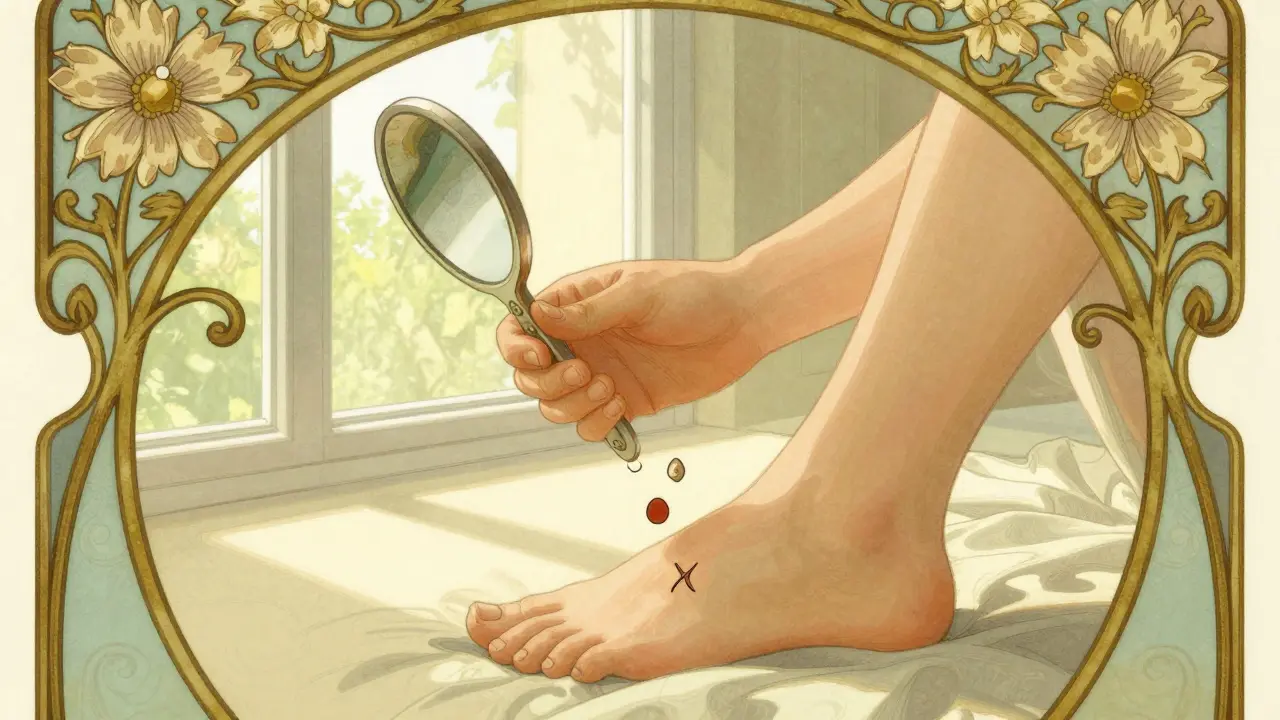
Every year, over 82,000 people in the U.S. lose a foot or leg to diabetes-related amputation. Most of these cases are preventable. The real problem isn’t the disease itself-it’s the silent damage happening under your feet every day. Diabetic foot ulcers don’t appear out of nowhere. They start as a tiny blister, a small cut, or a patch of redness you didn’t notice because you couldn’t feel it. By the time you see it, it’s often too late. But here’s the truth: if you check your feet every single day, you can stop most of these problems before they start.
Why Your Feet Are at Risk
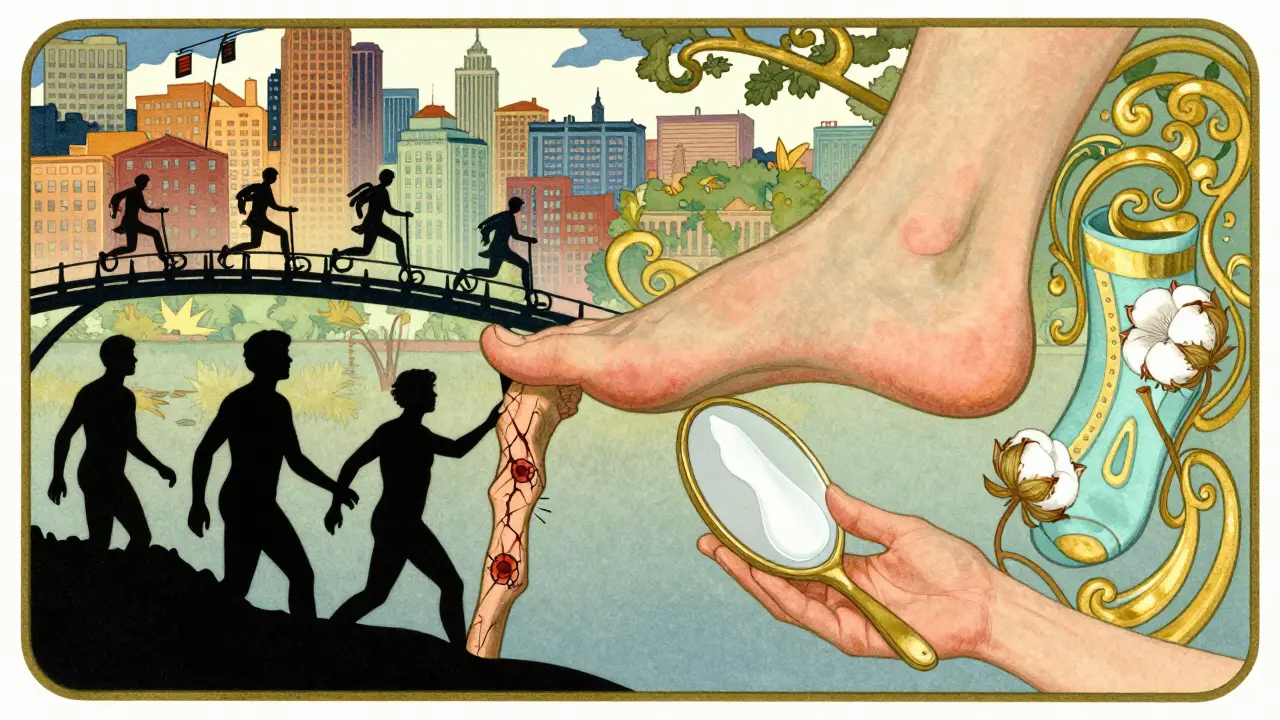
Diabetes doesn’t just raise your blood sugar. It slowly damages the nerves in your feet, a condition called peripheral neuropathy. That means you might not feel a blister forming, a rock in your shoe, or a cut from stepping on something sharp. At the same time, poor circulation makes it harder for your body to heal even the smallest wound. Together, these two issues create a perfect storm. A minor injury turns into an infection. An infection turns into an ulcer. And without quick action, that ulcer can lead to amputation.The International Working Group on the Diabetic Foot (IWGDF) classifies risk into four levels. If you’ve never had a foot problem and still feel normal sensation, you’re Risk 0. But if you’ve lost feeling in your feet-even a little-you’re Risk 1. If you have foot deformities like bunions or hammertoes, you’re Risk 2. And if you’ve had a foot ulcer or amputation before, you’re Risk 3. Your risk level determines how often you need to see a specialist, but your daily inspection doesn’t change. Everyone with diabetes needs to check their feet every day.
The Daily Foot Inspection Checklist
This isn’t a suggestion. It’s a non-negotiable part of managing diabetes. Here’s the exact routine backed by NYU Langone Health, the CDC, and the IWGDF 2023 guidelines.- Wash your feet daily in lukewarm water-between 90°F and 95°F. Test the temperature with your elbow or a thermometer. Hot water can burn you without you realizing it.
- Dry thoroughly, especially between your toes. Moisture there breeds fungus and cracks that lead to infection.
- Inspect every surface of both feet. Use a hand mirror or ask someone to help you see the bottoms. Don’t skip the areas between toes, under the ball of your foot, or around the heels.
- Look for these warning signs: blisters larger than 3mm, cuts deeper than 1mm, redness bigger than 1cm, swelling that makes your foot feel tighter, or skin that’s noticeably warmer than the other foot. Even a small change matters.
- Apply moisturizer to dry skin-except between your toes. Dry skin cracks. Cracks become entry points for bacteria.
- Trim your nails straight across, leaving 1-2mm of nail beyond the tip of your toe. Don’t round the edges. Don’t cut into the corners. Ingrown nails are a major cause of infection.
- Check your shoes before putting them on. Shake them out. Look for pebbles, torn linings, or worn spots. A tiny pebble can cause a serious ulcer in minutes.
The CDC found that 68% of foot ulcers start from injuries you never noticed-because inspections were inconsistent. Do this every day, same time, same place. Natural light between 10 a.m. and 2 p.m. gives you the clearest view. Don’t rely on dim bathroom lighting.
Footwear That Saves Feet
Wearing the wrong shoes is one of the top causes of diabetic foot ulcers. The IWGDF says 87% of forefoot ulcers and 79% of midfoot ulcers come from pressure points caused by shoes.You don’t need expensive “therapeutic” shoes if you’re low risk. But if you have neuropathy, foot deformities, or a history of ulcers, you need shoes designed to reduce pressure. Look for these features:
- At least 0.5 inches (12.7mm) of space between your longest toe and the front of the shoe
- Width that lets your toes spread naturally-no pinching
- A firm heel counter that doesn’t collapse when you press it
- No seams or stitching inside that could rub
Avoid sandals, flip-flops, and barefoot walking-even indoors. The CDC reports that walking barefoot for just five minutes a day increases your ulcer risk by more than 11 times. Even in summer, when it’s 90°F outside, don’t trade your supportive shoes for open sandals. Pressure mapping studies show sandals increase ulcer risk by 4.3 times.

What You Shouldn’t Do
There are myths about foot care that can hurt you.Don’t use corn removers or razor blades. Over-the-counter chemical treatments can burn your skin. Cutting corns or calluses yourself is dangerous-you can’t feel how deep you’re cutting.
Don’t soak your feet. Soaking dries out your skin and softens it too much, making it more likely to tear. Wash, don’t soak.
Don’t use heating pads or hot water bottles. You won’t feel if they’re too hot. Burns happen fast and heal slowly.
Don’t ignore redness or warmth. If your foot feels warm, looks red, or swells up, don’t wait. Call your doctor the same day. Early treatment stops infections before they spread.
Don’t assume exercise is always safe. Walking is great-but only if you’re cleared by your doctor. Unsupervised ankle exercises can increase ulcer risk by 22% if you have neuropathy and poor foot alignment.
When to See a Specialist
Your primary care doctor should check your feet at least once a year. But your risk level changes that.- Risk 0: Annual screening for nerve damage and blood flow
- Risk 1: Every six months
- Risk 2 or 3: Every one to three months, or as your podiatrist recommends
If your ankle-brachial index (ABI) is below 0.9, you need a vascular specialist. Below 0.5? That’s an emergency. Poor circulation means your foot can’t heal. You need treatment now.
If you’ve had a foot ulcer before, you need a team: a podiatrist, a diabetes educator, and possibly an orthotist who makes custom insoles. Integrated care reduces amputations by over 40%, according to CMS data from 2022.
Technology Can Help-But It’s Not a Replacement
New tools like smart socks and temperature-sensing mats can warn you of trouble before you see it. These devices detect temperature differences of more than 4°F between your feet-signaling inflammation up to a week before an ulcer forms. Studies show they predict 73% of ulcers early.But they’re expensive. Systems like Podimetrics or Siren Socks cost hundreds of dollars a year. Many people can’t afford them. And smartphone apps that analyze foot photos? They’re promising, but they need good internet-something 22 million rural Americans still don’t have.
Don’t wait for tech to save you. The cheapest, most effective tool is still your eyes and your hands.
Why People Don’t Stick to the Checklist
Only 42% of people with diabetes do daily foot checks. Why? Vision problems make it hard to see. Nerve damage makes it hard to remember. Low income makes it hard to afford proper shoes. Medicaid patients are nearly 30% less likely to follow the routine.It’s not about willpower. It’s about support. If you’re struggling, ask for help. Ask a family member to check your feet once a week. Ask your clinic if they offer free foot care education. Some states now require annual foot exams for Medicaid patients-but enforcement is weak. Don’t wait for the system to fix it. Fix it for yourself.
Your Foot Is Your Lifeline
Your feet carry you through life. With diabetes, they’re also your early warning system. A daily inspection takes less than five minutes. It doesn’t cost anything. But it can save your foot, your mobility, and your independence.Start today. Grab a mirror. Look at your feet. Write down what you see. Do it again tomorrow. And the next day. This isn’t about being perfect. It’s about being consistent. Because the difference between a blister and an amputation is often just one missed inspection.
Can I use a mirror to check the bottom of my feet if I have trouble bending over?
Yes. A handheld mirror or a floor mirror placed on the ground works well. Some people use a long-handled mirror designed for foot inspections. If you have vision problems, ask a family member or caregiver to help. The key is seeing every part of your foot-especially the soles and between the toes. Don’t skip this step just because it’s awkward.
What should I do if I find a small cut or blister on my foot?
Clean it gently with mild soap and water. Pat it dry. Cover it with a sterile, non-stick bandage. Do not use hydrogen peroxide or alcohol-they delay healing. Call your doctor the same day. Even a small break in the skin can become infected quickly. Never wait to see if it gets worse.
Is it safe to walk barefoot at home?
No. Walking barefoot-even indoors-increases your risk of foot ulcers by more than 11 times, according to CDC data. Always wear shoes or slippers with closed toes and good support. Even if your house is clean, small objects like pins, toys, or pet nails can cause serious injuries you won’t feel.
Do I need special socks for diabetes?
Yes. Choose socks made of moisture-wicking materials like cotton or bamboo blends. Avoid socks with tight elastic bands or seams that can cut into your skin. White socks make it easier to spot drainage or blood. Never wear compression socks unless your doctor prescribes them-they can reduce blood flow if you have poor circulation.
Can exercise help prevent foot ulcers?
Walking and low-impact activities are generally safe and help with circulation-but only if you’re cleared by your doctor. Avoid high-impact exercises like running or jumping if you have nerve damage. Never do ankle exercises without gait analysis. Unsupervised exercise can increase ulcer risk by 22%. Always wear your proper footwear during activity.
What if I can’t afford therapeutic shoes?
Talk to your doctor or a diabetes educator. Many clinics have shoe donation programs or partnerships with orthotic suppliers. Some Medicaid plans cover one pair of therapeutic shoes per year. Even if you can’t afford custom shoes, choose wide, soft, well-cushioned shoes from a reputable brand. Avoid cheap, flimsy footwear. Your feet need protection-don’t settle for less.
How do I know if my foot is infected?
Signs include redness spreading beyond 1cm, swelling that makes your shoe feel tight, warmth in one area compared to the other foot, pus, or a foul smell. Fever or chills mean the infection has spread. These are emergencies. Go to the clinic or ER immediately. Antibiotics won’t help if the infection is deep-you may need wound care or surgery. Don’t wait.
Is it true that nerve decompression surgery prevents ulcers?
No. The 2023 IWGDF guidelines strongly advise against nerve decompression surgery for ulcer prevention. Nine randomized trials found no benefit. The procedure doesn’t reduce ulcers or improve healing. It carries risks and costs without proven results. Stick to proven methods: daily checks, proper shoes, and early treatment.
11 Comments
Just started doing the daily foot check after my buddy lost his toe last year. Honestly? It’s become my favorite part of the day. Five minutes. A mirror. A notebook. Feels like I’m reclaiming control.
Don’t wait for a crisis. Do it now. Your future self will high-five you.
They say ‘check your feet’ but what they don’t tell you is Big Pharma doesn’t want you to know this works. Why? Because if you prevent amputations, you stop the cycle of expensive surgeries, antibiotics, and prosthetics. They profit from your suffering.
They’re lying to you. And the mirror? It’s not just glass-it’s a weapon.
From India here and let me tell you something-this is life-saving advice and it’s so simple. In my village, people think diabetes is just about sugar and medicine. But feet? Nobody talks about feet.
I showed this to my uncle who’s diabetic and he cried. Said he never knew a pebble in his slipper could cost him his leg. Now he checks his feet every evening after tea, with his granddaughter holding the mirror. It’s beautiful. This isn’t medical advice-it’s human advice.
And yes, we use old hand mirrors from the kitchen. No fancy tech needed. Just care.
I’ve had type 2 for 12 years and never did this until my mom got an ulcer. She’s fine now but I still see the scar. I started checking my feet every night before bed. No mirror, just my fingers. I trace every crease, every bump. It’s weird at first but now I feel more connected to my body than ever.
It’s not about fear. It’s about attention.
Ugh. Another ‘check your feet’ PSA. So predictable. Did you know that 87% of people who follow these ‘guidelines’ still end up with ulcers because they’re using the wrong moisturizer? Or because their socks have a 0.3mm seam? Or because they didn’t sterilize the mirror with UV light before use?
And don’t even get me started on the fact that the CDC’s 11x statistic is based on a 2017 study with a sample size of 12 people. This is pseudoscience wrapped in a PowerPoint.
Real medicine is precision. This? This is feel-good noise.
Interesting. The article presents a compelling case for daily foot inspections-empirically supported, clinically grounded, and pragmatically structured.
Yet, one must question: if the efficacy is so demonstrable, why is adherence below 50%? Is this a failure of education? Of access? Or is it, perhaps, a failure of systemic empathy?
Perhaps the real ulcer isn’t on the foot-it’s in the healthcare infrastructure that expects patients to self-manage with no support.
People think they’re saving money by not buying special shoes? That’s like not wearing a seatbelt because you’re only going to the store. You think you’re being smart? You’re just being stupid.
And don’t even get me started on those who soak their feet. Soaking is for spa days, not diabetics. You’re not at a resort-you’re at war with your own nerves.
Stop being lazy. Your foot isn’t a pet. It’s your lifeline. Treat it like it matters.
Hey, I’ve been doing this for 8 years now. Started after my cousin lost his leg. I’m not perfect-I missed a week last winter because of the snow. But I got back on track. The mirror helped. The notebook helped. And honestly? Talking to my wife about it made it stick.
You don’t have to be perfect. Just show up. Even if it’s just one day a week at first. Baby steps. Your feet will thank you. And so will your family.
Let me break this down. The article cites the IWGDF, CDC, NYU Langone-but where’s the peer-reviewed meta-analysis? Where’s the double-blind RCT proving daily inspection reduces amputation rates? Where’s the control group?
And why does every single recommendation assume the patient has access to natural light, a mirror, and the cognitive ability to follow a 7-step checklist?
This isn’t medicine. It’s a privileged fantasy.
I’m 64, diabetic since 45, and I used to hate checking my feet. Felt like a chore. Then I started doing it while watching my favorite true crime show. Now it’s part of the ritual. Same time, same spot, same mirror.
My husband says I talk to my feet now. I do. I say ‘hey, you okay?’ and I mean it.
It’s not about being perfect. It’s about being present. And honestly? It’s kinda peaceful.
It is imperative to underscore the clinical significance of adhering to the prescribed diabetic foot inspection protocol as delineated by the International Working Group on the Diabetic Foot, the Centers for Disease Control and Prevention, and the New York University Langone Health Division of Endocrinology.
Non-compliance with this regimen constitutes a significant deviation from evidence-based standards of care and may precipitate irreversible complications, including but not limited to: infection, osteomyelitis, gangrene, and lower-extremity amputation.
Therefore, it is the ethical and medical obligation of all individuals diagnosed with diabetes mellitus to perform daily, meticulous, and documented foot inspections under optimal lighting conditions, utilizing appropriate auxiliary devices where necessary, and to seek immediate professional consultation upon detection of any deviation from baseline dermal integrity.
Compliance is not optional. It is non-negotiable. And it is, quite literally, life-preserving.