
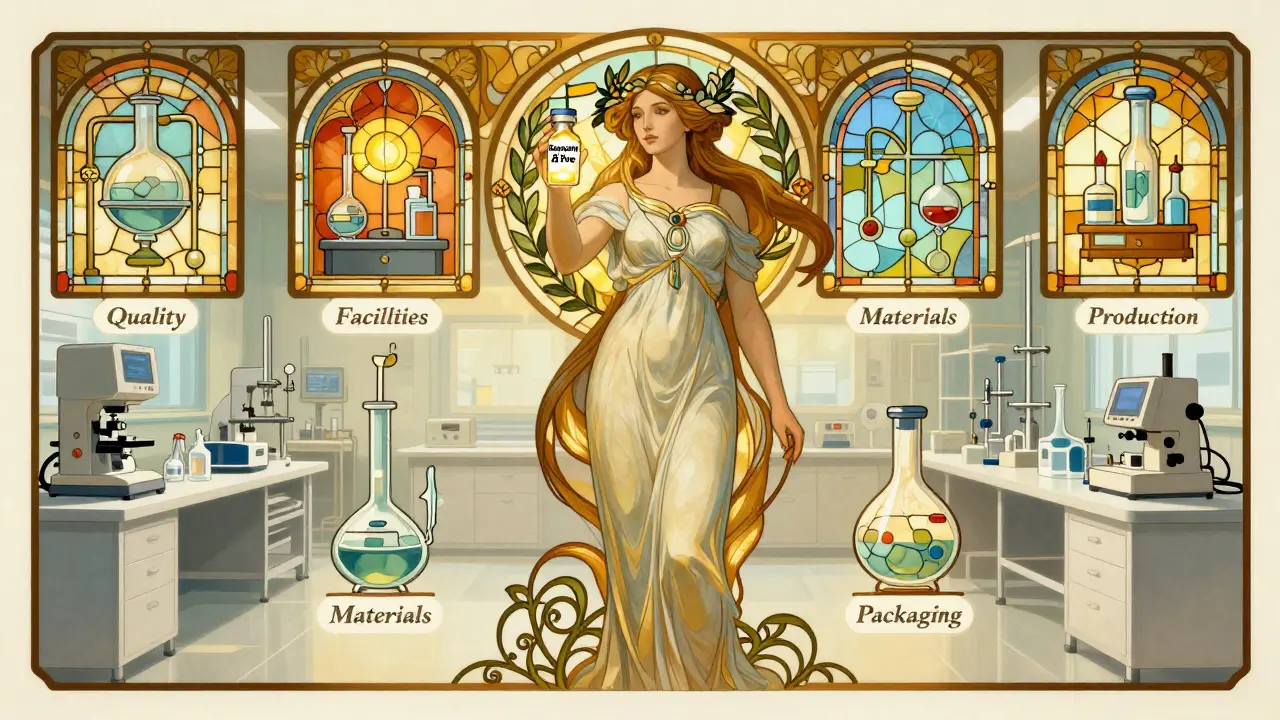
When the FDA shows up at your generic drug manufacturing facility, it’s not a surprise visit-it’s a systematic review of everything you do to make sure patients get safe, effective medicine. You don’t get a second chance to make a first impression, and the FDA knows it. They’re not there to shut you down. They’re there to confirm you’re doing what you said you’d do-and doing it right, every time.
Why the FDA Inspects Generic Drug Facilities
Every generic drug sold in the U.S. must meet the same strict standards as the brand-name version. That’s not just a slogan-it’s the law. The FDA’s job is to verify that your facility can consistently produce drugs that are bioequivalent, pure, and stable. It’s not about cost. It’s about control.
Since 2023, the FDA has used a risk-based model to pick which facilities get inspected. Sites with a history of problems, high-risk products, or sudden spikes in consumer complaints get prioritized. But even the cleanest facilities aren’t immune. Routine inspections happen every two to three years, and unannounced visits are becoming more common. You can’t just prepare when you know they’re coming. You have to be ready every day.
The Six Systems the FDA Looks At
The FDA doesn’t just walk through your plant and glance at a few records. They use a structured, six-system approach to evaluate your entire operation. Every inspection covers the Quality System-and at least two others. Here’s what they check:
- Quality System: This is non-negotiable. They’ll dig into your quality unit’s independence, authority, and documentation. Are you following 21 CFR 211.22(a)? That means your quality unit must have the power to stop production if something’s wrong. No exceptions.
- Facilities & Equipment: Is your cleanroom maintained? Are your equipment logs up to date? Did you validate that autoclave? They’ll check calibration records, cleaning procedures, and whether your layout prevents cross-contamination.
- Materials: Every raw material, from active ingredients to packaging, must be tested and approved. They’ll pull your supplier qualification files and ask: Did you test the lot? Is it stored properly? Is the certificate of analysis real?
- Production: Did your batch records match what actually happened? Were the parameters logged in real time? Did you document every deviation? They’ll compare your SOPs to your actual process-and if they don’t line up, you’re in trouble.
- Packaging & Labeling: One wrong label can cause a recall. They’ll check your labeling controls, barcode scanning logs, and whether your packaging area is segregated from production. Are you using the right lot numbers? Is the expiration date correct?
- Laboratory Control: This is where many facilities stumble. They’ll review your analytical methods, stability studies, and data integrity. Are your HPLC results traceable? Are raw data files backed up? Are you using electronic signatures properly?
It’s not about having perfect records-it’s about having honest, complete, and consistent ones. The FDA trains investigators to spot gaps. If your data looks too clean, it might be too fake.
What Happens During a Pre-Approval Inspection (PAI)
If you’re submitting a new generic drug application, expect a Pre-Approval Inspection. This isn’t a routine check-it’s a deep dive into whether your facility can actually make the product as described in your application.
The FDA team will focus on three questions:
- Is your facility ready for commercial production?
- Does your actual process match what you submitted?
- Is all your documentation complete and accurate?
They’ll walk through your production line and compare it to your application. If your SOP says the mixing time is 45 minutes, but your batch record says 30, that’s a red flag. If your stability samples are stored at 25°C but your application says 20°C, you’ll get an observation.
They’ll also check your analytical methods. Did you validate the test for impurities? Are your reference standards traceable? If your lab can’t prove the method works, your application gets delayed-or rejected.
The FDA 483 and What Comes After
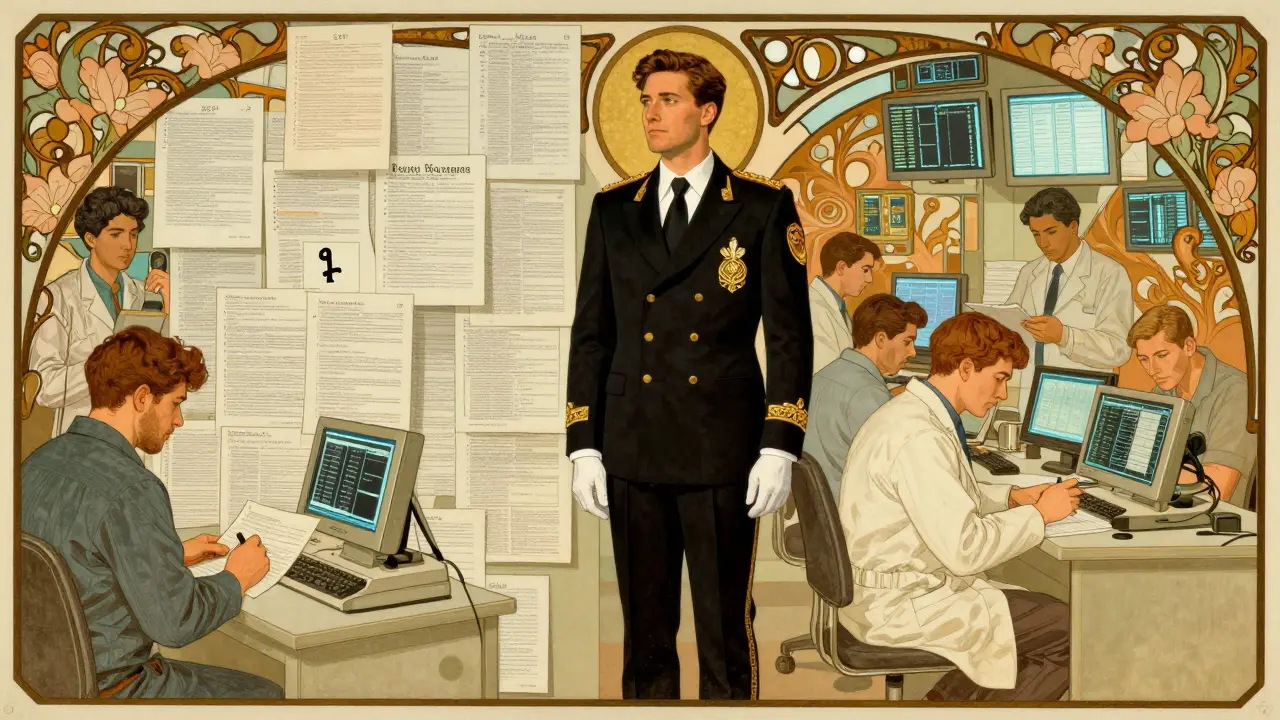
If the inspectors find problems, they’ll hand you a Form FDA 483. This isn’t a citation. It’s a list of observations-usually 3 to 15 items-ranked by severity. Common ones include:
- Lack of quality unit authority (21 CFR 211.22(a))
- Failure to investigate deviations (21 CFR 211.192)
- Inadequate validation of manufacturing processes (21 CFR 211.110)
- Missing or altered electronic records (21 CFR Part 11)
You have 15 business days to respond. Don’t wait. Don’t send a generic letter. Your response must be specific: what you found, why it happened, how you fixed it, and how you’ll prevent it again. Include evidence-updated SOPs, training logs, re-validation reports.
If the FDA thinks your response is weak, they may issue a warning letter. That’s serious. It can block your product approval or even lead to import alerts. But there’s a path forward. In June 2025, the FDA finalized guidance for Post-Warning Letter Meetings (PWLMs), giving you a direct line to regulators to discuss your corrective actions before they escalate.
How to Prepare-Beyond the Basics
Most companies think preparation means cleaning the floors and printing SOPs. That’s not enough. Real preparation means creating a culture of quality where every employee knows their role in compliance.
Here’s what actually works:
- Run mock inspections quarterly. Bring in an external auditor. Record the session. Watch where people hesitate or give vague answers.
- Designate an inspection area. A quiet room with a table, power outlets, and Wi-Fi. No interruptions. No coffee spills on documents.
- Train your staff. Not just QA. Everyone. Operators, maintenance, warehouse staff. If an inspector asks a lab tech why a batch was rejected, they should know the answer.
- Use the PreCheck program. Launched in 2024, this lets you submit detailed facility info-layout, quality systems, validation plans-before you even start production. The FDA gives feedback early. You fix issues before you invest millions.
- Document everything. Not just what you did, but why you did it. If you changed a process, document the risk assessment. If you had a deviation, show the root cause analysis.
The best-prepared facilities don’t just pass inspections-they impress them. The FDA notices when a company has mature quality systems. They notice when data integrity is built into the culture, not just enforced by policy.
What the Data Says
More than 90% of FDA inspections of generic drug facilities result in an ‘acceptable’ rating. That’s not luck. It’s discipline. Companies that treat compliance as a daily practice-not a checklist-consistently score higher.
But the bar is rising. In 2025, the FDA is increasing focus on data integrity and quality culture. Investigators are trained to spot manipulated data, missing metadata, or overly polished records that don’t match reality. They’re looking for the story your data tells-and if it doesn’t add up, they’ll find the gap.
Facilities that invest in quality management maturity-beyond basic compliance-see fewer observations and faster approvals. It’s not about spending more. It’s about spending smarter.
Final Thought: Be Ready Every Day
You can’t fake a quality culture. The FDA sees through it. If your team treats inspections as a threat, they’ll find problems. If your team treats them as a chance to prove you’re doing it right, they’ll walk away confident.
Generic drugs are the backbone of affordable healthcare. The FDA knows that. They’re not trying to punish you. They’re trying to protect patients. And if you’re committed to quality, you’re not just surviving inspections-you’re leading the industry.
What triggers an FDA inspection for a generic drug facility?
Inspections are triggered by a risk-based model. Factors include prior inspection history, product risk (like injectables or sterile products), consumer complaints, tips from whistleblowers, or if the facility is applying for a new drug approval. Routine inspections happen every 2-3 years, and unannounced visits are increasing.
What is a Form FDA 483?
Form FDA 483 is a list of observations made by FDA inspectors during an inspection. It’s not a warning letter-it’s a notice of potential violations. Each observation references a specific regulation, like 21 CFR 211.22(a). Companies have 15 business days to respond with corrective actions.
How long does an FDA inspection last?
Most inspections last 1-5 days, depending on facility size and complexity. Pre-Approval Inspections (PAIs) tend to be longer-often 3-7 days-because they involve deep reviews of application data, validation records, and process consistency.
Can the FDA shut down a facility?
Yes. If a facility has repeated serious violations, fails to respond adequately to a warning letter, or poses a direct risk to patient safety, the FDA can issue an import alert or seek a court order to halt operations. This is rare but possible for chronic non-compliance.
What is the PreCheck program?
Launched in 2024, the FDA’s PreCheck program lets manufacturers submit detailed facility plans-including layout, quality systems, and validation strategies-before construction or production begins. The FDA reviews the plan and gives feedback early, helping companies avoid costly redesigns and delays later.
Do I need to hire a consultant to pass an FDA inspection?
Not necessarily. Many facilities pass inspections without consultants by building strong internal quality systems. But if you’ve had prior issues, are new to FDA regulations, or are preparing for a Pre-Approval Inspection, a consultant with real FDA inspection experience can help you avoid common pitfalls and strengthen your response.
What happens if my response to the FDA 483 is rejected?
If the FDA finds your response inadequate, they may issue a warning letter. This can delay product approval, block imports, or lead to a follow-up inspection. You can request a Post-Warning Letter Meeting (PWLM) to discuss next steps. The FDA finalized guidance for PWLMs in June 2025 to make this process clearer.
Is it true that the FDA checks data integrity?
Yes. Data integrity is now a top priority. Inspectors check for deleted files, unexplained changes in electronic records, missing audit trails, and inconsistent timestamps. They’ll ask for raw data from HPLC, spectrophotometers, and other instruments. If you can’t show the original data, you’re at risk.
10 Comments
Been through a few of these inspections. The key isn't just having the docs right-it's making sure the guy running the mixer actually understands why it matters. Too many places treat compliance like a paperwork exercise.
Y'all are underestimating how much the FDA now digs into raw data files-like, actual chromatograms, not just the pretty graphs you print out. I saw a facility get slammed last year because their HPLC audit trail had gaps. They thought no one would notice. Big mistake. 😤
Let me tell you something-most facilities think they're ready until the FDA asks for the original electronic log from the autoclave run in March 2023. Then they panic. You can't fake a culture of quality. You either live it or you're just putting on a show. And the FDA? They've seen every trick in the book. They don't care if your floors shine. They care if your deviation logs tell the truth. If your data looks too clean, it's probably cooked. I've reviewed 47 inspection reports in the last 18 months. Every single one of the worst offenders had the same pattern: perfect records, zero real accountability, and a QA team that was too scared to say no to production. The ones who pass? They don't prep for the inspection. They live like they're always being watched. And yeah, it's exhausting. But it's the only way to keep people from getting poisoned by a bad batch of metformin because someone cut corners. The FDA isn't your enemy. The enemy is complacency. And right now, too many plants are sleeping at the wheel.
They say it's about safety but let's be real-this is all about control. The FDA doesn't want you to succeed. They want you to depend on them. That PreCheck program? It's a trap. They gather your whole system before you even start. Then they use it to block you later. And don't get me started on electronic records. They're watching every keystroke. Someone's got to be leaking this data to them. Who else would know exactly which files to check?
Mock inspections work. Do them quarterly. Train everyone. Document everything. That's it.
What's interesting is how many facilities treat the 483 as a failure rather than feedback. The FDA doesn't come to punish-they come to see if you're learning. If your response is just a list of fixes without context, they'll know you didn't dig deep enough. Real change starts when someone asks why the deviation happened, not just how to fix it. The best plants I've seen don't just fix the problem-they rebuild the system that let it happen.
21 CFR 211.22(a) is non-negotiable. The quality unit must have authority. Period. If your QA reports to operations, you're already in violation. No amount of shiny floors or polished SOPs can mask that structural failure. And let's not pretend that electronic signatures under 21 CFR Part 11 are optional. I've seen 12 facilities get warning letters last year alone for audit trail manipulation. If your LIMS doesn't lock records after submission, you're not compliant-you're gambling with patient safety. This isn't theory. It's codified law. And the FDA's new data integrity focus? It's not a trend. It's the new baseline. If you're still using paper logs for critical processes in 2026, you're not just behind-you're legally indefensible.
I've worked in plants where the operators didn't know what bioequivalence meant. That's not their fault-it's leadership's. If you want inspections to go well, start with the people on the floor. Make them feel like they're part of the mission, not just a checkbox. That changes everything.
Just got back from a facility in Gujarat that passed with zero observations. They didn't have fancy software or consultants. They had daily huddles, open-door QA, and every shift leader could explain their SOPs in their own words. The FDA inspector said, 'I didn't see perfection-I saw integrity.' That's the goal.
Thank you for this comprehensive overview. It is truly insightful. The emphasis on culture over compliance resonates deeply. One must remember that patient safety is the ultimate objective. 🙏