
Every year, Americans fill over 4 billion prescriptions for generic drugs. These medications make up 90% of all prescriptions but cost just 23% of what brand-name drugs do. Behind this massive access to affordable medicine is a quiet but powerful system: the Generic Drug User Fee Amendments, or GDUFA. This isn’t just a bureaucratic program-it’s the financial engine that keeps the FDA’s generic drug review machine running. Without it, waiting months-or even years-for a generic version of a life-saving drug to hit the market would be the norm, not the exception.
How GDUFA Keeps the FDA Working
Before 2012, the FDA’s generic drug review process was slow, unpredictable, and underfunded. Companies submitted applications for generic versions of brand-name drugs, but the agency often took 30 to 36 months just to respond. Many applications sat untouched for years. The system was drowning in paperwork, with no clear way to pay for the staff, inspections, or technology needed to process them. That changed with GDUFA, passed as part of the Food and Drug Administration Safety and Innovation Act in 2012. The idea was simple: let generic drug manufacturers pay fees to help fund the FDA’s review of their applications. It’s not a bribe. It’s not a shortcut. It’s a performance-based funding model. The FDA still makes approval decisions based on science, safety, and quality. But now, it has the resources to do so faster. Today, about 75% of the budget for the FDA’s Office of Generic Drugs comes from these user fees. That means companies pay for the reviewers who read their data, the inspectors who check their factories, and the IT systems that track every submission. Without these fees, the FDA would have to rely almost entirely on Congress for funding-and that money hasn’t kept up with demand.The Four Types of Fees
GDUFA doesn’t charge one flat fee. It’s broken into four clear categories, each tied to a specific part of the approval process:- Application fees: Every time a company submits a new generic drug application (called an ANDA), they pay $124,680 in FY 2023. This covers the cost of reviewing the chemistry, manufacturing, and clinical data.
- Program fees: Every company with an approved generic drug pays $385,400 annually. This helps fund the overall infrastructure-staff, training, compliance, and oversight.
- Facility fees: If a factory makes the active ingredient or the final pill, and it’s referenced in an approved application, the facility pays $25,850 per year. This ensures manufacturing sites meet quality standards.
- DMF fees: A Drug Master File (DMF) contains detailed info about ingredients or processes. If a company references a new DMF in their application, they pay $25,850. This helps the FDA review the source material before approving the drug.
These fees are updated yearly and adjusted for inflation. The FDA publishes exact amounts in its annual guidance documents. Companies pay through an online system called EUF, and deadlines are strict. Missing a payment can delay or even block approval.
Why This Matters for Patients
The real impact of GDUFA isn’t in the numbers-it’s in the pills on pharmacy shelves. Before GDUFA, the average time to approve a generic drug was over 3 years. Today, the FDA aims to review 60% of original applications within 15 months. In 2021, they hit 52%-a big improvement from the pre-GDUFA era, even if they missed the target. More approvals mean more competition. More competition means lower prices. Since GDUFA started, the number of generic drugs approved each year has jumped by 22%. That’s thousands of new options for patients. For example, when the patent expired for a popular cholesterol drug, four generic versions hit the market within 18 months thanks to faster reviews. The price dropped by over 80%. The Federal Trade Commission estimates GDUFA has helped save consumers $1.7 trillion over the past decade. That’s not a guess-it’s based on tracking price drops after generic entries. When a generic arrives early, brand-name companies can’t keep prices high.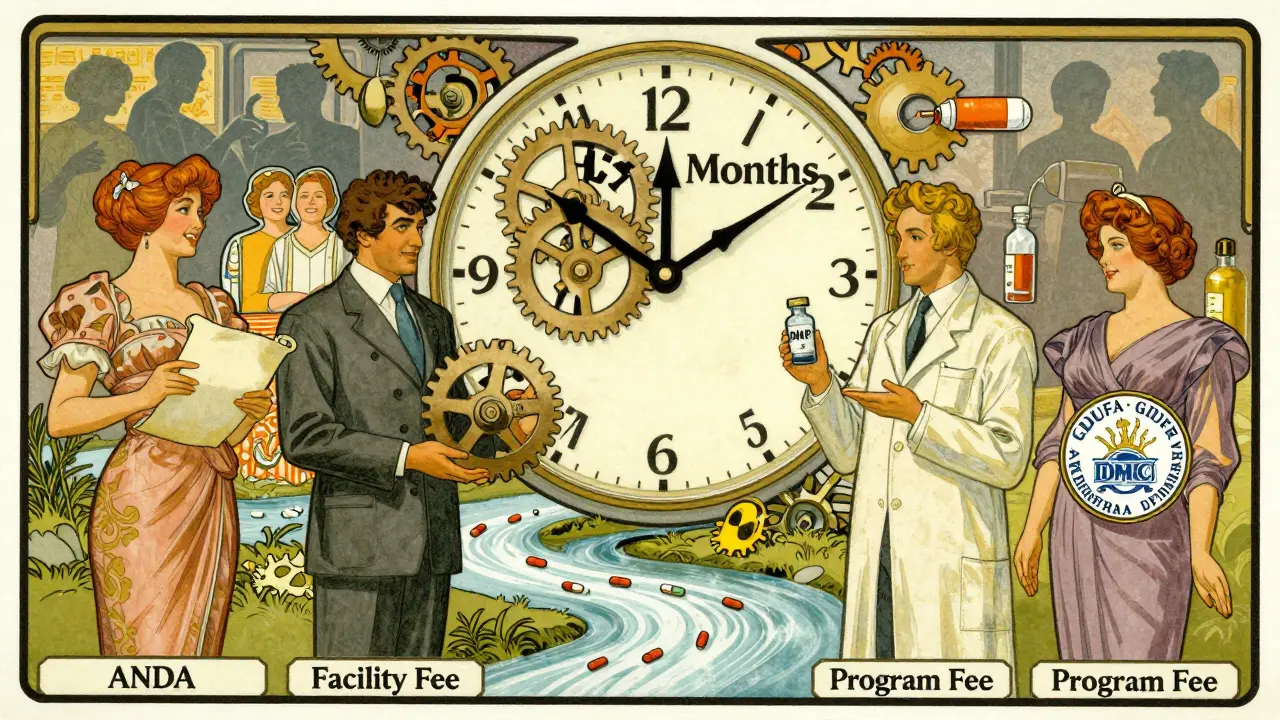
Who Pays and Who Struggles
The biggest generic manufacturers-Teva, Mylan, Sandoz-pay millions in fees each year. But they also have dozens of approved drugs and multiple factories. For them, the fees are a predictable cost of doing business. Smaller companies don’t have the same cushion. A small manufacturer with just one facility and three approved drugs might pay over $300,000 a year in fees. That’s a huge chunk of their budget. In a 2022 comment to the FDA, the Generic Pharmaceutical Association pointed out that 75% of small firms operate only one facility, making the facility fee disproportionately heavy. One company told the FDA their facility fee alone was 15% of their annual regulatory budget. That meant they couldn’t expand production, even when demand grew. The FDA offers a 75% fee reduction for qualifying small businesses, but only 18 such reductions were granted in 2022. Many small firms don’t even know they qualify-or find the paperwork too confusing.What’s Still Broken
GDUFA has fixed a lot, but not everything. A major problem is the backlog of old applications. Before GDUFA, over 1,500 generic drug applications were stuck in limbo. Even today, some of those are still pending. The FDA has pledged to clear them all by September 2024, but progress has been slow. Another gap? Over-the-counter (OTC) drugs. GDUFA doesn’t cover them. That’s a $117 billion market-think pain relievers, antacids, cough syrups. These products follow different rules and aren’t reviewed by the same team. Critics say this creates a two-tier system where prescription generics get fast reviews, but common OTC drugs don’t. There’s also the issue of transparency. While 85% of industry respondents say GDUFA improved communication, 40% still struggle to understand how fees are calculated for affiliated companies. If two companies share ownership, the FDA treats them as one entity for fee purposes. But figuring out who’s connected to whom isn’t always clear.
What’s Next for GDUFA
GDUFA III runs through 2027. But conversations are already happening about GDUFA IV. One big idea: expand the program to include OTC drugs. A Congressional report estimated that could bring in $150-200 million more per year. Another proposal: use real-world data-like patient outcomes from electronic health records-to inform post-market safety checks. That could help catch problems faster. The FDA is also working on a new tool: DMF completeness assessments. Before, a company would submit a drug application and wait months to find out if the ingredient data was incomplete. Now, manufacturers can submit just the DMF first. The FDA reviews it separately and gives feedback before the full application is even filed. This cuts delays and saves companies time and money. The Congressional Budget Office says GDUFA is one of the most cost-effective programs the FDA runs. For every dollar the agency spends on generic reviews, it gets $1.20 back in fees. That’s why experts expect it to be renewed again in 2032.What You Should Know
If you’re a patient, GDUFA means faster access to cheaper drugs. If you’re a manufacturer, it’s a complex but necessary system. If you’re a policymaker, it’s proof that industry funding can improve public health without compromising safety. The bottom line: GDUFA isn’t perfect. But it’s working. It turned a broken, slow system into one that’s predictable, transparent, and scalable. And for millions of Americans who rely on generic drugs every day, that’s everything.What is GDUFA and how does it affect generic drug approval?
GDUFA stands for the Generic Drug User Fee Amendments. It’s a program that lets generic drug manufacturers pay fees to fund the FDA’s review of their applications. Before GDUFA, it took 3 to 3 years to approve a generic drug. Now, the FDA aims to approve 60% of applications within 15 months. The fees pay for reviewers, inspections, and systems, making the process faster and more predictable without changing the scientific standards for approval.
Who pays the user fees under GDUFA?
Generic drug manufacturers pay the fees. This includes companies that submit applications for generic drugs, own manufacturing facilities that produce active ingredients or finished pills, or hold Drug Master Files (DMFs) that contain ingredient details. The fees are assessed based on the number of applications, facilities, and DMFs linked to each company. Affiliated companies are treated as a single entity for fee purposes.
How much do generic drug companies pay in fees each year?
In FY 2023, the fees were: $124,680 per ANDA application, $385,400 annual program fee per company, $25,850 per manufacturing facility referenced in an approved application, and $25,850 per DMF referenced. Large companies with multiple products and factories pay hundreds of thousands to millions annually. Small firms may pay over $300,000, which can be a significant burden.
Do GDUFA fees guarantee faster approval?
No. Fees don’t guarantee approval or speed up the scientific review. The FDA still evaluates each application based on safety, quality, and effectiveness. But the fees give the agency the resources to hire more reviewers, improve communication, and reduce backlogs-leading to faster decisions overall. In FY 2021, 52% of applications were approved within 15 months, up from under 20% before GDUFA.
Why doesn’t GDUFA cover over-the-counter (OTC) drugs?
GDUFA was designed specifically for prescription generic drugs submitted through ANDAs. OTC drugs follow a different regulatory path under the OTC monograph system, which hasn’t been included in GDUFA yet. This creates a gap: while prescription generics get fast reviews, common OTC products like ibuprofen or antacids don’t. Experts are pushing to expand GDUFA to cover OTCs, which could generate over $150 million annually in new fees.
13 Comments
I’ve been on a generic cholesterol med for years, and I never thought about how it got to the shelf. Knowing the FDA actually has funding to review these properly? That’s a relief. Feels good to know science isn’t getting buried under paperwork.
It’s wild how something so technical-user fees-ends up saving people thousands. I work with low-income patients, and this program? It’s literally the difference between them taking their meds or not. Thanks for highlighting this.
Look, I’m not some industry shill, but honestly? GDUFA is one of those rare government programs that actually works. Before this, we were waiting three years for generics just because Congress forgot to fund the FDA. Now? They’ve got staff, they’ve got systems, they’ve got deadlines. It’s not perfect, sure-but it’s functional. And in Washington? That’s practically a miracle. I’ve seen the backlog reports. The fact they cleared half of it in under a decade? That’s not luck. That’s accountability.
Okay, so I’m not a doctor, but I read a lot, and I’ve been following this for years. The thing people don’t get? It’s not that the FDA is slow because they’re lazy. It’s because they’re underfunded. And yes, companies pay fees-but those fees go to pay for inspectors, reviewers, IT systems. Not bonuses. Not travel. Not new SUVs. The FDA doesn’t even get to keep the extra money-it all goes back into the system. And if you think this is a corporate giveaway? Look at the numbers: 1.7 trillion saved. That’s not a trickle. That’s a flood. And small businesses? Yeah, they struggle. But the 75% discount exists. They just need help navigating the form. Maybe the FDA should send someone to walk them through it. Like, a real person. Not a website.
Let me be perfectly clear: this is not capitalism. This is corporatism. Private companies paying the government to expedite approval? That is not oversight. That is regulatory capture. The FDA was created to protect the public-not to become a toll booth for Big Pharma. The fact that we celebrate this as a "success" reveals the rot at the heart of American governance. We’ve traded integrity for efficiency. And efficiency, my friends, is just a euphemism for profit.
THIS. IS. HUGE. I’ve been screaming about this for years. People think generics are cheap because they’re "inferior"-NO. They’re cheap because the system finally got its act together. GDUFA didn’t lower standards. It raised speed. And speed means competition. Competition means prices crash. I’ve seen a $500 brand-name drug drop to $8 after generics hit. That’s not magic. That’s policy. And if we expand this to OTCs? Imagine ibuprofen at $1 a bottle. That’s not a dream. That’s the next step. Let’s do it.
While the GDUFA framework exhibits a superficial efficacy in streamlining ANDA submissions, one must interrogate the structural asymmetries embedded within its fee-tiered architecture. The facility fee, in particular, functions as a de facto barrier to market entry for SMEs, effectively entrenching oligopolistic control by vertically integrated conglomerates such as Teva and Sandoz. Furthermore, the absence of OTC inclusion constitutes a regulatory blind spot of alarming magnitude, given the pharmacoeconomic weight of self-care therapeutics. A holistic recalibration-perhaps via a tiered sliding-scale fee model anchored to revenue brackets-is not merely advisable; it is ontologically imperative.
Y’all act like this is some noble public service. Nah. This is corporate welfare with a side of bureaucracy. Companies pay fees? Cool. But they pass those costs right to us in higher drug prices. And don’t get me started on how they game the system-splitting facilities into "independent" entities just to dodge fees. The FDA’s "transparency"? Ha. I’ve read their guidance docs. It’s written like a legal thriller. If you’re not a lawyer or a CPA, you’re lost. And the fact they’re still sitting on 1,500 old apps? That’s not progress. That’s negligence. Wake up. This isn’t fixing the system. It’s just making it more expensive to play.
I am from India and we have so many generic drug makers here-like Cipla and Sun Pharma-and they export to USA. So I am happy to see that FDA is finally working faster. But I think USA should also help small Indian companies with fee waivers, because they are the ones who really bring prices down. Also, why not include OTC? I buy cough syrup and painkillers every month, and I don’t understand why they are left out. This is not fair. Please fix this. Thank you for sharing.
So… like… I read this whole thing and I’m just sitting here wondering… who’s paying for the reviewers’ coffee? Like, is it included? Do they get snacks? Do they get mental health days? I mean, imagine reviewing 150 applications a week. That’s not a job. That’s a trauma. And they’re just… sitting there? In cubicles? With no windows? I need to know this. I need to know if they have a break room. I need to know if they have a vending machine with kombucha. This is the real story.
My grandma takes five generics. She used to wait six months for refills. Now it’s two weeks. That’s it. That’s the whole story.
Just want to say-this program? It’s a game-changer. I work in pharmacy, and I’ve seen the shift. Before GDUFA? We’d get calls from patients asking why their med wasn’t available. Now? We get calls asking if there’s a cheaper version. That’s progress. And yeah, the fees are confusing. I’ve messed up payments myself. But the system? It’s better. Way better. And honestly? If we can expand it to OTCs? Do it. I’ll take 100mg ibuprofen for $0.10. Bring it on.
Look, I’ve been in this game for 20 years. I’ve seen the old days-paper applications, faxed forms, reviewers who didn’t even have email. We’d wait two years just to get a rejection letter. GDUFA? It didn’t just speed things up-it gave us dignity. Now we know when we’ll hear back. We know what’s expected. We know who to talk to. That’s not just efficiency. That’s respect. And yeah, small companies struggle. But here’s the thing: the FDA’s small biz discount? It’s real. You just gotta ask. And if you don’t? That’s on you. Stop blaming the system. Start using the tools. The system’s not broken. It’s just waiting for you to show up.