
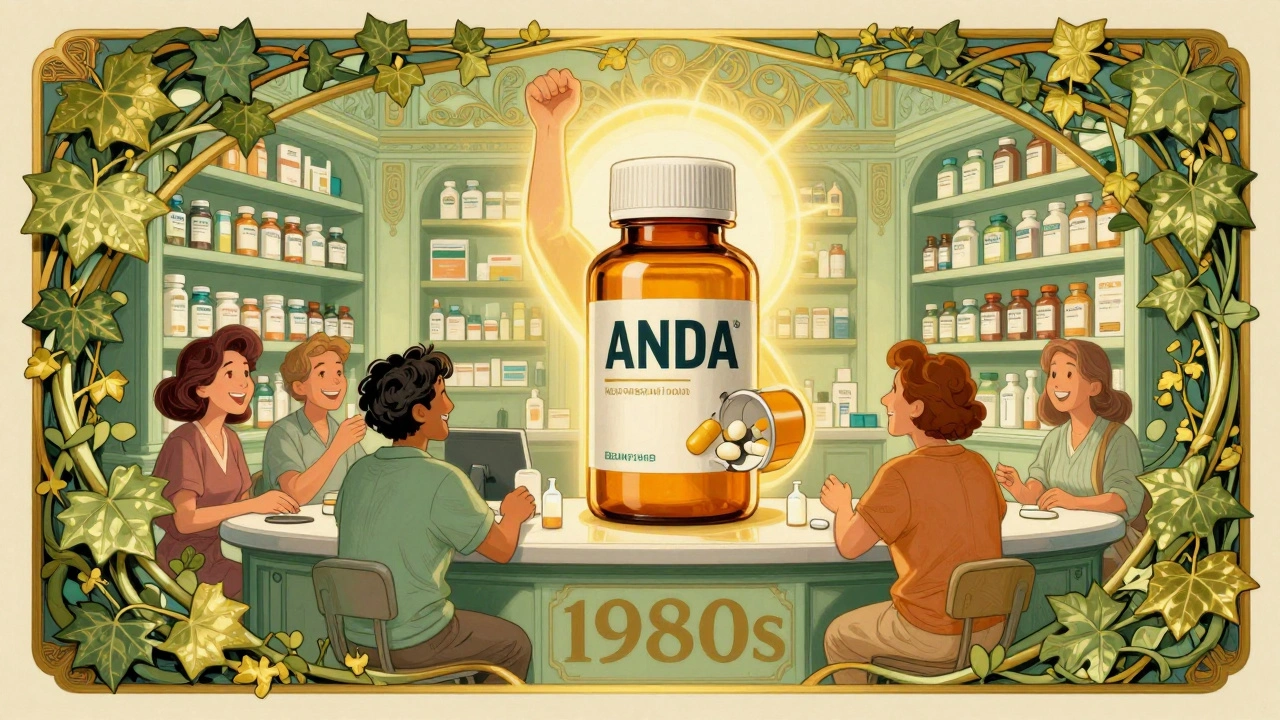
The Hatch-Waxman Act didn’t just change how drugs are approved in the U.S.-it saved billions and made life-saving medications affordable for millions. Before 1984, if you wanted to make a generic version of a brand-name drug, you had to start from scratch: run your own clinical trials, prove safety and effectiveness all over again, even though the original drug had already been approved by the FDA. That meant generic drugs were rare, expensive, and slow to reach patients. The Hatch-Waxman Act fixed that. It created a smarter, faster, and fairer system that lets generic manufacturers skip the redundant trials and get their versions to market quickly-without compromising safety.
How the Hatch-Waxman Act Works
The law, officially called the Drug Price Competition and Patent Term Restoration Act of 1984, introduced a new type of application called the Abbreviated New Drug Application, or ANDA. This is the backbone of the entire system. Instead of repeating clinical trials, generic makers only need to prove two things: their drug is chemically identical to the brand-name version, and it gets absorbed into the body at the same rate and amount. That’s called bioequivalence. The FDA requires that the generic’s blood levels fall within 80% to 125% of the brand’s-meaning it works the same way in your body.To do this, companies run small studies with healthy volunteers, measuring how quickly the drug enters the bloodstream and how long it stays there. These studies cost a fraction of full clinical trials. In 1984, developing a generic drug cost around $2.6 million. Today, it’s closer to $5-10 million-but that’s still 90% less than developing a brand-new drug.
The Orange Book and Patent Listings
The FDA publishes a public list called the Orange Book: Approved Drug Products with Therapeutic Equivalence Evaluations. Every brand-name drug company must list every patent that could block a generic from entering the market. This includes not just the main patent on the active ingredient, but also secondary patents on how the drug is made, packaged, or used. As of 2024, the Orange Book lists over 18,000 approved drugs, with an average of 3.5 patents per drug by the time generics enter the market.This transparency is critical. Generic companies use the Orange Book to figure out exactly when they can legally launch. But here’s where things get tricky. Generic applicants must file one of four patent certifications with their ANDA:
- Paragraph I: No patents listed.
- Paragraph II: Patents have expired.
- Paragraph III: We’ll wait until the patent expires.
- Paragraph IV: The patent is invalid or we won’t infringe it.
Paragraph IV is the game-changer. It’s the only one that triggers a legal showdown. When a generic company files a Paragraph IV certification, it’s essentially challenging the brand’s patent. That’s when the clock starts ticking on the 180-day exclusivity period.
The 180-Day Exclusivity Rule
The Hatch-Waxman Act gives the first generic company to file a successful Paragraph IV certification 180 days of exclusive rights to sell their version. No other generic can be approved during that time. This is a huge incentive. It means the first filer can capture most of the market before competitors arrive-and prices haven’t dropped yet.Companies have gone to extreme lengths to be first. In the early 2000s, generic manufacturers would camp outside FDA offices, waiting to submit applications the moment they were allowed. In 2003, the FDA changed the rules: if two companies file on the same day, they share the exclusivity. That reduced the chaos, but the race is still fierce.
And it works. Over 90% of brand-name drugs face generic competition within one year of patent expiration. In many cases, the first generic version drops the price by 80-90% almost overnight. A drug that costs $500 a month can become $50. That’s the power of competition.
Patent Litigation and the 30-Month Stay
When a generic company files a Paragraph IV certification, the brand-name manufacturer has 45 days to sue for patent infringement. If they do, the FDA is legally required to delay approval of the generic for up to 30 months. This is called the 30-month stay.On paper, it’s meant to protect patent rights. In practice, it’s often used as a delay tactic. The average patent lawsuit takes 31 months to resolve-meaning the stay can block a generic from entering the market even after the patent expires. That’s why some critics call it a loophole. Brand companies have used it to extend monopolies beyond their legal rights.
There’s another problem: “pay-for-delay” deals. Sometimes, the brand company pays the generic maker to delay its launch. The FTC has challenged dozens of these deals, calling them anti-competitive. In 2013, the Supreme Court ruled these settlements could be illegal if they’re meant to keep generics off the market. But they still happen.
Who Benefits?
The numbers speak for themselves. Since 1984, the U.S. generic drug market has grown from 19% of prescriptions to over 90% today. Generic drugs make up just 23% of total drug spending, meaning they save the system hundreds of billions each year. The Congressional Budget Office estimates the Hatch-Waxman Act has saved the U.S. healthcare system $1.7 trillion in the last decade alone.For patients, that means real savings. Medicare Part D beneficiaries saved an average of $3,200 per person in 2023 because they filled prescriptions with generics. For people on fixed incomes, chronic conditions, or multiple prescriptions, that’s life-changing.
Generic manufacturers like Teva, Viatris, and Sandoz built their businesses on this system. They invest millions in legal teams, regulatory experts, and bioequivalence studies-not because they want to, but because the law gives them a clear path to compete.

Where the System Falls Short
The Hatch-Waxman Act was designed for simple, small-molecule drugs-pills and capsules you swallow. It doesn’t work as well for complex drugs like biologics, which are made from living cells. That’s why Congress passed the Biologics Price Competition and Innovation Act (BPCIA) in 2010 to create a separate pathway for biosimilars.Another issue: “patent thickets.” Brand companies file dozens of minor patents-on packaging, dosing schedules, or manufacturing methods-to keep generics out. It’s legal, but it delays competition. The FDA has started pushing back, especially after the CREATES Act of 2019, which forces brand companies to provide samples to generic makers for testing. Some brand companies refused to share samples, blocking generic development. Now, the FDA can penalize them.
Drug shortages are also a growing concern. In 2023, 283 generic drugs were in short supply, often because manufacturing is outsourced overseas and quality control slips. The FDA is working on better oversight, but it’s not easy.
What’s Next?
The Hatch-Waxman Act is 40 years old, and the pharmaceutical world has changed. More drugs are complex. More patents are stacked. More companies are trying to game the system. But the core idea still works: if you can prove your drug is the same, you should be able to sell it.The FDA’s Generic Drug User Fee Amendments (GDUFA) III, implemented in 2023, is helping. It’s cut average ANDA review times from 36 months in 2012 to just 18 months today. More approvals. Faster access. Lower prices.
Congress is also looking at reforms. Some lawmakers want to limit the 30-month stay. Others want to crack down harder on pay-for-delay deals. But the real challenge is adapting the law for the next generation of drugs-like gene therapies and personalized medicines. The Hatch-Waxman Act wasn’t built for those. But its spirit-balancing innovation with access-still guides the conversation.
What is the Hatch-Waxman Act?
The Hatch-Waxman Act is a 1984 U.S. federal law that created a streamlined process for approving generic drugs through the Abbreviated New Drug Application (ANDA). It allows generic manufacturers to rely on the brand-name drug’s safety and effectiveness data, cutting development costs and time. It also gives brand companies patent term extensions to encourage innovation, balancing competition with incentives for research.
How does a generic drug get approved under Hatch-Waxman?
A generic company files an ANDA with the FDA, proving its drug has the same active ingredient, strength, dosage form, and route of administration as the brand-name version. It must also show bioequivalence through pharmacokinetic studies, demonstrating that the drug is absorbed into the body at the same rate and extent as the original. No new clinical trials are needed.
What is the Orange Book?
The Orange Book is a public list published by the FDA that includes all approved drug products and the patents associated with them. Generic manufacturers use it to identify which patents they must address before launching a generic version. Only patents listed in the Orange Book can be used to block generic approval under Hatch-Waxman.
Why does the first generic company get 180 days of exclusivity?
The 180-day exclusivity is an incentive for generic companies to challenge weak or invalid patents. Filing a Paragraph IV certification is expensive and risky-it often leads to lawsuits. The exclusivity period rewards the first company to take that risk by letting them be the only generic on the market for six months, giving them a chance to capture market share before others enter.
Can brand-name companies delay generic entry?
Yes. Through the 30-month stay, brand companies can delay generic approval by filing a patent lawsuit. They can also use strategies like patent thickets or pay-for-delay deals, where they pay a generic maker to postpone its launch. While some of these practices are legally challenged, they still occur and can delay patient access.
How much money has the Hatch-Waxman Act saved?
The Congressional Budget Office estimates the Hatch-Waxman Act has saved the U.S. healthcare system $1.7 trillion over the past decade. In 2023 alone, generic drugs saved the system $158 billion. For Medicare Part D beneficiaries, the average annual savings per person was $3,200.
Final Thoughts
The Hatch-Waxman Act isn’t perfect. It’s been stretched, gamed, and challenged. But it still works. It’s the reason you can buy a month’s supply of a heart medication for $4 instead of $400. It’s why pharmacies stock generics on nearly every shelf. And it’s why the U.S. leads the world in generic drug access.It’s not just law-it’s a system that turned competition into a public health tool. And as long as people need affordable medicine, it will keep doing that job.
8 Comments
Wow, I never realized how much this law actually affects my monthly prescriptions. My mom’s blood pressure med went from $380 to $12 last year-no joke. I just assumed generics were always cheap, but now I see it’s because of this 1984 law. Thanks for laying it out so clearly.
It’s amusing, really, how the public romanticizes this legislation as some kind of altruistic triumph-when in reality, it’s a carefully engineered compromise between Big Pharma and Big Generic, both of whom profit immensely while the average patient remains blissfully unaware of the legal gymnastics behind their $4 pills. The 180-day exclusivity? A corporate loophole dressed up as incentive. And don’t even get me started on pay-for-delay deals… 🤦♂️
Interesting to see how this system works compared to the UK’s NHS model-we don’t have patent extensions or 180-day exclusivity, but we do have bulk purchasing and price caps. The result? Cheaper drugs, slower approvals, but no one’s fighting over who files first. Still, the US system gets more generics out faster. 🇬🇧🇺🇸
I work in pharmacy tech and can confirm: when a generic hits the market after a Paragraph IV, the line at the counter goes nuts. People are literally cheering. One guy bought 3 months of his diabetes med and cried because it was $18 instead of $420. This law saves lives daily. 🙏
Let’s be real-this whole system is a circus. Generic companies file Paragraph IVs not because they believe the patent is invalid, but because they know the brand will settle to avoid a long trial. Then they get the 180 days and jack up prices before anyone else can enter. It’s not competition-it’s a rigged game where the only winners are the lawyers.
And don’t tell me about ‘saving billions’-those savings are theoretical. I’ve seen patients who got their meds cut off because the generic manufacturer went bankrupt after the exclusivity ended. This isn’t healthcare policy-it’s Wall Street arbitrage with a stethoscope.
Every time I hear someone praise Hatch-Waxman, I want to scream. You think this is about access? It’s about control. The Orange Book? A weapon. The 30-month stay? A delay tactic. The 180-day exclusivity? A monopoly with a handshake. And the FDA? They’re just the bouncer letting the rich kids into the club. This isn’t a public health win-it’s a legal loophole designed to keep profits high and innovation low. And now they’re trying to extend it to biologics? Please. We’re not fixing the system-we’re gluing more duct tape to a sinking ship.
Meanwhile, real people are skipping doses because they can’t afford the co-pay on the ‘generic’ that just got a 20% price hike after exclusivity ended. This isn’t justice. It’s capitalism with a medical license.
It is a profound moral failure of contemporary American governance that we must rely on a 40-year-old legislative compromise to ensure basic access to life-sustaining pharmaceuticals. The fact that we celebrate the existence of a $4 pill as a triumph of public policy-rather than lamenting the fact that a $400 pill ever existed-is indicative of a societal descent into moral complacency. The Hatch-Waxman Act does not represent progress; it represents the minimum viable ethical baseline for a civilization that still believes in property rights more than human rights. One cannot be proud of having stumbled into decency.
And yet, here we are-still letting brand companies control the supply chain. I’ve seen it firsthand: a generic company gets approved, the brand company refuses to sell them the reference drug for testing, and the FDA does nothing. The CREATES Act? A joke. They still drag their feet for months. And now the FDA’s review time is down to 18 months? That’s still 1.5 years of patients waiting for affordable meds. This isn’t reform-it’s rearranging deck chairs on the Titanic. Someone needs to shut down the patent thickets. Permanently.