

Depression doesn’t just make you feel down-it makes you forget to take your pills
If you’re managing a chronic condition like heart disease, diabetes, or high blood pressure, taking your meds every day isn’t optional. But if you’re also dealing with depression, that daily routine becomes a mountain. It’s not laziness. It’s not defiance. It’s the brain chemistry of depression quietly sabotaging your ability to stick to treatment.
Studies show people with depression are 2.3 times more likely to miss doses of critical medications like ACE inhibitors, beta-blockers, or diabetes drugs. That’s not a small risk. That’s a life-threatening gap. And it’s happening far more often than most doctors realize.
Depression doesn’t just cause sadness-it breaks your memory, focus, and motivation
Most people think non-adherence means someone just forgets. But depression doesn’t just make you forget-it makes it harder to plan, decide, or even care enough to try.
When your brain is flooded with stress hormones and low serotonin, simple tasks like opening a pill bottle or setting a phone reminder feel overwhelming. Research from the NIH shows depression impairs concentration, slows decision-making, and drains the energy needed for self-care. It’s not that patients don’t know they should take their meds. It’s that they physically can’t muster the mental effort to do it.
One study found that patients with moderate to severe depression were more likely to skip doses not because they felt better, but because they believed nothing would help. That hopelessness isn’t a personality flaw-it’s a symptom. And it’s one that directly interferes with treatment.
Here’s what non-adherence looks like in real life
Look for these patterns in patients-or in yourself-if you’re managing both depression and a long-term illness:
- Missing doses for several days in a row, then suddenly taking double the amount
- Running out of medication earlier than expected, with no refill request
- Saying “I feel fine, so I don’t need it” after just a few weeks
- Stopping meds because of side effects like drowsiness, dry mouth, or weight gain-common with antidepressants and heart meds
- Ignoring refill reminders or avoiding doctor visits
These aren’t signs of rebellion. They’re signs of depression. A 2017 study in Ethiopia found 57% of patients on antidepressants stopped taking them because of side effects like fatigue and weight gain. But here’s the twist: those same side effects are often worsened by depression itself. The brain amplifies discomfort when you’re already low. What feels unbearable to someone with depression might be mild to someone without it.
Use these tools to spot the problem early
There are two simple, validated tools that can reveal if depression is hurting adherence. Use them together.
The PHQ-9 is a nine-question depression screen. A score of 10 or higher means moderate depression-and that’s the threshold where adherence problems start climbing sharply. For every 5-point increase on the PHQ-9, adherence drops by about 23%.
The MMAS-8 is an 8-question scale that measures how often someone misses doses. Scores under 6 mean non-adherent. Scores under 8 mean inconsistent adherence. Only a score of 8 means full adherence.
When you combine them, you get a powerful picture. A 2021 Columbia University study showed that using both tools together improved prediction accuracy by 37% compared to using either one alone. That’s not just useful-it’s life-saving.
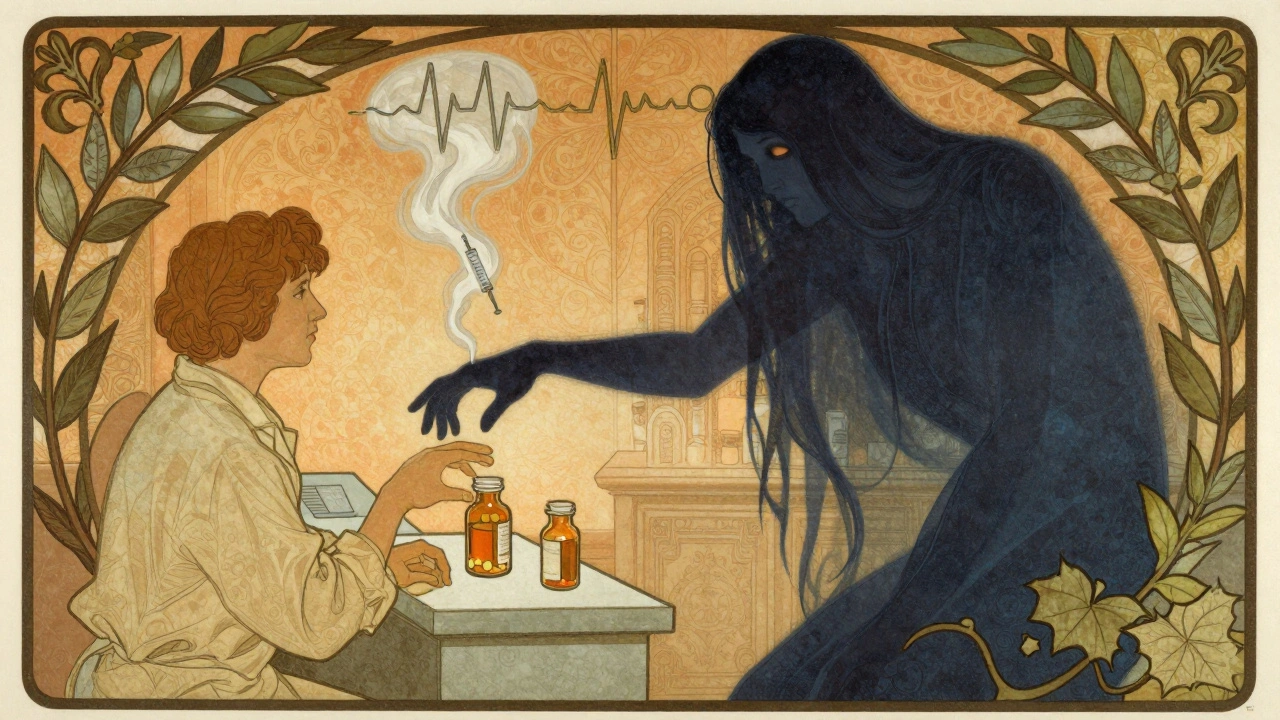
Side effects aren’t just physical-they’re emotional
Depression changes how you experience side effects. A dry mouth or slight dizziness might feel unbearable when you’re already exhausted and hopeless.
One study from Spain used the GARSI scale to measure how patients rated their side effects. Non-adherent patients scored significantly higher on side effect severity-even when their actual symptoms were no worse than those who stayed on treatment. Their depression made the side effects feel worse.
That’s why simply telling someone “the side effects will pass” doesn’t work. You need to map them. Ask patients to track daily: “On a scale of 1 to 10, how bad is your fatigue today? How about your mood?” Look for patterns. If fatigue spikes right after taking a pill and mood crashes at the same time, that’s a red flag.
What works: Real solutions that get people back on track
There’s no magic fix. But there are proven approaches that work.
Collaborative care-where a care team includes a depression specialist, pharmacist, and primary doctor-boosts adherence by nearly 30%. The MAPDep study in Spain showed that when patients and doctors reviewed adherence together every month, people stayed on meds longer and felt better faster.
Simple reminders help, but only if they’re tied to emotional support. A text message saying “Your pill is ready” isn’t enough. A message that says, “I know today’s hard. You’ve got this. Your meds are waiting,” makes a difference.
Medication simplification is another key. If someone’s on five pills a day, reduce it to two. Combine meds where possible. Fewer pills = fewer decisions = less mental load.
And don’t underestimate the power of asking: “Have you been able to take your meds like we talked about?” Not “Are you taking your meds?” That sounds like judgment. This sounds like curiosity. And curiosity opens the door.
Early warning signs: What to watch for in the first two weeks
It’s not enough to wait until someone misses a month of pills. The damage starts early.
The STAR*D trial found that patients who missed more than 20% of their doses in the first two weeks were nearly five times more likely to have treatment failure. That’s a critical window.
At the first sign of missed doses-especially if the patient is also scoring above 10 on the PHQ-9-act fast. Don’t wait for a full-blown crisis. Adjust the regimen. Offer support. Reassess the meds. Depression isn’t a barrier to treatment-it’s part of the treatment plan.

What’s changing: New tools on the horizon
Smartphone apps that track both mood and pill intake are showing promise. One 2024 study found these apps could predict missed doses 72 hours in advance with 82% accuracy. That’s not science fiction-it’s happening now.
Neuroimaging research is also uncovering brain patterns linked to both depression and adherence. The dorsolateral prefrontal cortex, a region tied to decision-making, shows less activity in people with depression who skip meds. In the next few years, we may see tools that detect this pattern before the person even realizes they’re struggling.
The World Health Organization is investing $15 million to build standardized recognition tools for low-resource areas. This isn’t just a Western issue. It’s global.
Final thought: It’s not about compliance-it’s about connection
Depression doesn’t make people bad patients. It makes them tired, overwhelmed, and disconnected-from their health, their goals, and sometimes, themselves.
Recognizing the link between depression and medication adherence isn’t about finding fault. It’s about seeing the real enemy: not the patient, not the meds, but the illness that steals the will to care.
When you spot the signs-low PHQ-9 scores, erratic refill patterns, complaints about side effects, sudden disengagement-you’re not just managing a disease. You’re reaching out to someone who’s drowning. And sometimes, that’s the only thing that brings them back to the surface.
Can depression cause someone to stop taking their heart medication?
Yes. Studies show depressed patients with heart failure are 2.3 times more likely to miss doses of critical medications like ACE inhibitors, beta-blockers, and diuretics. Depression doesn’t just affect mood-it impairs memory, motivation, and decision-making, making it harder to follow complex treatment plans.
What’s the best way to measure if someone is adhering to their meds?
The Morisky Medication Adherence Scale (MMAS-8) is the most widely used and validated tool. A score below 6 means non-adherent, below 8 means moderate adherence, and 8 means fully adherent. It’s quick, free, and works in any clinical setting.
How does depression make side effects feel worse?
Depression amplifies physical sensations. A dry mouth or mild dizziness that’s tolerable for most becomes overwhelming when you’re already exhausted and hopeless. Research shows non-adherent patients rate side effects as significantly more severe-even when objective symptoms are the same as those who stay on treatment.
Should I screen all patients with chronic illness for depression?
Yes. The American Heart Association recommends screening all heart failure patients with the PHQ-2 at every visit, followed by PHQ-9 if positive. The same logic applies to diabetes, hypertension, and other chronic conditions. Depression is common, often hidden, and directly impacts treatment success.
What’s the quickest way to improve adherence in someone with depression?
Simplify the regimen. Reduce pill burden, combine medications where possible, and pair reminders with emotional support. A 2023 study showed that when patients and doctors reviewed adherence together monthly, adherence jumped by 28.5%. Connection matters as much as the medicine.
Are there apps that help track depression and medication use?
Yes. Emerging smartphone apps that track both mood and pill intake have shown 82% accuracy in predicting missed doses 72 hours in advance. These tools are still being tested but offer real potential for early intervention, especially in remote or low-resource settings.
Can improving depression treatment improve medication adherence?
Absolutely. When depression symptoms improve-through therapy, medication, or both-adherence improves too. One 2024 study found that patients in collaborative care models saw better mood scores and higher adherence over 12 months. Treating depression isn’t separate from treating the physical illness-it’s part of it.
What to do next
If you’re a patient: Talk to your doctor about how you’ve been feeling-not just physically, but emotionally. Bring your pill bottle. Show them your refill history. Let them know if side effects feel unbearable. You’re not being difficult-you’re being honest.
If you’re a clinician: Start with the PHQ-9 and MMAS-8. Don’t wait for a crisis. Screen early. Simplify regimens. Ask open questions. Track patterns. You’re not just prescribing pills-you’re helping someone fight a silent battle.
Depression doesn’t care if you’re taking your blood pressure meds. But you can care enough to notice-and act.
14 Comments
This is such bullshit. People just don't want to take their meds because they're lazy. Stop making excuses for them. Depression? Yeah right. I've got a job, kids, and a dog to walk every day and I still take my pills. Stop coddling people.
Also, who the hell says 'meds' like it's a dirty word? Just say medication. You sound like a college student writing a paper.
There's something profoundly human here. We treat the body like a machine-take the pill, fix the leak, reset the system. But the mind? It's not a switch. It's a storm. And when the storm's inside you, even the simplest act-opening a bottle-feels like climbing Everest in a snowstorm. This isn't about compliance. It's about survival. And we've been measuring survival with a ruler made of judgment.
Maybe the real question isn't 'why won't they take their pills?' but 'why have we stopped seeing them as people?'
Ugh. Another feel-good article pretending depression is some mysterious force. It's not. It's just poor discipline. If you can scroll TikTok for 3 hours, you can set a phone alarm. Stop romanticizing non-adherence as some tragic brain chemistry thing. It's just laziness with a fancy label.
The PHQ-9 and MMAS-8? Cute. But let's be real-these tools were designed by Western academics who've never seen a rural clinic in India where patients choose between food and meds. You think a 9-question survey helps when someone's skipping meals to afford insulin? This is performative medicine. The real solution? Universal healthcare. Not more checklists.
People who don't take their meds are just selfish. They don't care about their families or the cost to the system. If you're too depressed to take a pill you're too depressed to be alive. Just say it.
This hit me so hard 😭 I've been on blood pressure meds for 5 years and I missed 3 weeks last winter. Not because I forgot. Because I just didn't care. And then one day I saw my mom crying because she thought I was dying. That's when I started again. I'm not proud. But this? This is the first time someone put my silence into words. Thank you.
America is falling apart because people think feelings are facts. You don't need a PHQ-9 you need a boot up the ass. My grandpa had diabetes and heart disease and he took his pills every damn day even when he was 90 and half blind. You think he had a therapist? No. He had grit. We need more grit not more apps.
I just want to say you're not alone. I've been there. I stopped my meds for 6 months because the side effects felt like my body was betraying me. But then I started journaling and talking to my pharmacist-not my doctor, my pharmacist-and it changed everything. You don't have to fix it all at once. Just take one pill today. That's enough. You're doing better than you think 💪
In my community in Kenya, we don't have apps or PHQ-9s. But we have neighbors. We have church groups. We have elders who ask, 'Did you eat today? Did you take your medicine?' It's not about technology. It's about belonging. When someone remembers you, you remember yourself. This article misses that. The real tool is human connection.
YES YES YES. I'm a nurse and I see this every day. People think we're judging them when we ask about meds. But we're not. We're terrified for them. You're not broken. You're not lazy. You're just fighting a war no one else can see. Keep going. I see you. 💖
I think the article is really thoughtful. I especially liked the part about collaborative care. My sister was in a program like that and it made all the difference. She said it felt like someone finally understood her instead of just telling her what to do. That kind of support matters more than we realize.
The neurocognitive load associated with polypharmacy in comorbid depressive disorders is significantly exacerbated by executive dysfunction. Mitigation requires multimodal intervention: pharmacologic simplification, behavioral activation via cue-dependent prompting, and affective validation to reduce attribution bias toward nonadherence. The MMAS-8 remains the gold standard for operationalizing adherence metrics in clinical workflows.
You know what they don't tell you? The government is using these apps to track your behavior. They want to know when you're not taking your meds so they can raise your insurance rates. Or worse-label you 'noncompliant' and cut your benefits. This isn't healthcare. It's social control. They're watching. Always watching.
Wow. You actually believe that? So now we're supposed to feel sorry for people who can't even manage a pill? Maybe if they weren't so addicted to their phones and Netflix they'd have the focus to take their meds. This is why America is falling apart.