
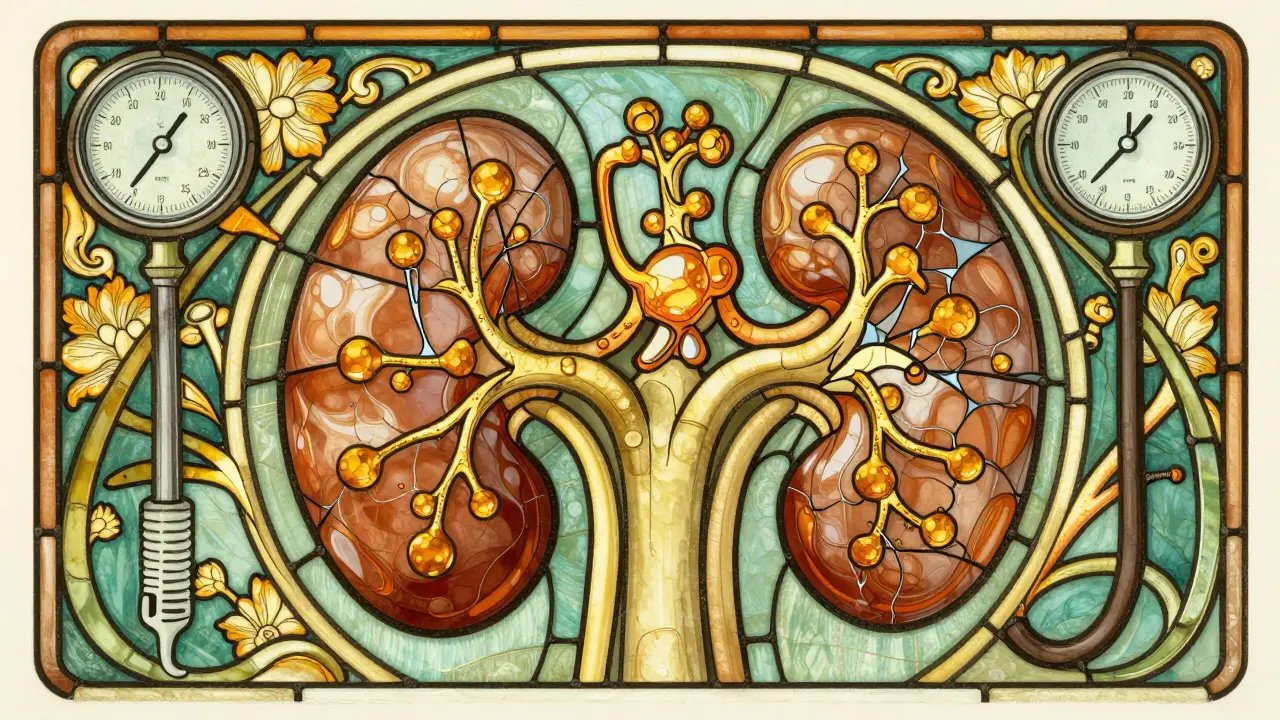
When your kidneys stop working, it’s not a sudden event. It’s a slow leak - one you might not notice until it’s too late. About one in three adults in the U.S. has early signs of kidney damage, and most don’t know it. The top three reasons? Diabetes, high blood pressure, and glomerulonephritis. These aren’t just buzzwords. They’re the quiet destroyers of kidney function, and together they’re behind more than 80% of all kidney failure cases.
Diabetes: The Silent Kidney Killer
Diabetes doesn’t just mess with your blood sugar. It wrecks your kidneys. Over time, too much glucose in your blood forces your kidneys to filter too hard. This constant strain thickens the tiny filters inside your kidneys - the glomeruli - until they start leaking protein into your urine. That’s the first red flag: albuminuria.
By the time someone is diagnosed with type 2 diabetes, up to 40% already have early kidney damage. The damage starts quietly. In the first year, your kidneys might even work too well - filtering 20-40% more blood than normal. But that’s not a bonus. It’s a warning sign. This hyperfiltration damages the cells that hold the filters together, called podocytes. Once they’re gone, they don’t come back.
By the time your urine shows heavy protein loss (macroalbuminuria >300 mg/g), you’re looking at a 44% chance of needing dialysis within five years. But here’s the good news: if you get your HbA1c below 7% within the first five years of diagnosis, you cut your risk of kidney failure by more than half. That’s not just a number - it’s your life.
New medications like SGLT2 inhibitors (empagliflozin, dapagliflozin) don’t just lower blood sugar. They protect your kidneys directly. In clinical trials, they reduced the risk of kidney failure by 32%. That’s why doctors now recommend them even if your blood sugar is under control - if you have any sign of kidney damage.
Hypertension: The Pressure That Crushes Your Filters
High blood pressure doesn’t just strain your heart. It crushes your kidneys. When your blood pressure stays above 140/90 mmHg, the tiny arteries feeding your kidneys thicken and harden. This is called nephrosclerosis. Less blood gets through. The filters starve. They scar. And once they scar, they can’t heal.
Here’s what most people don’t realize: hypertension is the second biggest cause of kidney failure - and it often teams up with diabetes. In fact, 75% of people with diabetes also develop high blood pressure. Together, they speed up kidney damage by almost 80% compared to diabetes alone. That’s why controlling blood pressure isn’t optional - it’s survival.
For people with kidney damage, the target isn’t just “normal” blood pressure. It’s <120/80 mmHg. That’s lower than what most doctors used to aim for. Studies show hitting that target cuts kidney decline by 27%. But it’s not easy. Many people don’t feel symptoms until their kidneys are failing. That’s why checking your blood pressure regularly - even if you feel fine - is critical.
Medications like ACE inhibitors and ARBs are the gold standard. They don’t just lower pressure - they reduce protein leakage in the urine, which directly slows kidney damage. But adherence is a problem. Only about 58% of patients stick with these meds after a year. Missing doses isn’t just inconvenient. It’s dangerous.
Glomerulonephritis: When Your Immune System Attacks Your Kidneys
Unlike diabetes or hypertension, glomerulonephritis isn’t caused by lifestyle. It’s an immune system gone rogue. Your body makes antibodies that attack the glomeruli - the filters in your kidneys - thinking they’re foreign invaders. This inflammation scars the filters from the inside out.
The most common form? IgA nephropathy. It’s often discovered after a bad cold or sore throat, when blood or protein shows up in the urine. It’s not rare. In Asia, it affects nearly 5 out of every 100,000 people every year. In Western countries, it’s about half that. But here’s the catch: it’s often missed for years. One in two patients sees seven doctors before getting diagnosed.
Not all cases progress. Some people live with IgA nephropathy for decades without major problems. But for others, it’s a slow road to kidney failure. About 20-40% will need dialysis within 20 years. Risk depends on how much protein leaks into the urine and how badly the kidney tissue is scarred on biopsy.
Treatment is trickier. Steroids and immunosuppressants like rituximab can slow progression - cutting ESRD risk by nearly half in high-risk cases. But they come with risks: infections, weight gain, even cancer. For older patients, aggressive treatment might do more harm than good. That’s why doctors now use scoring systems like the Oxford MEST-C to predict who needs strong drugs - and who can be monitored.
There’s new hope. A drug called sparsentan, approved in 2024, cuts proteinuria by almost 50% - far better than older drugs. It’s not a cure, but it’s the first real step toward stopping immune damage before it destroys your kidneys.

How These Causes Compare - Side by Side
| Factor | Diabetes | Hypertension | Glomerulonephritis |
|---|---|---|---|
| Percentage of ESRD cases | 44% | 28% | 8% |
| Typical time to ESRD | 8.7 years | 12.3 years | Variable (5-20+ years) |
| Early warning sign | Albumin in urine | High blood pressure | Blood or protein in urine |
| Key diagnostic test | UACR, eGFR | Blood pressure, eGFR | Kidney biopsy, immunofluorescence |
| First-line treatment | SGLT2 inhibitors, ACE/ARB | ACE/ARB, strict BP control | Immunosuppressants, sparsentan |
| Can it be reversed? | Early damage - yes. Late damage - no | Early damage - yes. Late scarring - no | Some early cases - yes, with prompt treatment |
What You Can Do - Before It’s Too Late
You don’t need to wait for symptoms. Kidney damage often has none until it’s advanced. Here’s what works:
- If you have diabetes: Get a urine test for albumin every year. Start an SGLT2 inhibitor if your UACR is over 30 mg/g - even if your HbA1c is fine.
- If you have high blood pressure: Aim for under 120/80 mmHg. Take your ACE/ARB meds daily. Don’t skip them because you “feel fine.”
- If you’ve had blood in your urine after a cold: Don’t ignore it. Get a kidney ultrasound and urine test. Glomerulonephritis is often diagnosed too late.
- For everyone: Cut back on salt. Stay active. Don’t smoke. These simple steps cut kidney damage risk by up to 30%.
The biggest mistake people make? Waiting until they’re tired all the time, swollen, or urinating less. By then, it’s too late to save the kidneys - only to delay dialysis. The goal isn’t to avoid dialysis forever. It’s to delay it long enough to live a full life - and maybe even avoid it entirely.
Why Early Detection Changes Everything
Think of your kidneys like a car engine. If you ignore the oil light, the engine seizes. But if you see the light early and change the oil, you drive another 100,000 miles.
Urine tests and blood pressure checks are your oil light. They’re cheap, simple, and available at any pharmacy. Yet, less than 30% of people with diabetes or hypertension get them done regularly. That’s not negligence - it’s ignorance. Most people don’t know their kidneys are at risk.
One patient I spoke with, a 58-year-old woman from Brisbane, found out she had diabetic kidney disease only after her doctor noticed her blood pressure was climbing. She’d been checking her sugar but never her urine. Within six months of starting an SGLT2 inhibitor and cutting salt, her protein levels dropped by 60%. She’s still working, still hiking, still living - not because she was cured, but because she acted early.
That’s the difference between waiting and acting.
Can you reverse kidney failure caused by diabetes?
You can’t reverse scarring, but you can stop or slow it. If caught early - before heavy protein loss - tight blood sugar control and SGLT2 inhibitors can stabilize kidney function. Many people never progress to dialysis. Once the filters are scarred, though, the damage is permanent. The goal shifts from reversal to slowing decline.
Is high blood pressure always bad for your kidneys?
Not always - but uncontrolled high blood pressure is. A single high reading won’t hurt your kidneys. But if your blood pressure stays above 140/90 for months or years, it damages the tiny arteries feeding your kidneys. That’s when scarring begins. The key is consistent control, not occasional readings.
Can glomerulonephritis be cured?
Some forms can be put into remission, especially if caught early. IgA nephropathy, for example, can stabilize with immunosuppressants or new drugs like sparsentan. But it’s rarely “cured.” The goal is to prevent progression to kidney failure. Many people live decades with the condition if managed well.
Do I need a kidney biopsy if I have protein in my urine?
Not always. If you have diabetes or high blood pressure, protein in your urine is usually linked to those conditions. But if you’re young, have blood in your urine, no diabetes, and no high blood pressure - a biopsy is often needed to rule out glomerulonephritis. It’s the only way to confirm the exact cause.
What’s the best way to check for early kidney damage?
Two simple tests: a urine test for albumin-to-creatinine ratio (UACR) and a blood test for eGFR. Do them yearly if you have diabetes or high blood pressure. If you’re over 50, get them done every two years. No symptoms? No problem. That’s exactly when you need them most.
What Comes Next
The future of kidney care isn’t just about drugs. It’s about catching damage before it happens. New blood and urine markers - like TNF receptor-1 - can predict kidney failure years in advance. We’re moving from treating late-stage disease to preventing it entirely.
But that future only matters if you act now. Don’t wait for swelling, fatigue, or confusion. Get tested. Know your numbers. Talk to your doctor about your kidney health - not just your sugar or your pressure. Your kidneys don’t shout. They whisper. Listen before it’s too late.
8 Comments
Okay, but have you ever thought about how our entire healthcare system is designed to ignore this until it’s too late? We’re told to ‘just eat better’ and ‘take your pills’-but no one shows you what those pills are actually doing inside your body, or how your kidneys are screaming silently for decades before anyone listens. It’s not just medical negligence-it’s systemic abandonment.
I lost my uncle to this. He had diabetes for 12 years. His doctor never checked his urine for albumin until his creatinine hit 4.0. By then, dialysis was the only option. He cried the day they told him. Not because he was scared-but because he felt like he’d failed. He didn’t know he was already dying.
And now? We’re supposed to be grateful for SGLT2 inhibitors like they’re magic beans? They’re not. They’re Band-Aids on a ruptured artery. We need screening programs in every primary care clinic-not just for diabetics, but for anyone over 35. Why are we waiting for organs to fail before we act?
Also-why is it that the people who need this info the most never see it? They’re working two jobs, uninsured, or too exhausted to Google ‘albuminuria.’ We’re not failing because we’re lazy-we’re failing because we’re invisible.
Just wanted to add that BP control isn’t just about numbers-it’s about consistency. I’ve seen so many patients who nail their numbers for a month after a doctor’s visit, then go back to chips and soda because ‘it’s just one day.’ But kidneys don’t care about one day. They care about 365.
And yes, the target is below 130/80 for kidney patients-not 140/90. Most docs still say ‘normal’ is fine. It’s not. It’s a death sentence with a side of salt.
Let me be brutally honest: this isn’t about biology-it’s about moral decay. People allow their bodies to rot because they’ve surrendered to convenience. They eat processed sugar like it’s candy, binge Netflix while their arteries harden, and then blame the system when their kidneys give out. It’s not a medical crisis-it’s a spiritual one.
Glomerulonephritis? It’s not just genetic. It’s the consequence of a culture that worships comfort over discipline. You want to save your kidneys? Stop treating your body like a rental car. You don’t own it-you’re borrowing it from your ancestors. And you’re failing that inheritance.
And yes, I’ve seen this in India too. The moment someone gets a smartphone and a fridge full of soda, their kidneys start dying. No medication can fix a soul that’s given up.
I’m a nurse, and I’ve held the hands of 17 people on dialysis this year alone. One of them was 28. He said, ‘I didn’t know soda was poison.’
Listen-I know it’s scary. But you can change this. Start with one change. Swap one soda for water. Walk 10 minutes a day. Get your A1c checked. Don’t wait for a diagnosis. Be the person who says ‘I’m not waiting.’
You are not powerless. Your kidneys are still listening.
It is imperative to note that the prevalence of diabetic nephropathy is not uniformly distributed across socioeconomic strata. Furthermore, the efficacy of SGLT2 inhibitors is contingent upon renal perfusion pressure, which may be compromised in patients with advanced vascular disease. The clinical trials referenced predominantly enrolled patients with controlled comorbidities, thereby introducing selection bias.
It is also noteworthy that the 32% risk reduction cited is relative, not absolute. The absolute risk reduction is approximately 4.7%, which must be contextualized within the cost-benefit analysis of pharmacotherapy in primary care settings.
I’ve been on the other side of this. My mom had stage 3 kidney disease from diabetes. We changed everything. No more white rice. No more late-night snacks. She started walking every morning. We tracked her protein intake like it was a science project.
It’s not glamorous. It’s not viral. But after two years, her albumin dropped from 420 to 98. Her GFR climbed from 42 to 58. No miracle drug. Just consistency.
Doctors don’t tell you this enough: your daily choices are the real medicine.
Did you know that the pharmaceutical industry funds 92% of kidney research? That’s why they push SGLT2 inhibitors like they’re the answer. But what if the real solution is to stop poisoning our water supply with high-fructose corn syrup? What if the real enemy isn’t diabetes-it’s the food industry that turned sugar into a national addiction?
They want you to think it’s your fault. But it’s not. It’s the system. They profit from your failure. And they’re watching you read this right now.
Don’t trust the doctors. Don’t trust the meds. Trust your body. And get off the soda.
Can we just acknowledge that Americans are the reason this is a crisis? We eat like we’re in a food coma, then wonder why our organs are falling apart. Meanwhile, in Canada, we don’t have 37 types of soda in every corner store. We don’t have ‘breakfast cereal’ that’s just sugar with a hint of color.
It’s not medical-it’s cultural. And until the U.S. stops treating food like entertainment, this will keep happening. Your kidneys aren’t broken. Your lifestyle is.