
Why biosimilars aren’t just generics with a fancy name
When you hear "generic drug," you probably think of a cheap, identical copy of a brand-name pill. That’s straightforward-same chemicals, same pill press, same results. But biosimilars? They’re not like that at all. A biosimilar isn’t a copy of a biologic drug-it’s a highly similar version made in living cells, not a lab beaker. And that difference changes everything.
Biologics, the original drugs, are made from living organisms: bacteria, yeast, or mammalian cells engineered to produce complex proteins like antibodies. Think of them as handmade gourmet meals cooked in a temperature-controlled kitchen with exact ingredients and timing. A biosimilar tries to recreate that same meal-but without knowing the recipe, the cook’s technique, or even what kind of stove was used. That’s the core challenge: the process defines the product. Change the process even slightly, and the final molecule can behave differently in the body.
The glycosylation problem: tiny sugars with huge consequences
One of the biggest headaches in biosimilar manufacturing is glycosylation. That’s the process where sugar molecules (glycans) attach to the protein backbone of a biologic. These sugars aren’t just decoration-they control how the drug moves through the body, how long it lasts, and how strongly it binds to its target.
Even a small shift in glycosylation can turn a safe, effective drug into one that triggers an immune reaction or clears from the bloodstream too fast. The problem? Glycosylation is wildly sensitive. Tiny changes in temperature, pH, oxygen levels, or even the type of nutrient mix fed to the cells can alter the sugar patterns. A batch made in a 1,000-liter bioreactor might have a different glycan profile than one made in a 100-liter tank-even if everything else is identical.
Manufacturers don’t just guess at the right profile. They use advanced mass spectrometry and chromatography to map out the exact glycosylation fingerprint of the original biologic. Then they spend years tweaking their own process-changing cell lines, feeding strategies, and harvest times-to match it. And they have to prove it works, every single time.
Scaling up: what works in a lab doesn’t work in a factory
Getting a biosimilar to work in a 5-liter lab bioreactor is one thing. Getting it to work in a 20,000-liter commercial tank is another. The physics changes. Mixing isn’t uniform. Oxygen doesn’t dissolve the same way. Heat spreads unevenly. Cells in a big tank experience different stress levels than those in a small one.
Imagine trying to bake the same cake in a home oven and a commercial bakery oven. Same recipe, different results. That’s what happens in biosimilar scale-up. Manufacturers have to rebuild the entire process from scratch-adjusting stirring speed, gas flow rates, and nutrient delivery-to make sure the cells "feel" the same environment at every scale.
Many smaller companies can’t afford the capital investment. Big bioreactors, specialized sensors, and cleanroom expansions cost tens of millions. And even if they can afford it, space is tight. Not every facility has room for 10,000-liter tanks. Some have to build new halls just to fit the equipment.
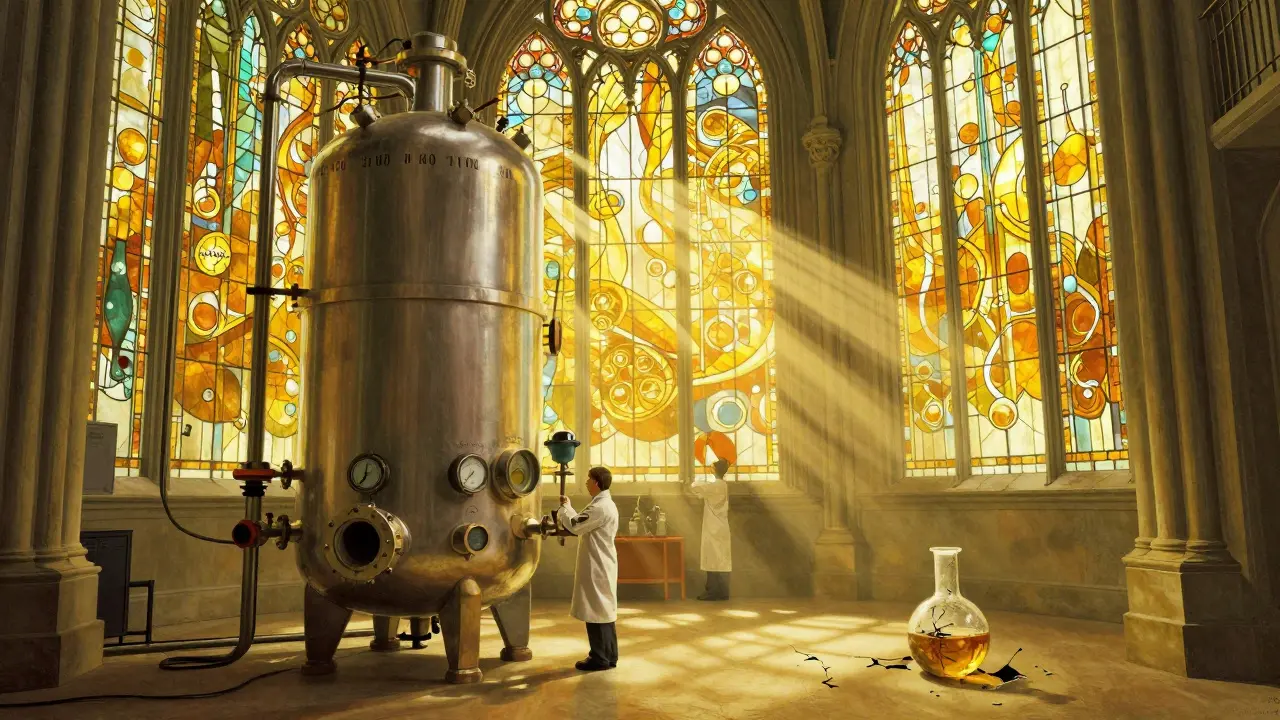
The cold chain nightmare: one spill, millions lost
Biosimilars are fragile. They can’t be left sitting out. They need constant refrigeration-from the moment they’re harvested until they’re injected into a patient. That’s called the cold chain. And it’s a major point of failure.
During filling, transport, or storage, a single punctured bag, a broken freezer, or a delayed shipment can ruin an entire batch. These aren’t pills you can repackage. These are living molecules. Once they degrade, they’re useless. And because each batch can cost $500,000 to produce, losing one isn’t just expensive-it’s a supply chain crisis.
Some manufacturers now use single-use, pre-sterilized bags and containers to reduce handling. Others are automating filling lines so humans don’t touch the product. But even then, logistics remain a nightmare. Shipping a biosimilar from Europe to Australia requires multiple temperature monitors, backup coolers, and strict documentation. One missed checkpoint, and the whole shipment gets tossed.
Regulatory maze: proving similarity without a blueprint
Getting a biosimilar approved isn’t like getting a generic approved. For generics, you just prove you have the same active ingredient. For biosimilars, you need to prove you’re nearly identical in structure, function, purity, and safety-across dozens of tests.
Regulators like the FDA and EMA require a mountain of data: analytical studies comparing over 100 quality attributes, preclinical studies in animals, and often clinical trials in patients to show no meaningful difference in effectiveness or side effects. And the rules keep changing. In 2023, the FDA updated its guidance to demand even more detailed structural analysis, especially for newer biosimilars like bispecific antibodies.
Companies need state-of-the-art labs with $2 million instruments just to run the tests. And they need scientists who know how to interpret the data. Many startups can’t afford this. That’s why the market is dominated by big players like Amgen, Samsung Bioepis, and Sandoz-companies with deep pockets and decades of biologics experience.

Technology is helping-but it’s not a magic fix
Manufacturers aren’t sitting still. They’re using new tools to fight complexity.
Single-use bioreactors are replacing stainless steel tanks. No more cleaning validation. No more cross-contamination. Faster changeovers. That’s huge for flexibility.
Process Analytical Technology (PAT) lets them monitor the process in real time. Sensors track pH, dissolved oxygen, and even cell health as the batch runs. If something starts to drift, the system can adjust automatically-before the product is compromised.
Artificial intelligence is stepping in too. Machine learning models analyze years of manufacturing data to predict which parameters will cause batch failures. Some companies now use AI to simulate how changes in feed rate might affect glycosylation-saving months of trial and error.
But these tools aren’t cheap. And they require expertise. A company can buy the latest automated system, but if they don’t have the right people to run it, it’s just a fancy paperweight.
The future: more complexity, more competition
The biosimilar market is exploding. It was worth $7.9 billion in 2022 and could hit $58 billion by 2030. More patents are expiring on blockbuster biologics like Humira and Enbrel. That’s good news for patients who need cheaper drugs.
But the barrier to entry keeps rising. Newer biosimilars-like antibody-drug conjugates or multi-specific antibodies-are even harder to make. They need extra purification steps, refolding techniques, and complex chemical attachments. Each step adds risk. One mistake, and the whole batch fails.
Smaller manufacturers are getting squeezed. Without the resources to invest in automation, AI, and global regulatory teams, they’re being pushed out. Expect consolidation. Big companies will buy up smaller ones-or build their own facilities.
The winners will be those who master three things: precision in manufacturing, agility in scaling, and depth in regulatory strategy. The rest? They’ll struggle to keep up.
Why this matters to you
If you’re a patient, biosimilars mean lower drug costs. If you’re a healthcare provider, they mean more affordable treatment options. If you’re in the industry, they mean a high-stakes game where one tiny change in a bioreactor can cost millions-and maybe even lives.
Understanding that biosimilars aren’t just "generic biologics" is key. They’re a triumph of science, engineering, and patience. And they’re far more complex than most people realize.
10 Comments
bro why is everyone acting like this is some sci-fi movie?? it's just proteins with sugar on them. i thought we were making medicine, not alchemy. 🤡
This is a remarkably well-articulated overview of the complexities involved in biosimilar development. The emphasis on glycosylation and scale-up challenges highlights the nuanced nature of biopharmaceutical manufacturing. It is imperative that regulatory frameworks evolve in tandem with technological advancements to ensure accessibility without compromising safety.
ok but what if the government is secretly controlling the sugar molecules?? 🤔 why do they need so many sensors?? i think the big pharma bots are making the cells cry 😭💔
The assertion that the process defines the product is scientifically sound and aligns with the principles of quality by design (QbD). However, the regulatory burden associated with demonstrating comparability across >100 quality attributes may inadvertently stifle innovation among smaller entities. A risk-based, tiered approach to analytical characterization could potentially mitigate this.
Let’s be real - if you’re a startup trying to make a biosimilar, you’re basically playing Jenga with a $500k tower made of living cells. One wrong move and boom. No more funding. No more lab. Just a very expensive paperweight and a very sad grad student.
This isn't just science. It's a marathon of precision. Every bioreactor, every sensor, every minute of cold chain - it’s all part of the mission. We don’t just make drugs. We protect lives. And that demands discipline, not just dollars.
We’ve been sold a myth: that ‘copying’ equals democratization. But when the process is the product, and the product is a sentient protein with emotional baggage (yes, I’m serious), then what we’re really doing is outsourcing biological sovereignty to a handful of oligopolistic biotech cartels. The glycan fingerprint? That’s not a biomarker - it’s a corporate watermark. And the cold chain? That’s the new iron curtain. We’re not curing disease. We’re maintaining a feudal system dressed in lab coats.
In many Asian cultures, the concept of harmony in process is deeply valued - much like the balance required in biosimilar manufacturing. The precision, patience, and respect for natural systems mirror traditional craftsmanship. This is not merely industrial; it is cultural engineering.
I just love how this post breaks it all down - like, yeah, we think generics are easy but this? This is like trying to clone a symphony by listening to it on a broken speaker. You can get the notes kinda close but the soul? The soul is in the way it’s played. And those sugars? They’re like the vibrato. Miss that and the whole thing falls flat. Kudos to the scientists who actually make this work 💪❤️
To everyone saying this is too hard - remember: we’re not just making drugs. We’re making hope affordable. Every time a biosimilar gets approved, a family can breathe easier. The tech is hard, the regulators are slow, the cold chain is terrifying - but none of that matters if we don’t keep showing up. Keep building. Keep tweaking. Keep fighting. The patients are counting on you. And you? You’re doing god’s work. 🙏