
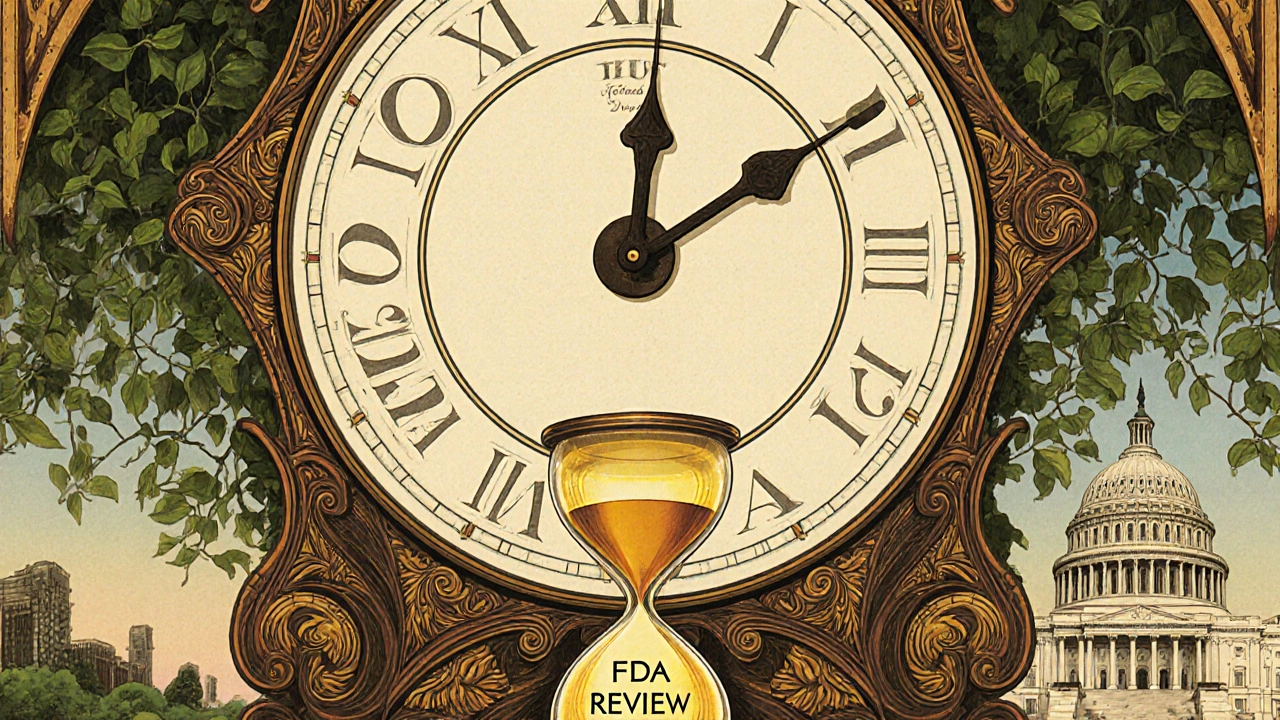
Why some drug patents last longer than 20 years
Most patents expire 20 years after the first filing. But if you look at the patent for a popular brand-name drug, you might see an expiration date that’s 25, 26, or even 28 years out. That’s not a mistake. It’s patent term restoration-a legal loophole built into U.S. law to make up for time lost waiting for the FDA to approve a new drug.
Here’s the problem: Drug companies file patents early-sometimes before they even start human trials. That protects their idea. But the FDA doesn’t approve drugs overnight. The average approval process takes 10 to 15 years. By the time the drug hits the market, half the patent life is already gone. Without patent term restoration, companies would have only a few years to recoup billions in R&D costs before generics show up.
Patent term restoration (PTE) fixes that. It gives back some of the lost time. But it’s not automatic. It’s a complex, high-stakes process that only a handful of companies can pull off correctly. And it’s one of the biggest reasons why brand-name drugs stay expensive so long.
How the Hatch-Waxman Act created PTE
The system started in 1984 with the Drug Price Competition and Patent Term Restoration Act-better known as the Hatch-Waxman Act. It was named after its two sponsors: Senator Orrin Hatch and Representative Henry Waxman. The goal was simple: balance two competing interests.
On one side, you had big drugmakers who needed time to make money on their innovations. On the other, you had generic drug companies who wanted faster access to the market. Hatch-Waxman tried to do both. It let generics enter the market faster by letting them rely on the original company’s safety data. But in return, it gave the original company a chance to get back some of the patent time lost during FDA review.
The law didn’t just cover human drugs. In 1988, it was expanded to include animal drugs. Later, in 2016, the 21st Century Cures Act added regenerative medicine products like cell and gene therapies. Today, PTE applies to human drugs, animal drugs, medical devices, food additives, and color additives.
The math behind the extension
It’s not as simple as adding five years to your patent. The formula is strict and involves several moving parts.
The basic rule: the extension can’t exceed five years. And the total patent life after extension can’t go beyond 14 years from the date the FDA approves the product. That’s the hard cap.
Here’s how it’s calculated:
- Regulatory Review Period (RRP): The time from when you submit your application to the FDA until they approve it.
- Pre-Grant Regulatory Review Period (PGRRP): The time between filing your patent and submitting your FDA application.
- Days of Applicant’s Due Diligence (DD): Any time you were slow. If you didn’t respond to FDA questions fast enough, those days get deducted.
- Total Patent Term (TP): The full 20-year term from your original filing.
The formula looks like this: PTE = RRP - PGRRP - DD - ½(TP - PGTP)
It’s messy. And that’s why most companies hire specialized lawyers. One missed document, one delayed response, and you lose months-or even the whole extension.

Who qualifies-and who doesn’t
Not every patent gets extended. Only one patent per product can be extended. And it has to be the first FDA approval for that active ingredient.
Here’s what you need to qualify:
- The patent must still be active when the product is approved.
- The product must have gone through a full regulatory review by the FDA.
- The patent hasn’t been extended before.
- You must apply within 60 days of FDA approval. Miss that window, and you’re out of luck.
There’s also a special rule for products using recombinant DNA technology-like insulin made with lab-grown bacteria. These get extra documentation requirements under 21 CFR § 60.21(c). Biologics, which are complex proteins made from living cells, now make up 34% of all PTE applications, up from 19% in 2018.
But here’s the catch: you can’t extend a patent if the product was already on the market before the patent was filed. That’s why some companies file patents early-even before animal testing.
Interim extensions: the safety net
What if your patent is about to expire, but the FDA hasn’t approved your drug yet? That’s where interim extensions come in.
You can apply for a temporary extension if you’re within six months of your patent’s expiration date and you still haven’t gotten FDA approval. This keeps your patent alive while you wait. It’s not a guarantee, but it’s a lifeline.
One major pharmaceutical company in Brisbane told me their team used this twice in the last five years. One drug got approved just two weeks after the interim extension kicked in. Without it, they would’ve lost all protection-and a $300 million investment.
Why PTE is controversial
On paper, PTE sounds fair. You lost time waiting for the government. You get some back. But in practice, it’s become a tool for extending monopolies far beyond what Congress intended.
Studies show that 91% of drugs that get a PTE still hold market control long after the extension ends. How? By layering on secondary patents-for new dosages, delivery methods, or formulations. These aren’t new drugs. They’re tweaks. But they block generics anyway.
According to the Journal of the American Medical Association, 78% of PTE applications in recent years involve secondary patents, not the original compound patent. That’s not what Hatch-Waxman was designed for.
And the cost? The Congressional Budget Office estimates PTE adds $4.2 billion a year to U.S. drug spending. Drugs with PTE hold onto 92% of their market share during the extension period. Once generics arrive, that drops to 37%.
Critics say the system is broken. Proponents say it’s necessary to keep innovation alive. The truth? It’s both.

The hidden costs of getting it right
Applying for PTE isn’t just paperwork. It’s a full-time job.
You need:
- Detailed logs of every FDA communication-emails, letters, meeting notes.
- Proof you didn’t delay. If you waited 30 days to respond to a request, those 30 days are subtracted from your extension.
- Coordinated teams: patent lawyers, regulatory affairs, clinical trial managers. If they’re not talking, your application fails.
A 2022 study in Nature Biotechnology found that 43% of PTE delays came from poor communication between departments. One company lost a 3-year extension because the regulatory team didn’t tell the patent team about a critical FDA meeting.
And the USPTO denies 12.7% of applications-mostly because of insufficient proof of due diligence. The FDA processed 287 PTE applications in 2023. The average time to decide? 217 days. That’s over seven months.
Patent attorneys say it takes 18 to 24 months of training to handle PTE correctly. Standard patent work? Six to 12 months. This isn’t legal work. It’s a hybrid of law, science, and logistics.
What’s changing in 2025 and beyond
The system is under pressure. The FDA released new guidance in January 2024 on what counts as "due diligence." The bar is higher now. You can’t just say you were "working on it." You need day-by-day records.
In 2024, a Federal Circuit court ruling in Eli Lilly v. USPTO tightened the rules even more. Now, companies have to prove they were moving forward at every stage-even before submitting to the FDA. That could cut average extensions by 8 to 12 months.
The FDA is also planning to launch a digital submission platform for PTE applications by mid-2026. That should speed things up. But it won’t fix the deeper problem: the system was built for small molecules, not biologics or gene therapies.
Meanwhile, Congress is considering the Preserve Access to Affordable Generics and Biosimilars Act. If it passes, it would ban some of the most aggressive PTE strategies-like extending patents on minor formulation changes.
And in December 2025, the Government Accountability Office will release a major review of PTE’s impact on drug prices. That report could trigger real reform.
What this means for you
If you’re a patient: PTE is why your prescription costs $800 a month instead of $50. It’s why you wait years for a generic version to appear.
If you’re a company: PTE is a lifeline. One successful extension can mean billions in revenue. But it’s risky. One mistake, and you lose it all.
If you’re an investor: Look at a drug’s patent timeline. If it has a PTE, it’s likely to stay protected longer than you think. But watch for secondary patents. That’s where the real monopolies hide.
PTE isn’t evil. It was designed to help innovation. But without oversight, it’s become a tool for prolonging profits at the expense of access. The system works-but only if you know how to use it. And right now, too few people do.
What is patent term restoration (PTE)?
Patent term restoration (PTE) is a legal process that extends the life of a patent to make up for time lost during FDA regulatory review. It applies to human drugs, animal drugs, medical devices, and certain food additives. The extension is calculated based on how long the product was under review, minus any delays caused by the applicant. The maximum extension is five years, and the total patent life after extension cannot exceed 14 years from FDA approval.
How long does a patent last after PTE?
A patent’s original term is 20 years from the filing date. With PTE, it can be extended by up to five years, but the total time from FDA approval to patent expiration cannot exceed 14 years. For example, if a drug is approved 12 years after the patent was filed, the patent may be extended by two years to reach the 14-year cap from approval.
Can any patent get a term extension?
No. Only one patent per product can be extended, and it must be the first FDA approval of that active ingredient. The patent must still be active when the product is approved, and the application must be filed within 60 days of approval. Patents for products already on the market before the patent was filed are ineligible.
What’s the difference between PTE and PTA?
Patent Term Extension (PTE) makes up for delays caused by the FDA’s regulatory review. Patent Term Adjustment (PTA) compensates for delays caused by the USPTO itself-like slow examination or failure to meet deadlines. PTE is about FDA time. PTA is about USPTO time. They’re separate processes with different rules.
How do I apply for patent term restoration?
You must file an application with the USPTO within 60 days of FDA approval. The application requires detailed documentation: all FDA submissions, correspondence, timelines, and proof of continuous progress. The FDA provides the regulatory review period data to the USPTO, which then calculates the extension. Most applicants hire specialized patent attorneys due to the complexity and high stakes.
What happens if I miss the 60-day deadline?
You lose the right to apply. There are no exceptions. The 60-day window is absolute. Many companies lose extensions because their legal and regulatory teams aren’t aligned. If the FDA approves the drug on March 1, the application must be filed by April 30. Any delay-no matter how small-means no extension.
Are there any recent changes to PTE rules?
Yes. In January 2024, the FDA released new guidance requiring stricter proof of "due diligence"-meaning companies must show daily progress during regulatory review, not just milestone dates. A 2024 Federal Circuit ruling also raised the bar for proving diligence before FDA submission. These changes are making extensions harder to get and shorter on average.
Can biologics get patent term restoration?
Yes. Since the 21st Century Cures Act of 2016, biologics-including monoclonal antibodies, gene therapies, and cell therapies-are eligible for PTE. In fact, biologics now make up 34% of all PTE applications, up from 19% in 2018. They’re more complex and take longer to approve, so the extension is often critical for recouping development costs.
9 Comments
Really well-explained breakdown. I work in pharma regulatory and PTE is one of those things that sounds simple until you're deep in the weeds with FDA correspondence logs. One missed email reply and you lose months. It's insane how much hinges on documentation.
Fun fact: biologics now make up 34% of PTE apps 🤯
Used to be all small molecules. Now we're talking gene therapies and cell treatments that take 12+ years to approve. The system's barely keeping up.
My buddy at a startup lost a 3-year extension because the clinical team didn't tell the patent lawyers about a delayed FDA meeting. One team didn't talk to the other. Boom. $200M gone.
Not even a joke. Happened last year.
It's fascinating how this law was designed in 1984 for aspirin-like drugs and now it's being stretched to cover CRISPR therapies and mRNA vaccines. The framework was never meant for this complexity. We're patching a 40-year-old system with duct tape and hope.
Big Pharma's favorite loophole. They don't innovate-they just tweak pill coatings and call it a new drug.
For anyone reading this and thinking, 'I could handle this myself'-please don't. The USPTO denies nearly 13% of applications due to incomplete due diligence records. This isn't just legal work. It's a full-time job requiring coordination between scientists, lawyers, and regulators. Hire the experts.
They say it's to encourage innovation... but what if it's really just a way to keep prices high and patients paying? The 14-year cap? That's just a theater. Look at the secondary patents-they're the real money makers. The system isn't broken. It's working exactly as intended... for them.
USPTO and FDA are in cahoots with Big Pharma. You think this is about fairness? No. It's control. The digital platform in 2026? Just another trap to make it harder for small players. Watch.
Wait-so if you file a patent before animal testing and then wait 12 years for approval, you get up to 5 extra years? But if you're slow responding to FDA questions, those days are cut? That’s brutal. One typo in an email and you lose millions? This feels like a game where the rules change mid-play.