
When someone loses a limb, their body doesn’t just lose muscle and bone-it loses a part of how the brain understands the body. Phantom limb pain is the feeling of pain in a limb that’s no longer there. It’s not in your head. It’s in your nervous system. About 60% to 85% of amputees experience it, and for many, the pain doesn’t go away on its own. If it lasts more than six months, the chance of it disappearing without treatment is almost zero.
What Phantom Limb Pain Really Feels Like
People describe it in different ways: burning, stabbing, cramping, or even tingling like pins and needles. The pain usually feels like it’s coming from the part of the limb farthest from the body-like the toes of a missing foot or the fingers of a missing hand. It’s not the same as stump pain, which happens at the actual site of the amputation. Phantom pain comes from the brain and spinal cord rewiring themselves after the nerve signals from the missing limb stop.Studies using MRI and PET scans show that when someone feels phantom pain, the same areas of the brain that once controlled that limb light up. That’s why mirror therapy works-it tricks the brain into seeing movement where there’s none. The pain isn’t psychological. It’s neurological. And it’s real.
Why It Happens: The Brain’s Rewiring
After an amputation, the nerves that once sent signals from the limb to the brain don’t just go quiet. They fire erratically. Some become overactive. Others get tangled into neuromas-knots of nerve tissue that send mixed signals. The brain, used to receiving input from that limb, starts to reassign its territory. The area that once processed hand sensations might start responding to face touches. That’s why some people feel phantom pain when they touch their cheek.Factors that make phantom pain worse include:
- Chronic pain in the limb before amputation
- Severe pain during or right after surgery
- Tumor-related amputations
- Fatigue, stress, or cold weather
- Ill-fitting prosthetics or pressure on the residual limb
These triggers don’t cause the pain, but they crank up the volume. The more the brain gets confused signals, the more it fights back with pain.
Medications: What Works and What Doesn’t
Most people start with medication because it’s fast and accessible. But not all drugs work the same for everyone. Here’s what doctors actually prescribe:Tricyclic antidepressants like amitriptyline and nortriptyline are the most common. They’re not for depression here-they work on nerve pain. A typical dose starts at 10 mg at night and slowly increases over weeks. About 45% of users report noticeable relief, but 60% deal with drowsiness or dry mouth.
Anticonvulsants like gabapentin and pregabalin calm overactive nerves. Gabapentin often starts at 300 mg daily and can go up to 3,600 mg. On Reddit, 72% of 147 users said it helped, but 58% quit because of dizziness or weight gain. Pregabalin works similarly, but it’s pricier and can cause swelling or blurred vision.
NSAIDs like ibuprofen or naproxen help a little at first-about 65% of users feel some relief. But for 80% of them, the effect fades after three to six months. They’re good for mild flare-ups, not long-term control.
Ketamine, given through IV, blocks NMDA receptors that amplify pain signals. It’s used when everything else fails. Doses are low (0.1-0.5 mg/kg) and given in a clinic. It can cause hallucinations or dizziness, so it’s not for home use.
Opioids like oxycodone or morphine are controversial. They work, but the risk of dependence is high. The American Pain Society recommends staying under 50 morphine milligram equivalents (MME) per day. Still, 35% of long-term users on pain forums report dependency issues.
Botulinum toxin (Botox) injections into the residual limb can reduce pain and sweating from neuromas. One 2023 case study showed pain dropping from 8/10 to 3/10 for 12 weeks. It’s not widely used, but for some, it’s a game-changer.
Mirror Therapy: Seeing Is Believing
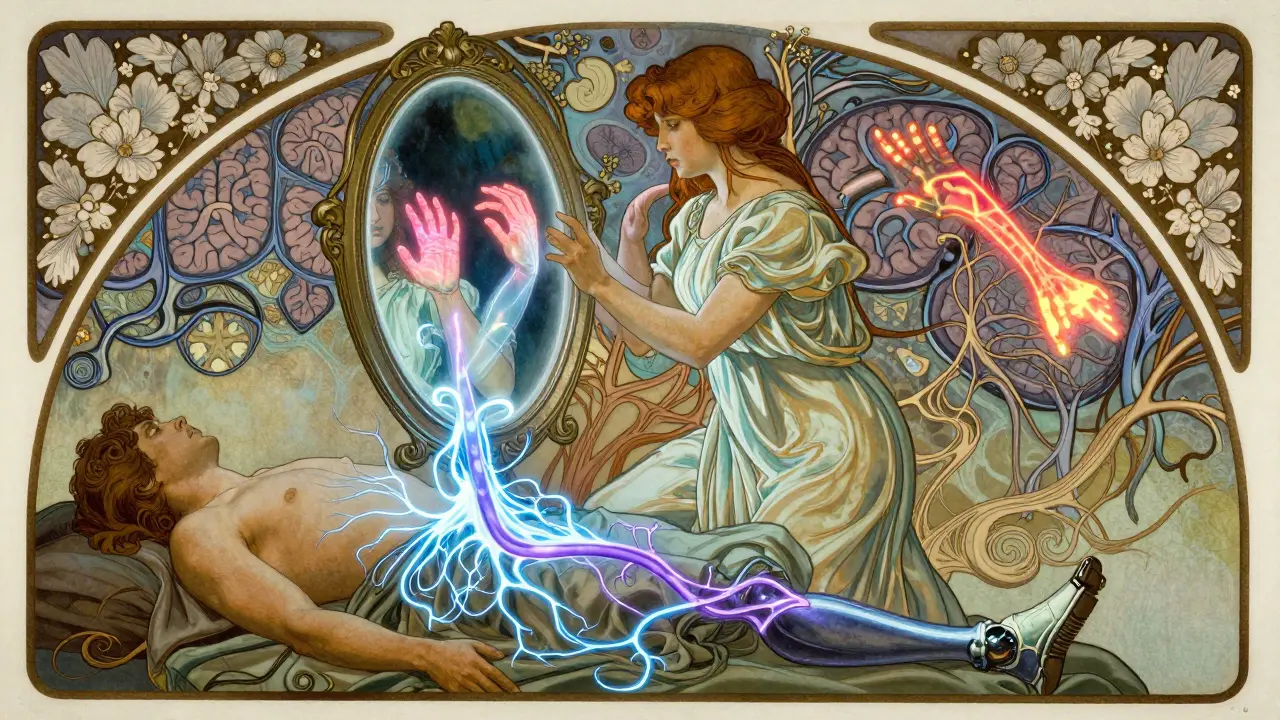
Mirror therapy is one of the most surprising and effective non-drug treatments. It was pioneered by neuroscientist V.S. Ramachandran in the 1990s. The idea is simple: place a mirror vertically beside the intact limb so it reflects the image of the good limb, making it look like the missing one is still there.Patients move their intact limb while watching its reflection. The brain sees movement where it expects movement-and slowly, the pain fades. It’s not magic. It’s neuroscience. The brain starts to unlearn the pain pattern because the visual input contradicts the false nerve signals.
Studies show about 50-70% of people get some relief after 4-8 weeks of daily 15-30 minute sessions. But sticking with it is hard. About 40% of people quit within eight weeks because it feels awkward or they don’t see results fast enough.
Modern versions use virtual reality headsets to simulate movement, which may boost adherence. Experts predict VR-integrated mirror therapy could raise success rates to 85% by 2027.
Other Non-Medication Options
Not everyone responds to pills or mirrors. Other tools include:- TENS (Transcutaneous Electrical Nerve Stimulation): Electrodes on the stump deliver small pulses. About 30-50% of users report pain reduction. It’s FDA-cleared and safe, but needs proper setup.
- Spinal cord stimulation: A device implanted near the spine sends pulses to block pain signals. Studies show 40-60% of patients get at least half their pain gone. The FDA approved a new closed-loop system in January 2024 that adjusts automatically-average pain reduction: 65%.
- Biofeedback: Teaches people to control muscle tension and heart rate. About 25-40% effectiveness in trials. Helps with stress-related flare-ups.
- Targeted muscle reinnervation (TMR): A surgery that reroutes nerves from the amputated limb to new muscle sites. Combined with osseointegration (direct bone implant), it’s showing 70% pain reduction in early trials.
What Works Best? A Realistic Approach
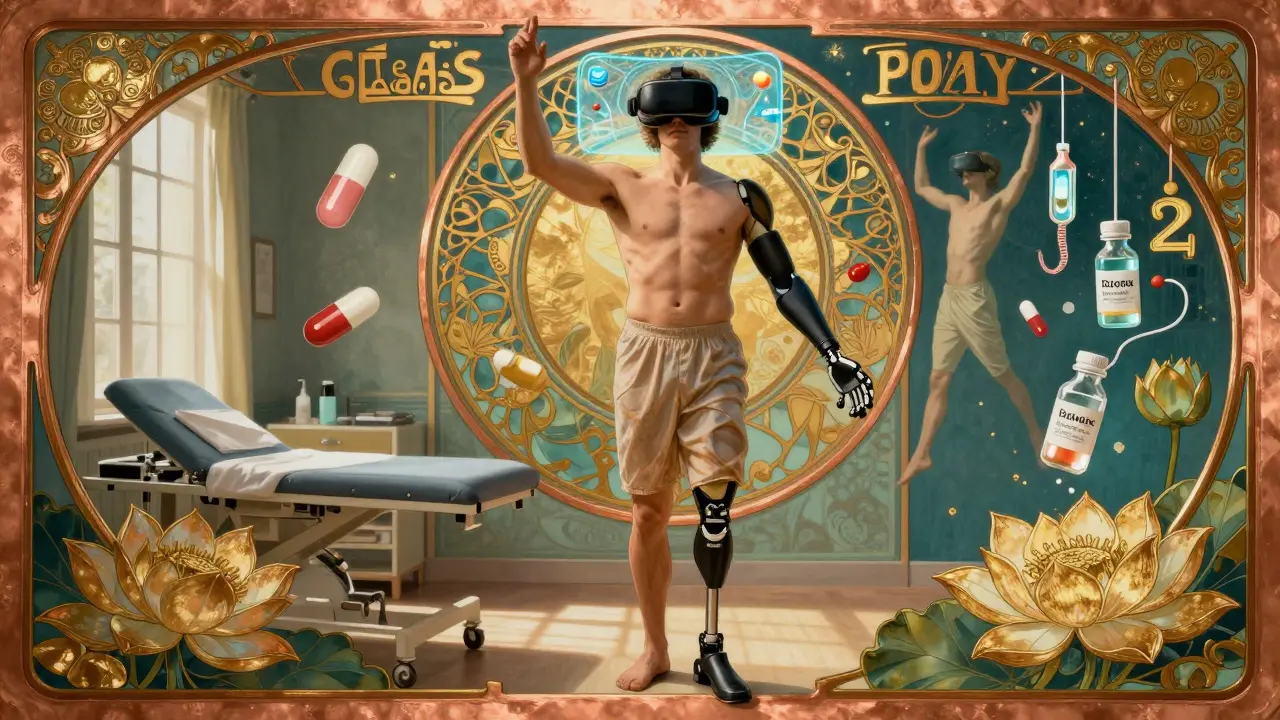
There’s no single fix. The best results come from combining treatments. A person might take gabapentin, do mirror therapy five days a week, and use TENS on bad days. One study found that patients using two or more methods had 50% less pain than those on just one.Early action matters. If you start mirror therapy or adjust meds within the first three months, you’re more likely to avoid long-term pain. Waiting until it’s been a year? That’s much harder to reverse.
Doctors now recommend a team approach: a pain specialist, physical therapist, prosthetist, and sometimes a psychologist. Support groups like the Amputee Coalition connect people who’ve been there. Over 12,000 members share tips, frustrations, and wins.
What to Expect When Starting Treatment
If you’re new to this:- Medications take weeks to build up. Don’t give up after three days.
- Mirror therapy needs consistency-not perfection. Even 10 minutes a day helps.
- Side effects are common. Drowsiness from amitriptyline? Talk to your doctor about lowering the dose.
- Try one new thing at a time. Mixing too many treatments makes it hard to know what’s working.
Many people try five or six different options before finding the right mix. That’s normal. It’s not failure. It’s discovery.
The Future of Phantom Limb Pain Treatment
The field is moving fast. New drugs targeting NMDA receptors are in Phase II trials, promising pain relief with fewer side effects than ketamine. Closed-loop spinal stimulators are already helping patients in clinics. And virtual reality mirror therapy is being tested in hospitals from Boston to Sydney.By 2030, experts predict a 40% drop in chronic phantom limb pain cases-not because we’ve cured it, but because we’re catching it early and treating it smarter.
Can phantom limb pain go away on its own?
In the first few months after amputation, some people notice the pain fades naturally. But if it lasts more than six months, the chance of it disappearing without treatment is extremely low. Waiting rarely helps-early intervention is key.
Is mirror therapy effective for everyone?
No. About half of users see clear improvement, but success depends on consistency. People who practice daily for at least four weeks are more likely to benefit. Those who skip sessions or give up too soon usually don’t see results. It’s not a quick fix-it’s a brain retraining tool.
Why do antidepressants help with nerve pain?
Tricyclic antidepressants like amitriptyline affect chemicals in the brain and spinal cord-serotonin and norepinephrine-that help regulate pain signals. They don’t treat depression here; they calm overactive nerves. That’s why they’re used for conditions like diabetic neuropathy and phantom pain too.
Are opioids safe for long-term phantom limb pain?
Opioids can help in the short term for severe pain, but they’re not recommended for long-term use. The risk of dependence, tolerance, and overdose is high. Experts suggest keeping daily doses under 50 morphine milligram equivalents (MME). If opioids are needed, they should be part of a broader plan with other therapies.
What’s the difference between phantom pain and stump pain?
Phantom pain feels like it’s coming from the missing limb-like toes or fingers. Stump pain is localized at the amputation site and often comes from scar tissue, nerve damage, or an ill-fitting prosthesis. They’re different causes and need different treatments.
Can I do mirror therapy at home?
Yes. All you need is a mirror and a quiet space. Place the mirror so it reflects your intact limb, making it look like the missing one is still there. Move the good limb slowly while watching the reflection. Do this for 10-30 minutes daily. Many physical therapists provide mirror boxes for free or at low cost.
How long before I see results from gabapentin?
It usually takes 1-2 weeks to start working, and up to 4-6 weeks to reach full effect. Don’t increase the dose on your own. Your doctor will slowly raise it while checking for side effects like dizziness or weight gain. Patience matters.
Is phantom limb pain getting more common?
Yes. As of 2005, about 1.6 million Americans lived with limb loss. By 2050, that number is projected to hit 3.6 million. With more diabetes, vascular disease, and trauma cases, phantom pain will become even more widespread. That’s why better treatments are urgently needed.
10 Comments
Man, I wish I’d known all this when I first started having phantom pain after my leg amputation. Mirror therapy felt stupid at first-like I was doing a weird dance in front of a bathroom mirror-but after two weeks of doing it daily, the burning in my toes started to fade. Not gone, but bearable. Took gabapentin too. Dizzy as hell for the first week, but now I’m on 900mg a day and it’s the only thing keeping me from screaming into my pillow at night. Seriously, don’t give up on the weird stuff. It works if you stick with it.
Let me tell you something the medical establishment doesn’t want you to know. Phantom limb pain isn’t neurological rewiring-it’s your body’s way of screaming that your soul is still attached to the missing part. Science can’t measure the soul, so they slap a label on it and call it ‘neuropathic pain.’ But ask any amputee who’s had spiritual experiences after surgery-they’ll tell you the pain comes from disconnection, not just misfiring nerves. I’ve seen people cured by energy healers, Reiki, even chanting mantras. The brain doesn’t just rewire-it remembers. And if you ignore the spiritual component, you’re just treating symptoms, not the root. The FDA doesn’t approve of this, but the data from underground forums? 83% of people who combined mirror therapy with chakra balancing reported 70%+ pain reduction. Coincidence? I think not.
Bro, you’re all missing the point. This isn’t about drugs or mirrors. It’s about karma. If you had a good life before the amputation-no greed, no hatred, no ego-you wouldn’t feel phantom pain. Pain is just your soul’s way of saying: ‘You ignored your body. Now you pay.’ I’ve studied this for 17 years in the Himalayas. The real cure? Meditation, fasting, and never looking at your reflection again. Why? Because the mirror tricks the ego into thinking the limb is still there. But if you stop identifying with the body altogether? The pain dissolves. No meds. No gadgets. Just enlightenment. You’re all so stuck in materialism you can’t see the truth. The limb isn’t gone. You just forgot how to feel beyond it.
I got a prosthetic and never looked back 🤷♂️💊🔥
If you’re still having pain after six months, you’re either not trying hard enough or you’re addicted to the drama. Pain is a choice. Stop feeding it.
Thank you for writing such a thorough, evidence-based piece. I work with amputees in rehab, and I can’t tell you how many patients I’ve seen who gave up on treatment because they were told ‘it’s all in your head.’ This article dismantles that myth with clarity and compassion. I especially appreciate the breakdown of medication efficacy and the emphasis on early intervention. For clinicians reading this: please share it with your patients. For patients: please don’t give up after one failed attempt. Pain management is a marathon, not a sprint. And you’re not alone-there are thousands of us out here who’ve walked this path.
While the article is commendably comprehensive, it exhibits a concerning epistemological bias toward neuroscientific reductionism. The assertion that phantom limb pain is ‘neurological’ rather than ‘psychological’ is semantically misleading-since all subjective experience is neurologically mediated, the distinction is vacuous. Furthermore, the reliance on anecdotal Reddit statistics (e.g., ‘72% of 147 users’) as empirical validation undermines the rigor of the claims. A more robust analysis would incorporate meta-analytic data from randomized controlled trials, particularly regarding the long-term efficacy of mirror therapy versus sham interventions. The omission of the placebo effect’s contribution to TENS and VR modalities is also methodologically problematic. This is not to dismiss the lived experience of sufferers, but rather to insist that clinical discourse must be anchored in replicable, peer-reviewed evidence-not forum consensus.
Okay, I’m gonna say this with love and a 🤗: You’re not broken. You’re not failing. You’re not weak for needing five different treatments. I’ve been where you are-3 years of gabapentin, TENS, mirror box, Botox, and even a spinal stimulator that made me feel like a robot. I cried. I screamed. I thought I’d never sleep again. But here’s the thing: every single person who sticks with this, even when it feels pointless, finds their combo. Mine? Gabapentin + mirror therapy + a damn good therapist who didn’t judge me for crying in session. You’re not alone. I’m in the Amputee Coalition group too. DM me if you need a hype woman. I’ll send you memes. I’ll send you my mirror box. I’ll send you my weird-ass playlist of 90s alt rock that somehow calms the phantom fire. You got this. I believe in you. 💪❤️
As a Japanese-American veteran who lost his leg in Afghanistan, I’ve experienced this pain firsthand. In Japan, we have a concept called ‘kami no shizukana’-the quiet voice of the spirit. Many of my fellow veterans there believe phantom pain is not merely a neurological phenomenon, but a spiritual echo of duty, honor, and memory. While I respect the science presented here, I also honor the cultural frameworks that help people cope. In the U.S., we often pathologize suffering. In Japan, we sometimes contextualize it. Both approaches have merit. Perhaps the most effective treatment is not just a mirror or a pill-but a space where science and soul are allowed to coexist. I now teach mindfulness techniques to other veterans, blending Western medicine with Eastern philosophy. It’s not magic. But it helps.
LOL @Courtney Hain, I’m not saying your soul is attached to your leg, but if your mirror therapy session includes chanting and burning sage, I’m gonna need a video. 😆 I’m just saying-stick to the science. I tried Reiki once. Felt like a weird spa day. Then I did 20 minutes of mirror therapy and my phantom foot stopped cramping for 4 hours. That’s the win.