
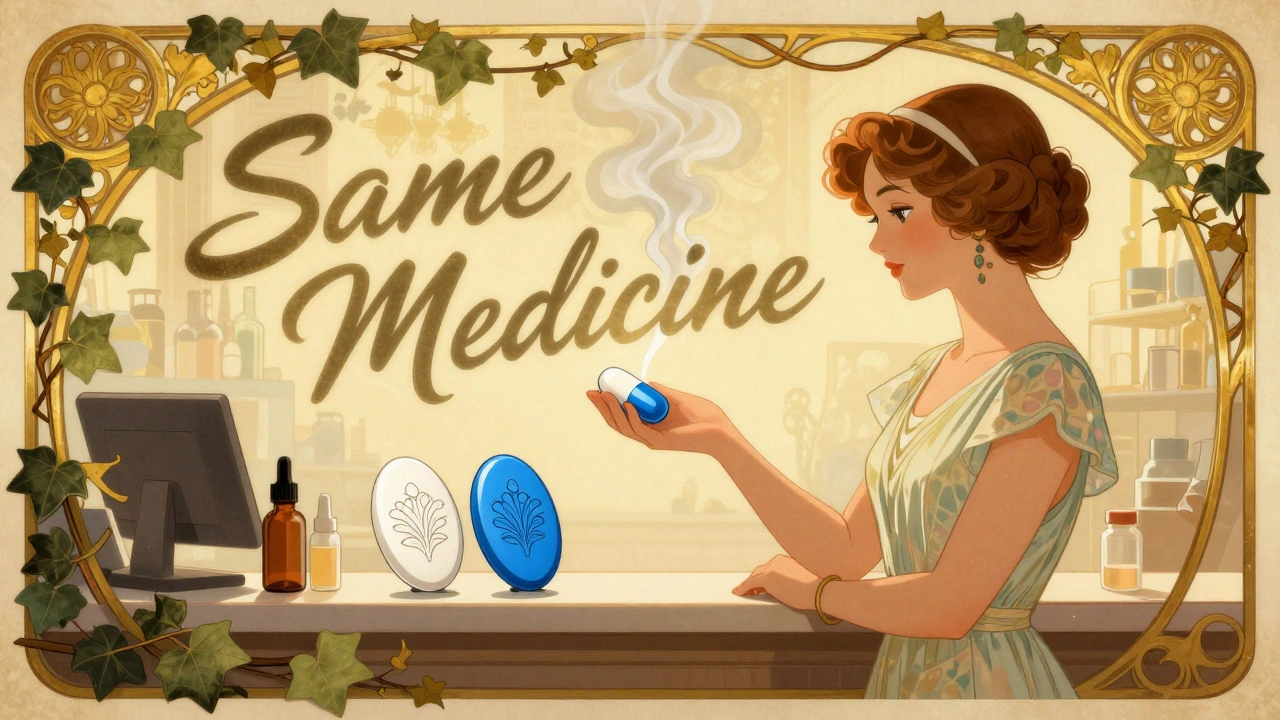
Have you ever opened a prescription bottle and thought, "This isn’t the same pill I took last month"? You’re not imagining it. The color might be blue instead of white. The shape could be oval instead of round. Even the imprint on the tablet is different. And yet, your doctor still says it’s the same medicine. What’s going on?
The answer isn’t about quality, safety, or effectiveness. It’s about trademark laws.
Why can’t generic drugs look like the brand-name version?
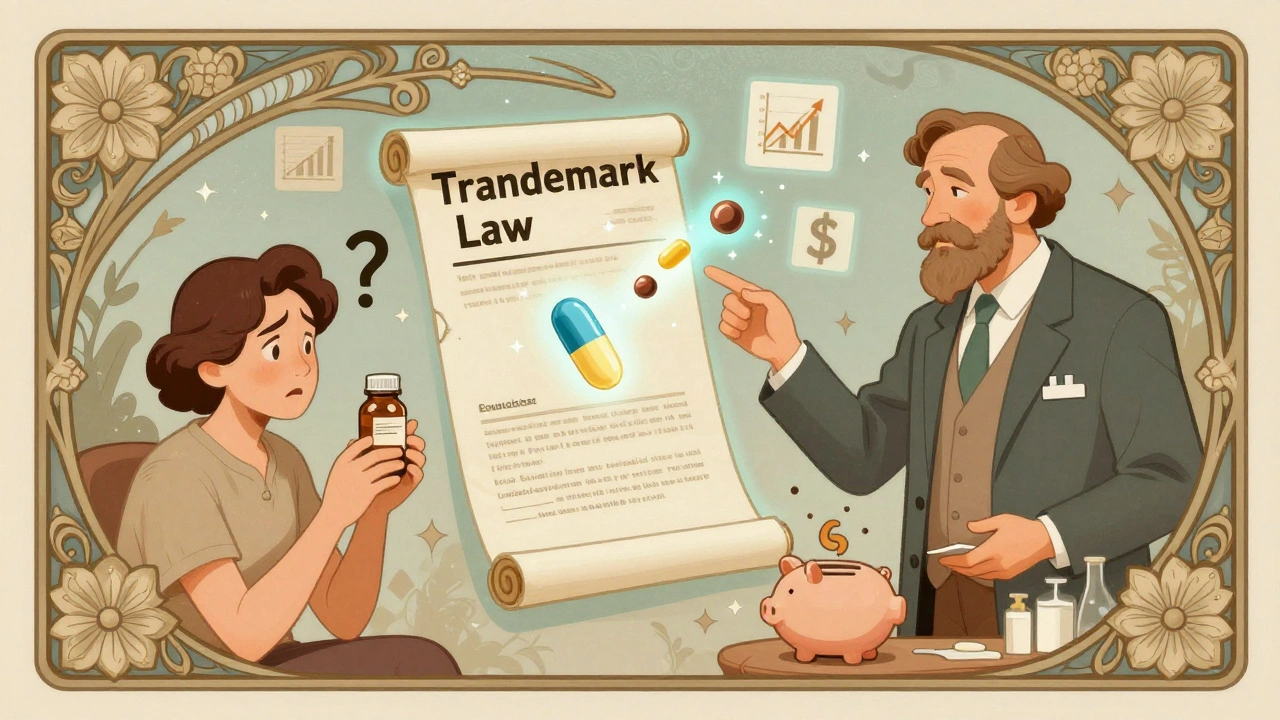
Generic drugs are required by U.S. law to look different from brand-name drugs - not because they’re different in how they work, but because of trademark rules. These rules exist to prevent confusion in the marketplace. If a generic pill looked exactly like the brand-name version, someone could argue it was trying to trick consumers into thinking it was made by the original company. That’s not allowed under trademark law.
The U.S. Food and Drug Administration (FDA) makes this clear: "Trademark laws in the United States do not allow a generic drug to look exactly like other drugs already on the market." This isn’t a suggestion. It’s a legal requirement. Generic manufacturers have to design their pills so they’re visually distinct from both the brand-name version and any other drug already sold in the U.S.
What parts of the pill actually change?
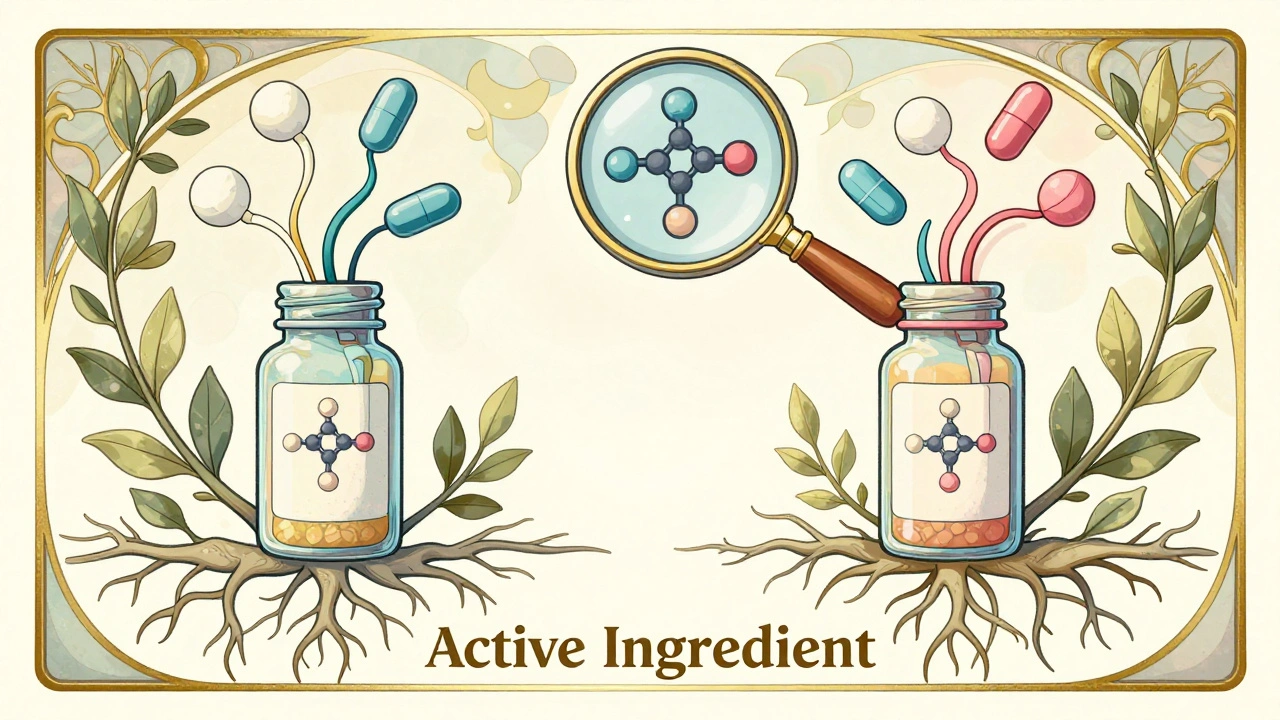
The active ingredient - the part that treats your condition - stays exactly the same. But everything else can change:
- Color: A brand-name pill might be white. The generic version could be yellow, blue, or even pink.
- Shape: Round pills become oval. Capsules might switch from oblong to capsule-shaped with a different cap color.
- Size: Generics can be slightly larger or smaller, even if they contain the same dose.
- Imprint: The letters or numbers stamped on the pill are changed to meet trademark rules and help identify the manufacturer.
- Flavoring and fillers: These inactive ingredients (like dyes, binders, or sweeteners) are swapped out to avoid copying the brand’s exact formula.
All of these changes are legal - and intentional. The FDA says these differences "do not affect the performance, safety, or effectiveness of the generic medicine." That means your blood pressure medicine, your cholesterol pill, or your antidepressant will work just as well, no matter what color it is.
How do we know generics work the same?
Before a generic drug hits the shelf, it must pass strict testing. The FDA requires manufacturers to prove their version is bioequivalent to the brand-name drug. That means it releases the same amount of active ingredient into your bloodstream at the same rate.
Studies show the difference in absorption between brand and generic drugs is tiny - around 3.5% on average. The FDA accepts a range of 80% to 125% for bioequivalence. So even if your body absorbs a little more or less, it’s still within a safe, effective range.
Dr. Janet Woodcock, former head of the FDA’s drug evaluation center, put it simply: "Generic drug companies must provide scientific evidence that shows that their active ingredient is the same as that of the brand-name medicine they copy, and FDA must review that evidence." That review isn’t a formality. It’s rigorous.
Why do pharmacies keep switching the look of my pills?
Here’s where things get confusing for patients. When you refill a prescription, the pharmacy might give you a generic from a different manufacturer than last time. Each company makes its own version - and each version looks different.
That’s why you might get a white oval pill one month, then a blue capsule the next. Neither is wrong. Both are approved by the FDA. But the change in appearance can cause anxiety. Some people worry they’ve been given the wrong medicine. Others stop taking it altogether.
According to UMass Memorial Health, this kind of confusion leads to medication errors. One study found patients were more likely to skip doses or take the wrong amount when their pills looked unfamiliar. That’s why pharmacies now put special labels on vials to warn you: "This is a different manufacturer. Same medicine."
Is there a downside to this system?
The biggest downside isn’t safety - it’s perception. Many people believe that if a pill looks different, it must be weaker or inferior. That’s not true. But it’s a hard myth to break.
Some patients report feeling uneasy switching to generics - even when they’ve used them safely for years. One Reddit user wrote: "I’ve been on the same generic for 5 years. Last refill looked nothing like the others. I thought I was being scammed. Called my doctor. Turned out it was just a different supplier."
Pharmacists and doctors now spend more time explaining this to patients. Many clinics hand out simple fact sheets: "Color doesn’t change the dose. Shape doesn’t change the effect. Only the active ingredient matters."
There’s also a financial upside. Generics cost 80% to 85% less than brand-name drugs. In the U.S., about 90% of prescriptions are filled with generics - but they make up only about 23% of total drug spending. That’s billions saved every year.
What’s being done to reduce confusion?
The FDA has started encouraging generic manufacturers to make their pills look as similar as possible to the brand-name version - within the limits of trademark law. That means if the brand pill is a small, white, round tablet with an imprint of "LIP 20," the generic might be a small, white, round tablet with a different imprint like "L20."
This isn’t a free pass to copy the exact look. It’s a smart compromise: reduce visual shock for patients while still respecting legal boundaries. Some manufacturers are already doing this. Others still use bold colors and unusual shapes - often because they’re cheaper to produce or because they’re trying to stand out in a crowded market.
The FDA continues to monitor both brand and generic drugs after approval. They inspect manufacturing plants, test batches, and track side effects. If a generic drug causes problems, it gets pulled - just like a brand-name drug would.
What should you do if your pill looks different?
Don’t panic. Don’t stop taking it. Don’t assume it’s fake.
Instead:
- Check the label on your bottle. It should list the name of the manufacturer.
- Compare the pill’s imprint and color to the description on the pharmacy’s website or the FDA’s online database.
- If you’re still unsure, call your pharmacy. They can confirm it’s the same medication.
- Ask your doctor or pharmacist if you can stick with one generic manufacturer - if it’s available and covered by your insurance.
Most people never have a problem. But if you’ve had bad experiences with appearance changes before, let your pharmacist know. They can note it in your file and try to keep you on the same version.
Bottom line: It’s the same medicine, just dressed differently
Generic drugs are not cheaper because they’re lower quality. They’re cheaper because companies don’t have to spend millions on research, marketing, or advertising. The active ingredient is identical. The way it works in your body is identical. The risks and benefits are identical.
The only thing that’s different? The color. The shape. The imprint. And that’s not a flaw - it’s the law.
Trademark laws protect brands. But they also protect patients by making sure multiple companies can compete. That competition drives prices down - and keeps life-saving drugs affordable for millions.
So next time you pick up a prescription and think, "This doesn’t look right" - take a breath. It’s probably just a different manufacturer. And it’s still doing exactly what it’s supposed to do.
Why do generic drugs look different from brand-name drugs?
Generic drugs must look different because U.S. trademark laws prohibit them from copying the exact appearance of brand-name drugs. This prevents consumer confusion and protects the brand identity of the original manufacturer. Differences in color, shape, size, and imprint are required by law - even though the active ingredient and effectiveness are identical.
Are generic drugs less effective because they look different?
No. Generic drugs must meet strict FDA standards for bioequivalence, meaning they deliver the same amount of active ingredient into your bloodstream at the same rate as the brand-name version. Studies show differences in absorption are typically under 3.5%, well within the FDA’s accepted range of 80-125%. Appearance has no effect on how well the drug works.
Can I ask for the same generic manufacturer every time?
Yes, you can ask your pharmacist to fill your prescription with the same generic manufacturer each time. While they aren’t required to do so, many pharmacies will accommodate this request if the medication is available and covered by your insurance. Just let them know you’ve had issues with appearance changes in the past.
What should I do if I’m confused by a change in my pill’s appearance?
Don’t stop taking your medication. Check the label on your bottle for the manufacturer’s name and the pill’s imprint. Compare it to the description on your pharmacy’s website or the FDA’s online database. If you’re still unsure, call your pharmacy. They can confirm it’s the same drug. Many pharmacies now add warning labels to vials when the appearance changes.
Are there any risks with switching between different generic versions?
The main risk is patient confusion, not medical danger. Switching between different generic manufacturers doesn’t affect how the drug works. But if you’re not expecting a change in color or shape, you might think you’ve been given the wrong medicine. This can lead to skipped doses or unnecessary anxiety. Clear labeling and communication from your pharmacist can prevent this.
14 Comments
Okay but let’s be real - trademark laws are a weird loophole that lets Big Pharma control the narrative even when the science says otherwise. 🤔 The active ingredient is identical, sure, but the visual whiplash? That’s a psychological hack. Patients panic, compliance drops, and suddenly the brand-name drug looks like the safer option - even when it’s not. It’s not about safety. It’s about perception engineering.
so like… if i take a blue pill instead of a white one… does it still fix my anxiety? or am i just hallucinating the difference? 🤯
TRADMARK LAWS?!?!? That’s the excuse? Not ‘oh we need to stop people from thinking generics are fake’ - nooo, it’s ‘we must protect the corporate logo on a pill’? That’s not law, that’s capitalism wearing a lab coat. 🤡 I’ve seen pills that look like candy - bright pink, glittery, shaped like stars - and people are terrified to take them. Meanwhile, the brand-name version is just a boring white circle with ‘LIP 20’ on it. Who’s really being protected here? The patient? Or the shareholders?
Let’s be clear: The FDA requires bioequivalence. That’s a scientific standard. Not a suggestion. Not a guideline. A requirement. The color? Irrelevant. The shape? Irrelevant. The imprint? Required for identification, not branding. The cost? 85% lower. The outcome? Identical. So why are we even having this conversation? Because people don’t understand science. And that’s the real problem.
bro you think this is bad? wait till you get a generic from India that looks like a neon green egg. i took it thinking it was vitamin b12. turned out it was my blood pressure med. i almost called an ambulance. then i checked the label. same damn active ingredient. i felt like an idiot. but hey - i’m alive. so i guess it worked. 🤷♂️
I’ve been on the same generic for 7 years. Last month, my pill went from white oval to light blue capsule. I stared at it for 10 minutes. Then I Googled the imprint. Then I called my pharmacist. She laughed and said, ‘Yeah, we switched suppliers. Same drug. Same dose. Same you.’ I cried a little. Then I took it. And I’m still here. 💙
It is a matter of considerable legal and pharmaceutical jurisprudence that the United States Food and Drug Administration, in accordance with the Lanham Act, mandates that generic pharmaceuticals must be visually distinct from their branded counterparts in order to preserve the integrity of intellectual property rights. The active ingredient, while pharmacologically equivalent, is not the sole determinant of regulatory compliance. The visual differentiation serves a public policy function: the prevention of consumer misidentification. This is not a trivial concern, but a foundational principle of pharmaceutical regulation in a market economy.
But what if I just… don’t trust it? Like, what if I’ve been on this pill for 10 years and now it’s a different color and I feel like my body is rejecting it? What if I’m not crazy, I’m just… scared? And what if my doctor doesn’t get it? What if they just say ‘it’s the same’ and walk away? Who’s supposed to hold space for that fear? I’m not asking for the same pill. I’m asking to be believed.
Let me tell you something about American healthcare. The fact that we even have this debate proves how broken the system is. In Germany, generics look nearly identical - because they trust their pharmacists and their regulators. Here? We turn a simple pill change into a psychological crisis. We’re not just paying for medicine. We’re paying for fear. And someone’s profiting from that fear. The brand-name companies? The pharmacies? The insurance middlemen? All of them. It’s a spectacle. And we’re all just spectators in a circus.
My grandma used to say ‘if it’s the same inside, it’s the same’ - and she never had a college degree. She took generics her whole life. Never had a problem. But now people overthink everything. Just take the damn pill. If your doctor says it’s good, it’s good. Don’t let a color change ruin your health.
Every time I see someone panic over a pill change, I think: this is why we need better patient education. Not just from doctors - from pharmacists, from apps, from social media. We need simple, visual guides: ‘This is your pill. This is what it looks like. This is what changes. This is what doesn’t.’ We have the tech. We have the data. What we lack is the will to make it accessible. Let’s fix that. One pill at a time.
Oh please. You think trademark law is the problem? The real problem is that people think they’re entitled to the exact same pill every time. That’s not medicine. That’s consumerism. You don’t get to demand your ‘brand experience’ when you’re on a generic. You get the science. And the science doesn’t care what color your pill is. If you can’t handle that, maybe you shouldn’t be taking meds at all. Just sayin’.
Just took my 3rd refill this month and it’s now a purple triangle 🟣🔺. I thought I was being scammed. Turned out it’s the same as last time. Just a different manufacturer. I’m just glad I didn’t throw it out. 🙏💊
Look I get it. The science says it’s the same. But why make it so confusing? Why not just let generics look like the brand? If people are gonna panic anyway, why not remove the trigger? This whole system feels like it was designed by someone who hates patients. And I’m not mad. I’m just… tired.