
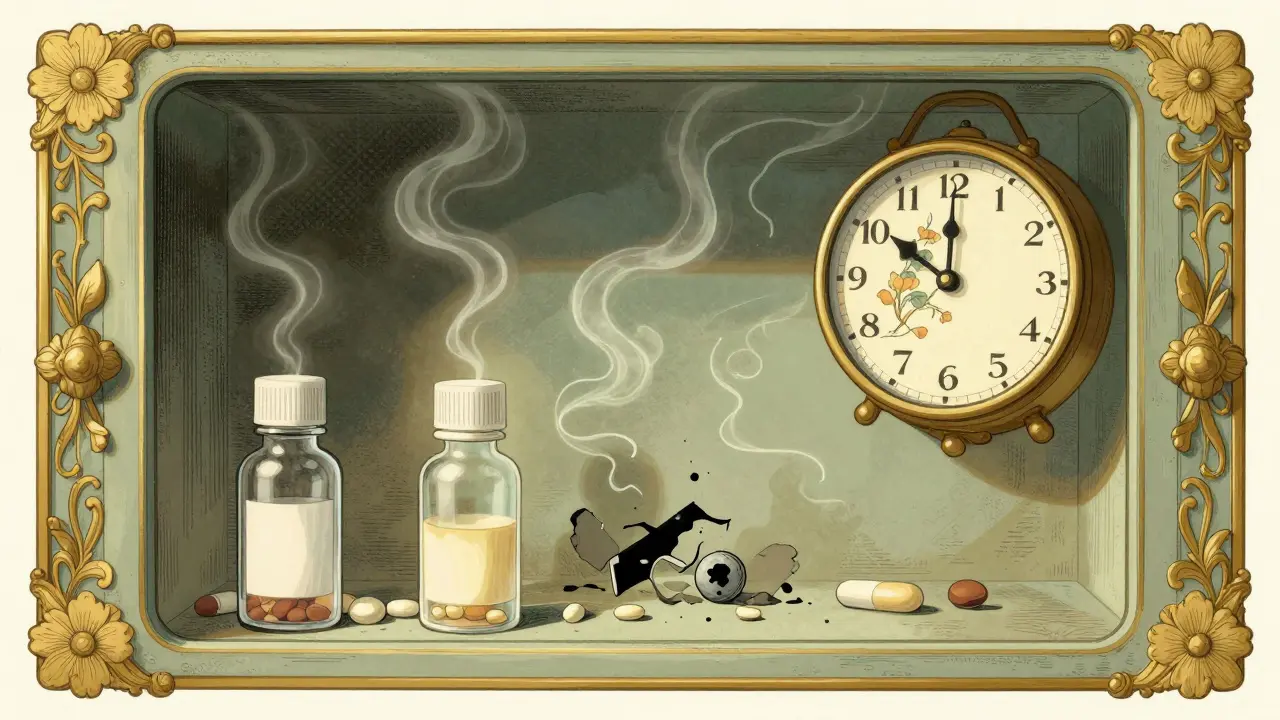
Most people assume that when a pill or liquid medicine passes its expiration date, it suddenly becomes useless-or worse, dangerous. But the truth is more subtle: medications don’t just stop working on the date printed on the bottle. They’ve been slowly losing strength since the moment they were made. The expiration date isn’t a cliff edge. It’s a safety line drawn by scientists to guarantee you get at least 90% of the active ingredient you paid for. After that date? It’s a gamble. And sometimes, that gamble comes with real risks.
How Medications Break Down-It’s Chemistry, Not Magic
Your medicine isn’t sitting still. Even on your shelf, its active ingredients are reacting with air, moisture, and light. These reactions are called degradation. The most common ones are hydrolysis (water breaking chemical bonds), oxidation (oxygen changing molecular structure), and photolysis (light breaking things apart). Think of it like an apple turning brown after you cut it-except instead of just looking bad, it stops doing its job.
Take ibuprofen, for example. It’s one of the most stable drugs out there. Studies show that even after years past its expiration date, if stored properly, it often still contains over 90% of its original strength. But that’s not true for everything. Liquid antibiotics like amoxicillin suspension? They start falling apart within weeks after mixing, even before the printed date. That’s because liquids are far more vulnerable to water and bacteria than solid tablets or capsules.
Some drugs are just inherently unstable. Levothyroxine, used for thyroid conditions, can lose potency if exposed to humidity. Epinephrine in EpiPens breaks down faster than most people realize-studies show a clear drop in effectiveness between 1 and 90 months after expiration. And tetracycline? It doesn’t just weaken. It can degrade into compounds that are toxic to the kidneys. That’s why some expired meds aren’t just useless-they’re dangerous.
Why the Expiration Date Isn’t the Whole Story
The expiration date you see on your medicine isn’t random. It’s the result of years of testing. Manufacturers put drugs through what’s called accelerated aging: storing them at 40°C and 75% humidity for months to simulate years of real-world exposure. They use tools like HPLC-MS-high-tech machines that can detect even 0.05% of a degraded compound-to measure how much active ingredient remains.
The U.S. Pharmacopeia (USP) requires that a drug must still contain at least 90% of its labeled potency on the expiration date. So a 200 mg tablet must have at least 180 mg of the real drug left. That’s the bar. Most manufacturers set their expiration dates at 1 to 3 years after production, even if testing shows the drug could last longer. Why? Because they’re being conservative. They don’t want to risk lawsuits or recalls if someone gets sick from a weakened dose.
The U.S. military’s Shelf Life Extension Program (SLEP), started in 1986, tested over 100 drugs from stockpiles and found that 88% were still safe and effective years-sometimes over a decade-past their labeled dates. Some lasted 15 years. But here’s the catch: those drugs were stored in climate-controlled warehouses, sealed in original packaging, and never opened. Your bathroom cabinet? Not even close.
Where You Store Medicine Matters More Than You Think
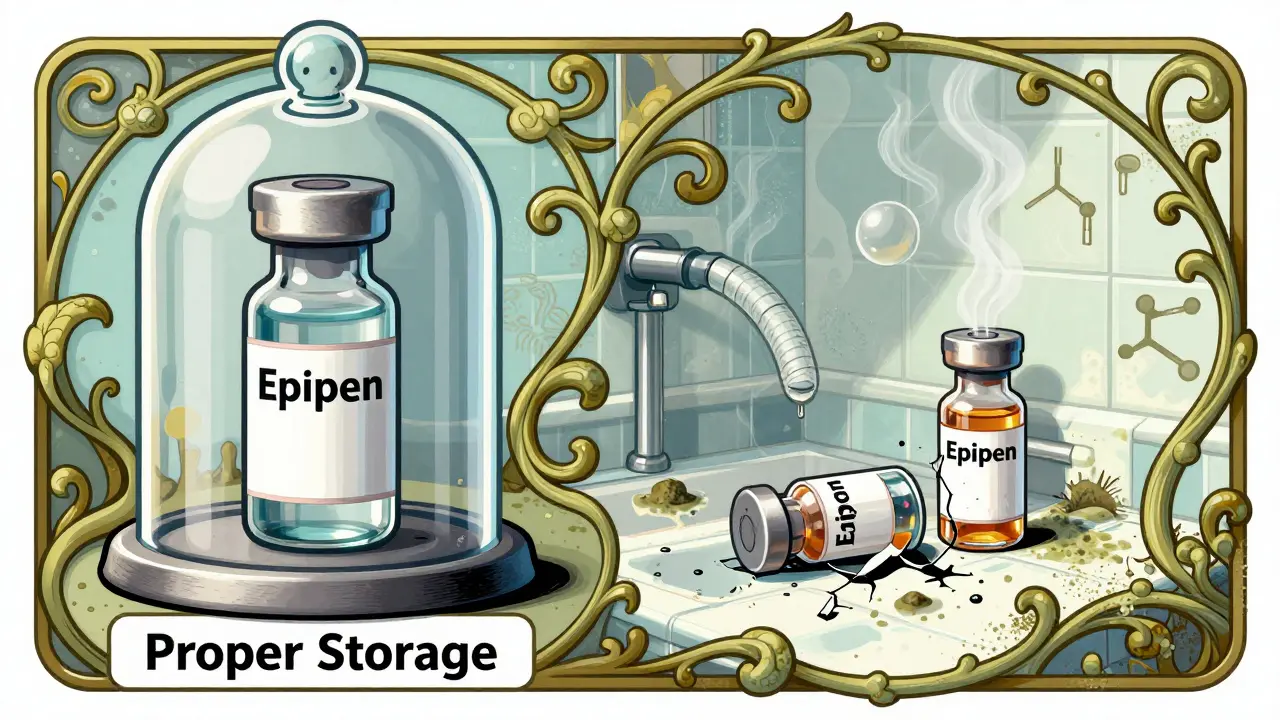
It’s not just about the date. It’s about where you keep it. The bathroom is one of the worst places in your house for medicine. Every shower sends steam into the air, raising humidity levels. That moisture accelerates hydrolysis, which breaks down pills and capsules. Heat from the dryer or sunlight through a window makes it worse.
Studies show that storing meds in a bathroom can cut their shelf life by 30-50% compared to a cool, dry bedroom drawer. A study on medications aboard the International Space Station found that high heat and humidity sped up degradation by up to 100%. You don’t need a space station to see the same effect. Your kitchen above the stove? Bad. Near a radiator? Worse. A drawer in your bedroom, away from windows and sinks? That’s ideal.
Light also plays a role. Some drugs-like nitroglycerin, certain antibiotics, and even some vitamins-are light-sensitive. That’s why they come in dark bottles. If you keep them in a clear jar on your counter, you’re speeding up their breakdown. Always keep them in their original packaging. It’s not just for labels-it’s protection.
Not All Medicines Are Created Equal
Some drugs are rock solid. Others? They fall apart fast. Here’s a quick breakdown:
- Very stable: Ibuprofen, aspirin, acetaminophen, most antidepressants, and statins. These often retain potency for years past expiration if stored well.
- Medium stability: Antibiotics like amoxicillin (in pill form), blood pressure meds, and diabetes drugs. They’re okay past expiration, but potency drops faster.
- Unstable: Liquid antibiotics (after mixing), insulin, epinephrine (EpiPens), nitroglycerin, levothyroxine, and eye drops. These can become ineffective or even harmful after expiration.
Even two brands of the same drug can behave differently. A 2017 study found that ibuprofen from one manufacturer degraded faster than another-not because of the active ingredient, but because of the fillers. Ingredients like hypromellose, polyethylene glycol, and polysorbate can pull moisture into the tablet and make the drug break down quicker. So if you switch brands and notice your pain relief isn’t working like before, it might not be in your head.
When It’s Risky to Use Expired Medicine
Using an expired painkiller? Maybe not a big deal. Using an expired antibiotic? That’s a different story.
Antibiotics that have lost potency don’t just fail to cure an infection-they can make things worse. A weakened dose doesn’t kill all the bacteria. It kills the weak ones, leaving behind the strong ones. That’s how antibiotic resistance starts. The FDA warns that sub-potent antibiotics are one of the biggest hidden dangers of expired meds.
Emergency drugs like EpiPens are another red flag. If you’re having a severe allergic reaction and your EpiPen doesn’t deliver enough epinephrine, you could die. There’s no second chance. Same with insulin-if it’s degraded, your blood sugar could spike dangerously. And for drugs with a narrow therapeutic index-like warfarin or lithium-tiny changes in dose can cause serious side effects or toxicity.
The FDA’s official stance is clear: don’t use expired medicines. Their 2023 guidance says there’s no guarantee of safety or effectiveness after the date. And they’re right. Because while most drugs are fine, you can’t tell which ones aren’t without a lab test. And you don’t have one.
What You Should Do Instead
Don’t panic if you find an expired pill. But don’t take it either-unless it’s something minor like a headache tablet, and you’re out of options. Even then, it’s not ideal.
Here’s what to do:
- Check the date. If it’s only a few months past, and it’s a stable drug like ibuprofen, and you stored it properly, the risk is low-but still not zero.
- Look at the pill. If it’s cracked, discolored, smells weird, or is sticky, throw it out. That’s a sign of degradation.
- Don’t use emergency meds. EpiPens, insulin, nitroglycerin-replace them on time. No exceptions.
- Store meds right. Cool, dry, dark. Not the bathroom. Not the car. A drawer in your bedroom is best.
- Dispose of safely. Don’t flush them. Don’t toss them in the trash. Take them to a pharmacy drop-off or a community drug take-back program.
Pharmaceutical companies spend over $1.2 billion a year just testing how long their drugs last. They’re not doing it for fun. They’re doing it because people’s lives depend on it. And while science shows many drugs last longer than their labels say, the system exists to protect you from the few that don’t.
You wouldn’t drive a car with worn-out brakes because it "seems fine." Don’t take medicine that might not work because it "looks okay." Your health isn’t worth the risk.
Are expired medications always dangerous?
No, not always. Many solid medications like ibuprofen or aspirin retain most of their potency for years past their expiration date if stored properly. But some, like antibiotics, epinephrine, or insulin, can become ineffective or even harmful. Since you can’t tell which ones are still good without lab testing, it’s not worth the risk.
Why do expiration dates only last 1-3 years if drugs can last longer?
Manufacturers set expiration dates based on conservative testing to guarantee at least 90% potency. They don’t test for 10-year stability because it’s expensive and unnecessary for consumer use. The military has proven many drugs last longer-but only under perfect storage conditions. Your medicine cabinet isn’t a military warehouse.
Can I still use an expired EpiPen in an emergency?
If it’s your only option and you’re having a life-threatening allergic reaction, using an expired EpiPen is better than using nothing. But it may not work as well. Studies show epinephrine loses potency over time, especially after 12-24 months past expiration. Never rely on an expired EpiPen. Replace it before it expires.
Does storing medicine in the fridge help?
Only if the label says to. Most pills don’t need refrigeration. In fact, the moisture in a fridge can cause some medications to break down faster. Only store insulin, certain antibiotics, or eye drops in the fridge if the instructions say so. Otherwise, keep them in a cool, dry place like a bedroom drawer.
How do I know if a pill has degraded?
Look for changes: discoloration, cracking, crumbling, unusual odor, or stickiness. Liquid medications may look cloudy or have particles. If anything looks off, don’t take it. Even if it’s before the expiration date, poor storage can ruin it.
15 Comments
My grandma keeps all her pills in a Tupperware in the pantry. She’s 87 and still takes her blood pressure meds like clockwork. Never had an issue. Maybe she’s just lucky, but I think storage matters more than the date.
Man, I used to think expiration dates were just corporate BS-until I found a 5-year-old bottle of amoxicillin in my old backpack. Smelled like wet socks and looked like a science experiment gone wrong. Tossed it faster than my ex’s number.
i always keep my meds in a little box under my bed. no light no steam no drama. even my ibuprofen from 2021 still kicks ass. no cap
So glad someone finally explained this without sounding like a pharmaceutical ad! 🙌 I used to feel guilty tossing expired meds-now I know it’s not just about waste, it’s about safety. Also, bathroom = worst place for pills. Full stop.
MY EPI PEN EXPIRED IN 2022. I STILL HAVE IT. I’M NOT USING IT. I’M NOT PLAYING ROULETTE WITH MY LIFE. SOMEONE PLEASE TELL ME WHY THIS ISN’T COMMON KNOWLEDGE??
People treat medicine like milk. ‘Oh, it’s just a week past the date, it’s probably fine.’ No. It’s not. You don’t drink spoiled milk because it ‘looks okay.’ Don’t take expired insulin because it ‘looks normal.’ This isn’t a suggestion-it’s a survival rule.
And if you’re storing your thyroid meds in the bathroom? You’re not just careless. You’re endangering yourself. That’s not ignorance. That’s negligence.
There’s a reason the FDA says don’t use them. Not because they’re profit-hungry. Because people die when they assume.
I’ve seen it. A neighbor. A 62-year-old man. Thought his expired warfarin was ‘fine.’ Ended up in the ER with a brain bleed. Don’t be that guy.
Used to work in a rural clinic in the Outback. We had zero refrigeration. We’d test expired antibiotics with simple pH strips and visual checks. Some were still viable. But we never gave them out without warning the patient. Knowledge is power but caution is cheaper than a funeral.
Y’all need to chill. I’ve been taking expired Advil since 2018. Still works. My knee’s happy. The FDA is just scared you’ll stop buying new bottles. 🤷♂️💊
It is an empirical fact that pharmaceutical degradation follows first-order kinetics, governed by Arrhenius equation parameters. The shelf-life extension observed in SLEP is attributable to controlled thermal and hygroscopic conditions, which are non-representative of domestic storage environments. Therefore, extrapolating military data to civilian contexts constitutes a logical fallacy.
Furthermore, the presence of excipients such as polyethylene glycol may catalyze hydrolytic pathways, rendering comparative brand analyses statistically significant at p < 0.05. One must not conflate potency retention with bioavailability.
I used to think this was all hype until my mom had a bad reaction to an expired antibiotic. She didn’t get better. She got worse. Now I check every bottle before I take anything. Not because I’m paranoid-because I care.
Let me be clear: if you are using an expired EpiPen, insulin, or nitroglycerin, you are not being resourceful-you are gambling with your life. There is no ‘maybe it’ll work.’ There is only ‘it might not.’ And when your life depends on it, ‘might’ is not a strategy. This is not a suggestion. It is a mandate for survival.
It’s fascinating how the pharmaceutical industry leverages regulatory frameworks to enforce planned obsolescence under the guise of bioequivalence. The SLEP data alone should trigger a systemic overhaul-but no, we’d rather sell you a new bottle of amoxicillin every 18 months than admit the system is overengineered.
And yet, the average consumer remains blissfully unaware that their $15 bottle of aspirin could be chemically intact for a decade. The real tragedy isn’t the degradation-it’s the commodification of fear.
In India, we’ve been using expired meds for decades because we can’t always afford new ones. But we know which ones are safe-ibuprofen, paracetamol, some antihistamines. We avoid antibiotics and insulin like fire. It’s not ignorance. It’s adaptation.
Still, I agree: if you can afford it, replace them. But don’t judge people who don’t have the luxury.
What about vitamins? I have a bottle of vitamin D from 2020. It’s still in the original bottle, stored in a drawer. Is it still good? Or am I just peeing out expensive yellow urine?
Everything decays. Stars die. Relationships crumble. Pills turn to dust. We cling to dates like they’re holy writ-but time doesn’t care about your calendar. The real expiration date isn’t printed on the bottle. It’s written in the choices you make when you’re scared, broke, or just too tired to care.